8RR2 image
Deposition Date 2024-01-22
Release Date 2024-08-07
Last Version Date 2024-10-30
Entry Detail
PDB ID:
8RR2
Keywords:
Title:
3-keto-glycoside eliminase/hydratase in komplex with alpha-3-keto-glucose
Biological Source:
Source Organism:
Method Details:
Experimental Method:
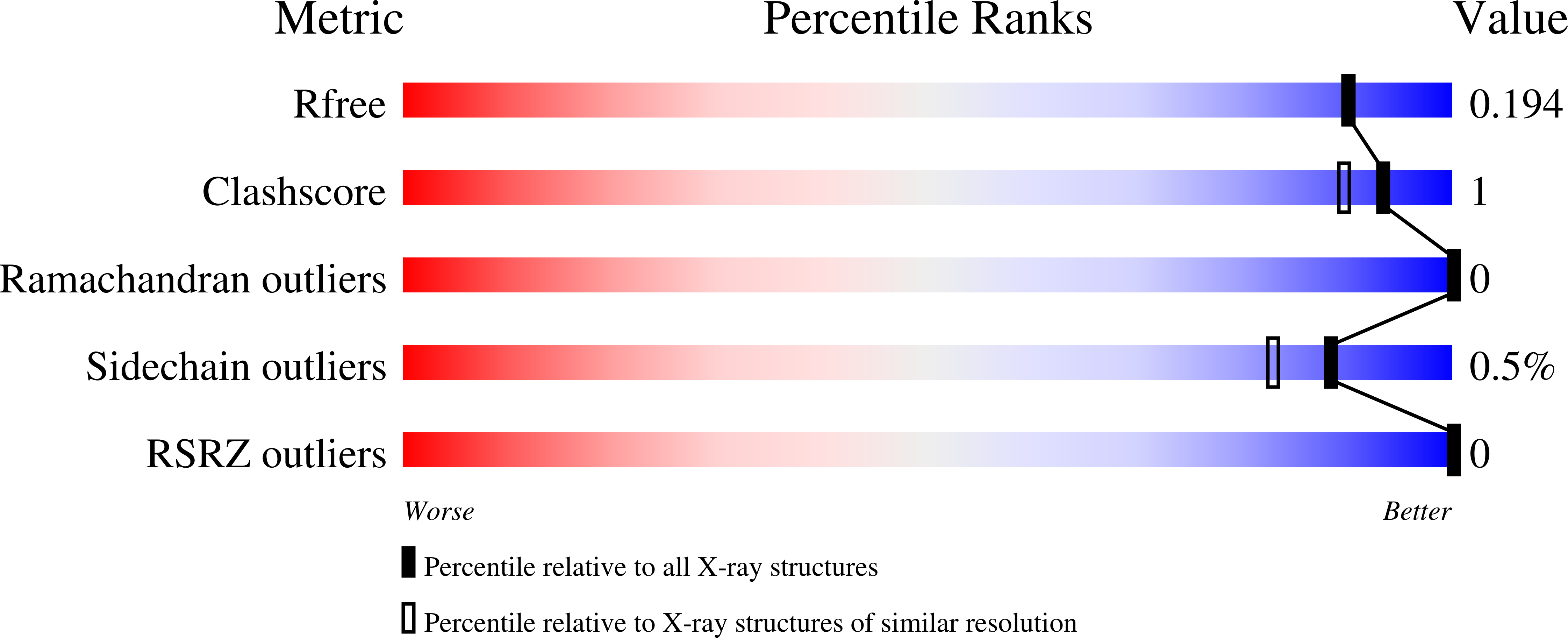
Resolution:
1.74 Å
R-Value Free:
0.19
R-Value Work:
0.16
R-Value Observed:
0.16
Space Group:
P 21 21 21
Macromolecular Entities
Structures with similar UniProt ID
Protein Blast
Polymer Type:polypeptide(L)
Molecule:3-keto-disaccharide hydrolase domain-containing protein
Chain IDs:A, B
Chain Length:276
Number of Molecules:2
Biological Source:Bacteroides thetaiotaomicron
Primary Citation
Enzyme Machinery for Bacterial Glucoside Metabolism through a Conserved Non-hydrolytic Pathway.
Angew.Chem.Int.Ed.Engl. 63 e202410681 e202410681 (2024)
PMID: 39041709 DOI: 10.1002/anie.202410681

Abstact

The flexible acquisition of substrates from nutrient pools is critical for microbes to prevail in competitive environments. To acquire glucose from diverse glycoside and disaccharide substrates, many free-living and symbiotic bacteria have developed, alongside hydrolysis, a non-hydrolytic pathway comprised of four biochemical steps and conferred from a single glycoside utilization gene locus (GUL). Mechanistically, this pathway integrates within the framework of oxidation and reduction at the glucosyl/glucose C3, the eliminative cleavage of the glycosidic bond and the addition of water in two consecutive lyase-catalyzed reactions. Here, based on study of enzymes from the phytopathogen Agrobacterium tumefaciens, we reveal a conserved Mn2+ metallocenter active site in both lyases and identify the structural requirements for specific catalysis to elimination of 3-keto-glucosides and water addition to the resulting 2-hydroxy-3-keto-glycal product, yielding 3-keto-glucose. Extending our search of GUL-encoded putative lyases to the human gut commensal Bacteroides thetaiotaomicron, we discover a Ca2+ metallocenter active site in a putative glycoside hydrolase-like protein and demonstrate its catalytic function in the eliminative cleavage of 3-keto-glucosides of opposite (α) anomeric configuration as preferred by the A. tumefaciens enzyme (β). Structural and biochemical comparisons reveal the molecular-mechanistic origin of 3-keto-glucoside lyase stereo-complementarity. Our findings identify a basic set of GUL-encoded lyases for glucoside metabolism and assign physiological significance to GUL genetic diversity in the bacterial domain of life.

Legend

Protein

Chemical

Disease

Primary Citation of related structures
Feedback Form
Name
Email
Institute
Feedback