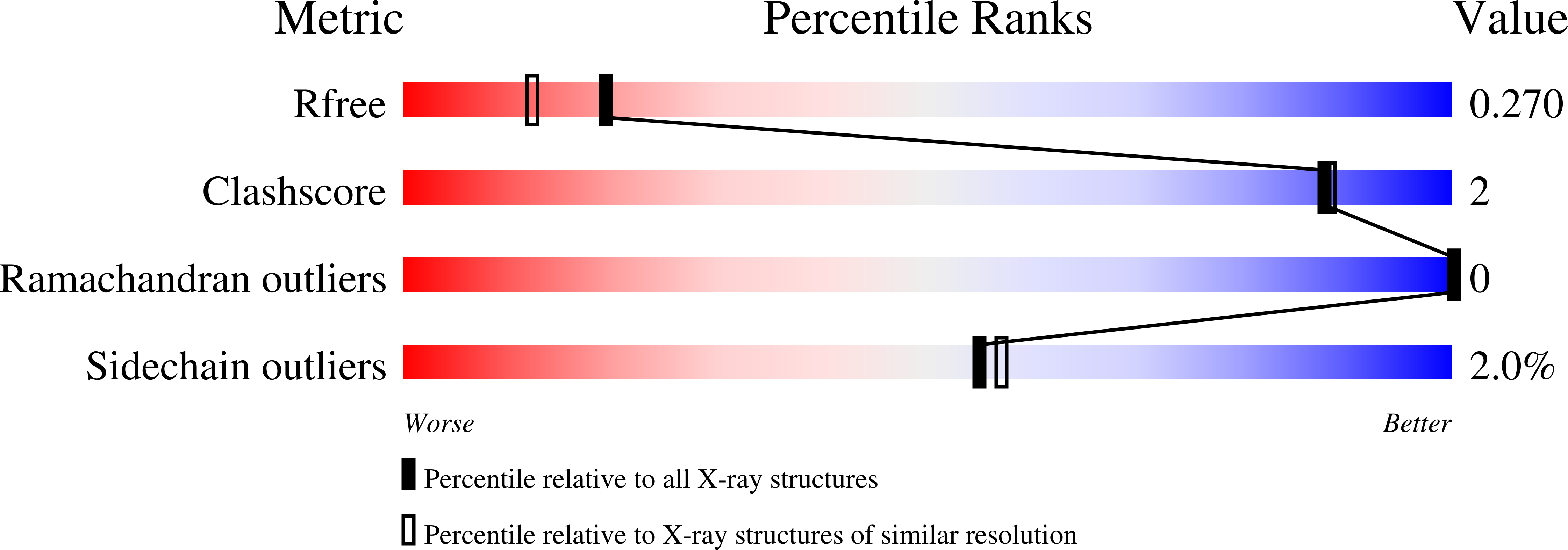
8RGI image
Deposition Date 2023-12-13
Release Date 2024-03-20
Last Version Date 2024-04-10
Entry Detail
PDB ID:
8RGI
Title:
Structure of DYNLT1:DYNLT2B (TCTEX1:TCTEX1D2) heterodimer.
Biological Source:
Source Organism:
Homo sapiens (Taxon ID: 9606)
Host Organism:
Method Details:
Experimental Method:
Resolution:
2.02 Å
R-Value Free:
0.25
Space Group:
P 41 21 2
Macromolecular Entities
Structures with similar UniProt ID
Protein Blast
Polymer Type:polypeptide(L)
Molecule:Dynein light chain Tctex-type 1
Gene (Uniprot):DYNLT1
Chain IDs:A
Chain Length:113
Number of Molecules:1
Biological Source:Homo sapiens
Structures with similar UniProt ID
Protein Blast
Polymer Type:polypeptide(L)
Molecule:Dynein light chain Tctex-type protein 2B
Gene (Uniprot):DYNLT2B
Chain IDs:B
Chain Length:142
Number of Molecules:1
Biological Source:Homo sapiens
Ligand Molecules
Primary Citation
Structure and tethering mechanism of dynein-2 intermediate chains in intraflagellar transport.
Embo J. 43 1257 1272 (2024)
PMID: 38454149 DOI: 10.1038/s44318-024-00060-1

Abstact

Dynein-2 is a large multiprotein complex that powers retrograde intraflagellar transport (IFT) of cargoes within cilia/flagella, but the molecular mechanism underlying this function is still emerging. Distinctively, dynein-2 contains two identical force-generating heavy chains that interact with two different intermediate chains (WDR34 and WDR60). Here, we dissect regulation of dynein-2 function by WDR34 and WDR60 using an integrative approach including cryo-electron microscopy and CRISPR/Cas9-enabled cell biology. A 3.9 Å resolution structure shows how WDR34 and WDR60 use surprisingly different interactions to engage equivalent sites of the two heavy chains. We show that cilia can assemble in the absence of either WDR34 or WDR60 individually, but not both subunits. Dynein-2-dependent distribution of cargoes depends more strongly on WDR60, because the unique N-terminal extension of WDR60 facilitates dynein-2 targeting to cilia. Strikingly, this N-terminal extension can be transplanted onto WDR34 and retain function, suggesting it acts as a flexible tether to the IFT "trains" that assemble at the ciliary base. We discuss how use of unstructured tethers represents an emerging theme in IFT train interactions.

Legend

Protein

Chemical

Disease

Primary Citation of related structures
Feedback Form
Name
Email
Institute
Feedback