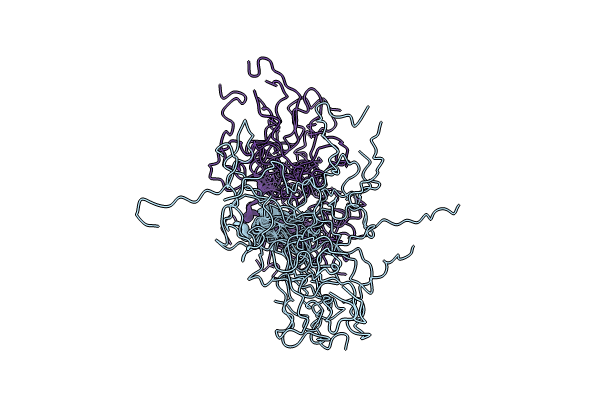
8RAJ image
Deposition Date 2023-12-01
Release Date 2024-06-05
Last Version Date 2024-07-17
Entry Detail
PDB ID:
8RAJ
Keywords:
Title:
NMR structure of PKS docking domains
Biological Source:
Source Organism:
Host Organism:
Method Details:
Experimental Method:
Conformers Calculated:
200
Conformers Submitted:
20
Selection Criteria:
structures with the least restraint violations
Macromolecular Entities
Structures with similar UniProt ID
Protein Blast
Polymer Type:polypeptide(L)
Molecule:Beta-ketoacyl synthase
Gene (Uniprot):MexAM1_META2p0008
Chain IDs:A
Chain Length:62
Number of Molecules:1
Biological Source:Methylorubrum extorquens AM1
Structures with similar UniProt ID
Protein Blast
Polymer Type:polypeptide(L)
Molecule:Trimethylamine monooxygenase
Gene (Uniprot):MexAM1_META2p0010
Chain IDs:B
Chain Length:49
Number of Molecules:1
Biological Source:Methylorubrum extorquens AM1
Ligand Molecules
Primary Citation
Insights into docking in megasynthases from the investigation of the toblerol trans -AT polyketide synthase: many alpha-helical means to an end.
Rsc Chem Biol 5 669 683 (2024)
PMID: 38966669 DOI: 10.1039/d4cb00075g

Abstact

The fidelity of biosynthesis by modular polyketide synthases (PKSs) depends on specific moderate affinity interactions between successive polypeptide subunits mediated by docking domains (DDs). These sequence elements are notably portable, allowing their transplantation into alternative biosynthetic and metabolic contexts. Herein, we use integrative structural biology to characterize a pair of DDs from the toblerol trans-AT PKS. Both are intrinsically disordered regions (IDRs) that fold into a 3 α-helix docking complex of unprecedented topology. The C-terminal docking domain (CDD) resembles the 4 α-helix type (4HB) CDDs, which shows that the same type of DD can be redeployed to form complexes of distinct geometry. By carefully re-examining known DD structures, we further extend this observation to type 2 docking domains, establishing previously unsuspected structural relations between DD types. Taken together, these data illustrate the plasticity of α-helical DDs, which allow the formation of a diverse topological spectrum of docked complexes. The newly identified DDs should also find utility in modular PKS genetic engineering.

Legend

Protein

Chemical

Disease

Primary Citation of related structures
Feedback Form
Name
Email
Institute
Feedback