Planned Maintenance: Some services may turn out to be unavailable from 15th January, 2026 to 16th January, 2026. We apologize for the inconvenience!

8R42 image
Deposition Date 2023-11-10
Release Date 2024-03-13
Last Version Date 2024-10-09
Entry Detail
PDB ID:
8R42
Keywords:
Title:
Structure of CHI3L1 in complex with inhibititor 2
Biological Source:
Source Organism(s):
Homo sapiens (Taxon ID: 9606)
Expression System(s):
Method Details:
Experimental Method:
Resolution:
2.32 Å
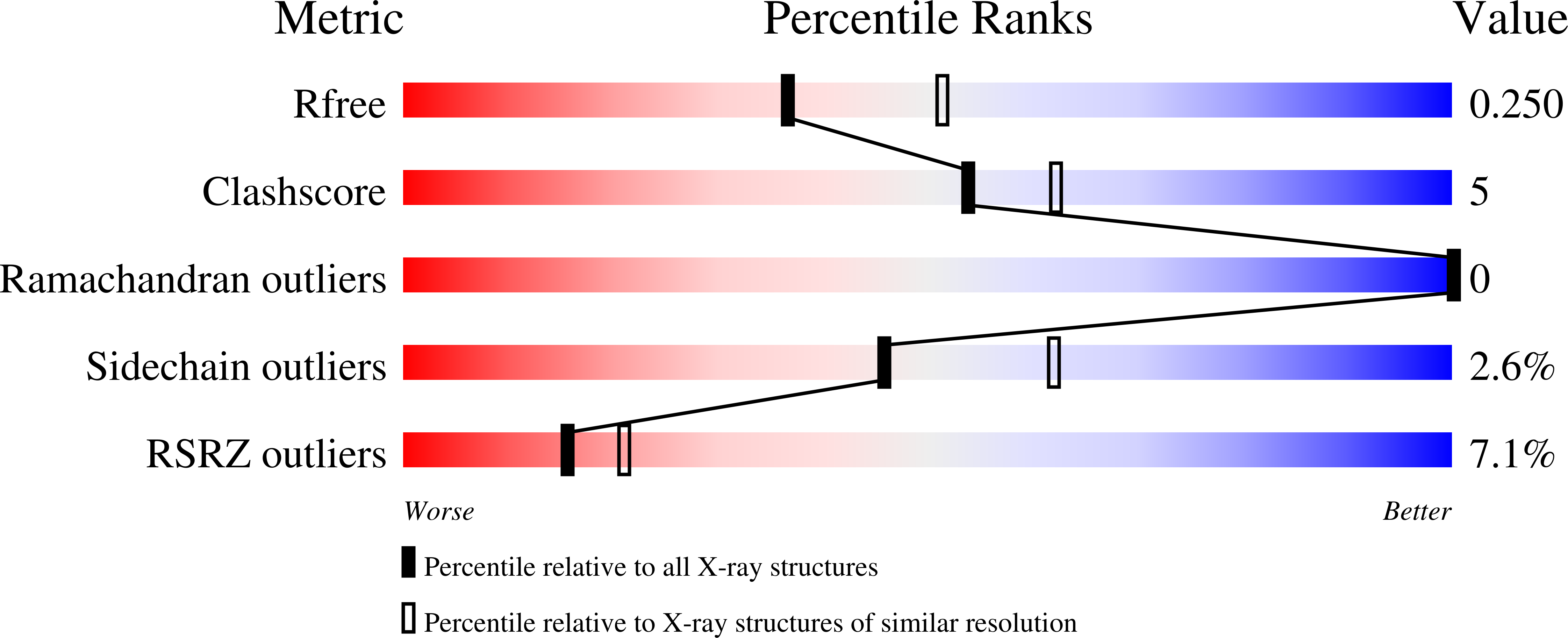
R-Value Free:
0.25
R-Value Work:
0.20
R-Value Observed:
0.20
Space Group:
I 21 21 21
Macromolecular Entities
Structures with similar UniProt ID
Protein Blast
Polymer Type:polypeptide(L)
Molecule:Chitinase-3-like protein 1
Gene (Uniprot):CHI3L1
Chain IDs:A, B
Chain Length:383
Number of Molecules:2
Biological Source:Homo sapiens
Primary Citation
Structure-Based Discovery of High-Affinity Small Molecule Ligands and Development of Tool Probes to Study the Role of Chitinase-3-Like Protein 1.
J.Med.Chem. 67 3959 3985 (2024)
PMID: 38427954 DOI: 10.1021/acs.jmedchem.3c02255

Abstact

Chitinase-3-like-1 (CHI3L1), also known as YKL-40, is a glycoprotein linked to inflammation, fibrosis, and cancer. This study explored CHI3L1's interactions with various oligosaccharides using microscale thermophoresis (MST) and AlphaScreen (AS). These investigations guided the development of high-throughput screening assays to assess interference of small molecules in binding between CHI3L1 and biotinylated small molecules or heparan sulfate-based probes. Small molecule binders of YKL-40 were identified in our chitotriosidase inhibitors library with MST and confirmed through X-ray crystallography. Based on cocrystal structures of potent hit compounds with CHI3L1, small molecule probes 19 and 20 were designed for an AS assay. Structure-based optimization led to compounds 30 and 31 with nanomolar activities and drug-like properties. Additionally, an orthogonal AS assay using biotinylated heparan sulfate as a probe was developed. The compounds' affinity showed a significant correlation in both assays. These screening tools and compounds offer novel avenues for investigating the role of CHI3L1.

Legend

Protein

Chemical

Disease

Primary Citation of related structures
Feedback Form
Name
Email
Institute
Feedback