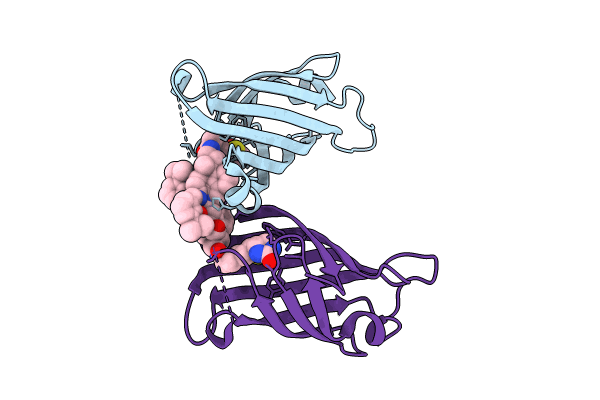
8QEX image
Deposition Date 2023-09-01
Release Date 2024-07-31
Last Version Date 2024-10-16
Entry Detail
PDB ID:
8QEX
Title:
Streptavidin variant with a cobalt catalyst for CH metal-catalyzed hydrogen-atom-transfer (M-HAT)
Biological Source:
Source Organism(s):
Expression System(s):
Method Details:
Experimental Method:
Resolution:
1.90 Å
R-Value Free:
0.25
R-Value Work:
0.22
R-Value Observed:
0.23
Space Group:
I 1 2 1
Macromolecular Entities
Structures with similar UniProt ID
Protein Blast
Polymer Type:polypeptide(L)
Molecule:Streptavidin
Chain IDs:A, B
Chain Length:168
Number of Molecules:2
Biological Source:Streptomyces avidinii
Ligand Molecules
Primary Citation
An evolved artificial radical cyclase enables the construction of bicyclic terpenoid scaffolds via an H-atom transfer pathway.
Nat.Chem. 16 1656 1664 (2024)
PMID: 39030420 DOI: 10.1038/s41557-024-01562-5

Abstact

While natural terpenoid cyclases generate complex terpenoid structures via cationic mechanisms, alternative radical cyclization pathways are underexplored. The metal-catalysed H-atom transfer reaction (M-HAT) offers an attractive means for hydrofunctionalizing olefins, providing access to terpenoid-like structures. Artificial metalloenzymes offer a promising strategy for introducing M-HAT reactivity into a protein scaffold. Here we report our efforts towards engineering an artificial radical cyclase (ARCase), resulting from anchoring a biotinylated [Co(Schiff-base)] cofactor within an engineered chimeric streptavidin. After two rounds of directed evolution, a double mutant catalyses a radical cyclization to afford bicyclic products with a cis-5-6-fused ring structure and up to 97% enantiomeric excess. The involvement of a histidine ligation to the Co cofactor is confirmed by crystallography. A time course experiment reveals a cascade reaction catalysed by the ARCase, combining a radical cyclization with a conjugate reduction. The ARCase exhibits tolerance towards variations in the dienone substrate, highlighting its potential to access terpenoid scaffolds.

Legend

Protein

Chemical

Disease

Primary Citation of related structures
Feedback Form
Name
Email
Institute
Feedback