8Q05 image
Deposition Date 2023-07-27
Release Date 2024-08-07
Last Version Date 2024-11-27
Entry Detail
PDB ID:
8Q05
Keywords:
Title:
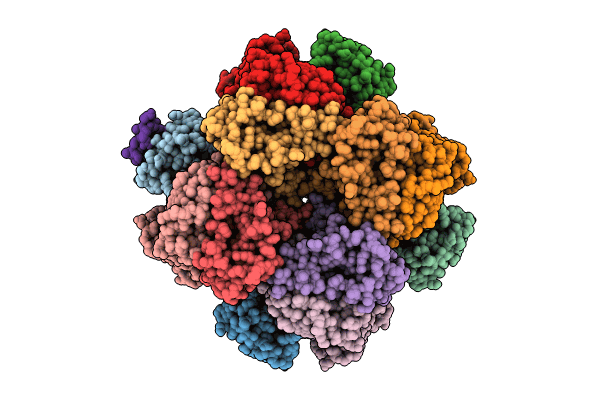
Chlorella sorokiniana Rubisco with CsLinker (alpha3-alpha4) bound: D4 symmetry expanded
Biological Source:
Source Organism:
Method Details:
Experimental Method:
Resolution:
2.77 Å
Aggregation State:
PARTICLE
Reconstruction Method:
SINGLE PARTICLE
Macromolecular Entities
Structures with similar UniProt ID
Protein Blast
Polymer Type:polypeptide(L)
Molecule:Ribulose bisphosphate carboxylase large chain
Gene (Uniprot):rbcL
Chain IDs:B (auth: A), D (auth: C), F, H (auth: I), J (auth: L), L (auth: O), N (auth: S), P (auth: W)
Chain Length:475
Number of Molecules:8
Biological Source:Chlorella sorokiniana
Structures with similar UniProt ID
Protein Blast
Polymer Type:polypeptide(L)
Molecule:Ribulose bisphosphate carboxylase small subunit, chloroplastic
Gene (Uniprot):RBCS
Chain IDs:C (auth: P), E (auth: D), G, I (auth: J), K (auth: M), M (auth: Q), O (auth: T), Q (auth: X)
Chain Length:183
Number of Molecules:8
Biological Source:Chlorella sorokiniana
Polymer Type:polypeptide(L)
Molecule:CsLinker (alpha3-alpha4)
Chain IDs:A (auth: Z)
Chain Length:138
Number of Molecules:1
Biological Source:Chlorella sorokiniana
Primary Citation
A promiscuous mechanism to phase separate eukaryotic carbon fixation in the green lineage.
Nat.Plants 10 1801 1813 (2024)
PMID: 39384944 DOI: 10.1038/s41477-024-01812-x

Abstact

CO2 fixation is commonly limited by inefficiency of the CO2-fixing enzyme Rubisco. Eukaryotic algae concentrate and fix CO2 in phase-separated condensates called pyrenoids, which complete up to one-third of global CO2 fixation. Condensation of Rubisco in pyrenoids is dependent on interaction with disordered linker proteins that show little conservation between species. We developed a sequence-independent bioinformatic pipeline to identify linker proteins in green algae. We report the linker from Chlorella and demonstrate that it binds a conserved site on the Rubisco large subunit. We show that the Chlorella linker phase separates Chlamydomonas Rubisco and that despite their separation by ~800 million years of evolution, the Chlorella linker can support the formation of a functional pyrenoid in Chlamydomonas. This cross-species reactivity extends to plants, with the Chlorella linker able to drive condensation of some native plant Rubiscos in vitro and in planta. Our results represent an exciting frontier for pyrenoid engineering in plants, which is modelled to increase crop yields.

Legend

Protein

Chemical

Disease

Primary Citation of related structures
Feedback Form
Name
Email
Institute
Feedback