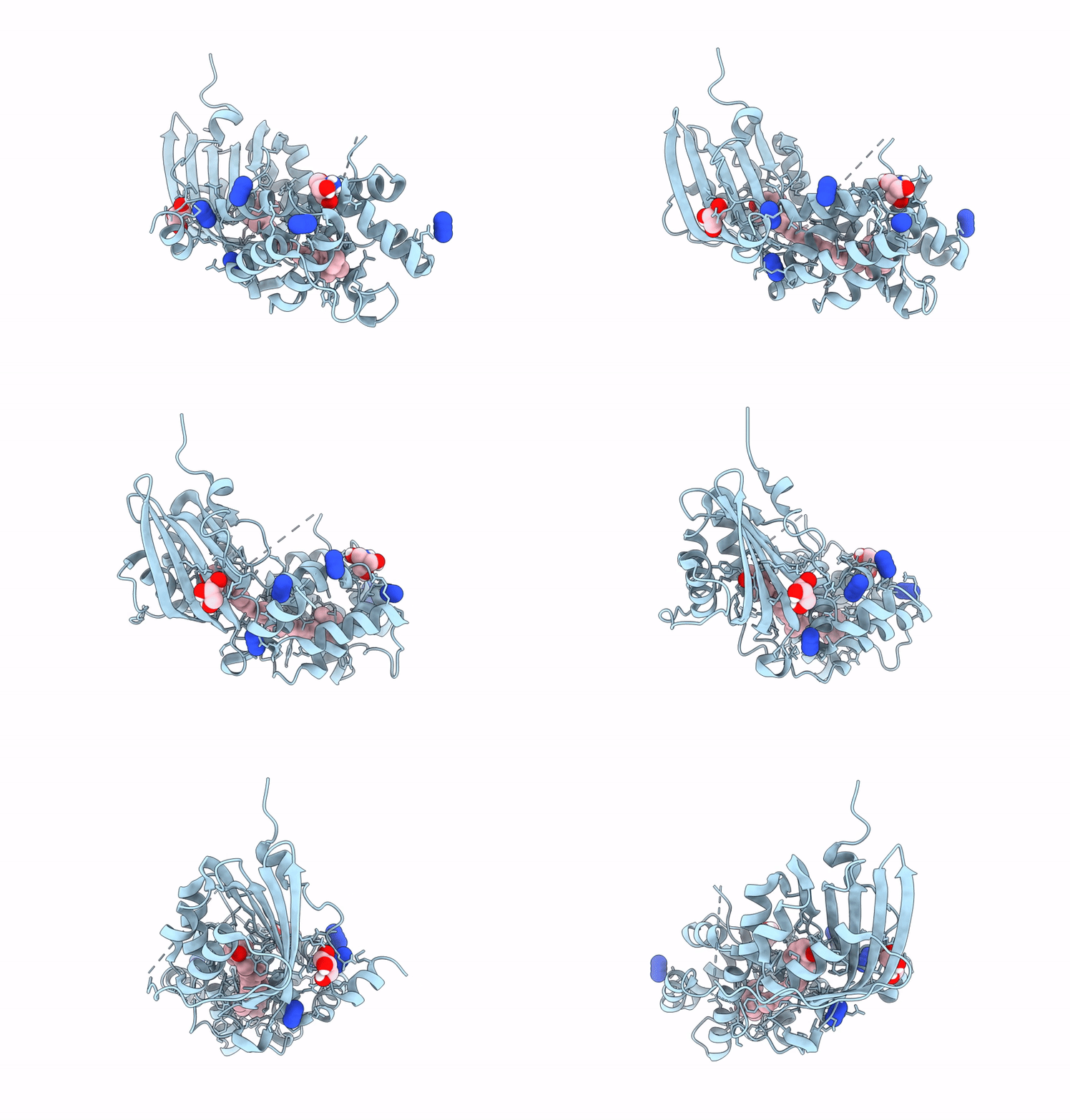
8PZK image
Deposition Date 2023-07-27
Release Date 2024-01-03
Last Version Date 2024-10-09
Entry Detail
PDB ID:
8PZK
Keywords:
Title:
Crystal structure of the Orange Carotenoid Protein 2 (OCP2) from Gloeocapsa sp. PCC 7428
Biological Source:
Source Organism:
Host Organism:
Method Details:
Experimental Method:
Resolution:
1.80 Å
R-Value Free:
0.24
R-Value Work:
0.19
Space Group:
P 43 21 2
Macromolecular Entities
Structures with similar UniProt ID
Protein Blast
Polymer Type:polypeptide(L)
Molecule:Orange carotenoid-binding protein
Gene (Uniprot):Glo7428_2455
Mutagens:E26A
Chain IDs:A
Chain Length:321
Number of Molecules:1
Biological Source:Gloeocapsa sp. PCC 7428
Modified Residue
Compound ID Chain ID Parent Comp ID Details 2D Image
CSO A CYS modified residue
Primary Citation
Structural framework for the understanding spectroscopic and functional signatures of the cyanobacterial Orange Carotenoid Protein families.
Int.J.Biol.Macromol. 254 127874 127874 (2024)
PMID: 37939760 DOI: 10.1016/j.ijbiomac.2023.127874

Abstact

The Orange Carotenoid Protein (OCP) is a unique photoreceptor crucial for cyanobacterial photoprotection. Best studied Synechocystis sp. PCC 6803 OCP belongs to the large OCP1 family. Downregulated by the Fluorescence Recovery Protein (FRP) in low-light, high-light-activated OCP1 binds to the phycobilisomes and performs non-photochemical quenching. Recently discovered families OCP2 and OCP3 remain structurally and functionally underexplored, and no systematic comparative studies have ever been conducted. Here we present two first crystal structures of OCP2 from morphoecophysiologically different cyanobacteria and provide their comprehensive structural, spectroscopic and functional comparison with OCP1, the recently described OCP3 and all-OCP ancestor. Structures enable correlation of spectroscopic signatures with the effective number of hydrogen and discovered here chalcogen bonds anchoring the ketocarotenoid in OCP, as well as with the rotation of the echinenone's β-ionone ring in the CTD. Structural data also helped rationalize the observed differences in OCP/FRP and OCP/phycobilisome functional interactions. These data are expected to foster OCP research and applications in optogenetics, targeted carotenoid delivery and cyanobacterial biomass engineering.

Legend

Protein

Chemical

Disease

Primary Citation of related structures
Feedback Form
Name
Email
Institute
Feedback