8PYR image
Deposition Date 2023-07-26
Release Date 2024-03-06
Last Version Date 2025-04-30
Entry Detail
PDB ID:
8PYR
Keywords:
Title:
Crystal structure of the dual T-loop phosphorylated Cdk7/CycH/Mat1 complex
Biological Source:
Source Organism:
Homo sapiens (Taxon ID: 9606)
Lama glama (Taxon ID: 9844)
Host Organism:
Method Details:
Experimental Method:
Resolution:
2.15 Å
R-Value Free:
0.24
R-Value Work:
0.21
R-Value Observed:
0.22
Space Group:
P 1 21 1
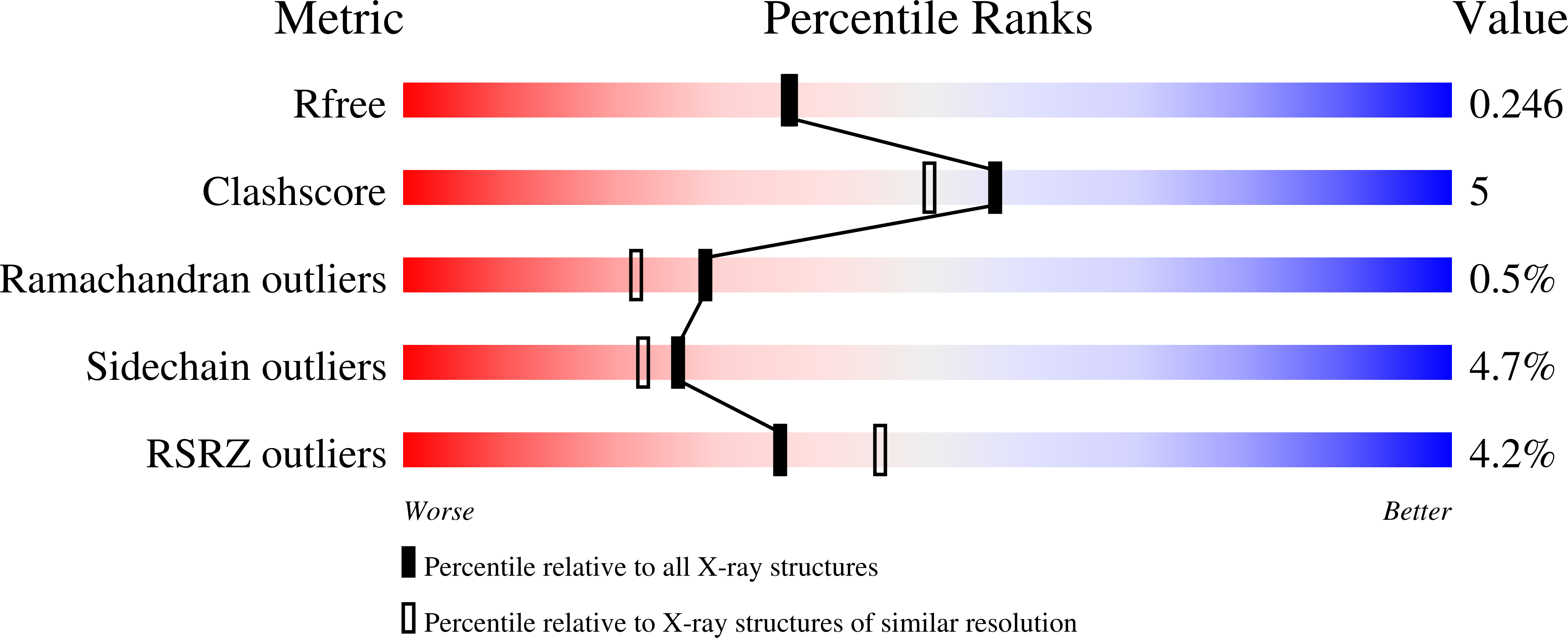
Macromolecular Entities
Structures with similar UniProt ID
Protein Blast
Polymer Type:polypeptide(L)
Molecule:Cyclin-dependent kinase 7
Gene (Uniprot):CDK7
Chain IDs:A, E
Chain Length:346
Number of Molecules:2
Biological Source:Homo sapiens
Structures with similar UniProt ID
Protein Blast
Polymer Type:polypeptide(L)
Molecule:Cyclin-H
Gene (Uniprot):CCNH
Chain IDs:B, F
Chain Length:323
Number of Molecules:2
Biological Source:Homo sapiens
Structures with similar UniProt ID
Protein Blast
Polymer Type:polypeptide(L)
Molecule:CDK-activating kinase assembly factor MAT1
Gene (Uniprot):MNAT1
Chain IDs:C, G
Chain Length:82
Number of Molecules:2
Biological Source:Homo sapiens
Polymer Type:polypeptide(L)
Molecule:Nanobody (VHH-RD7-04)
Chain IDs:D, H
Chain Length:115
Number of Molecules:2
Biological Source:Lama glama
Modified Residue
Compound ID Chain ID Parent Comp ID Details 2D Image
SEP A SER modified residue
TPO A THR modified residue
Ligand Molecules
Primary Citation
Structural basis of Cdk7 activation by dual T-loop phosphorylation.
Nat Commun 15 6597 6597 (2024)
PMID: 39097586 DOI: 10.1038/s41467-024-50891-z

Abstact

Cyclin-dependent kinase 7 (Cdk7) is required in cell-cycle and transcriptional regulation owing to its function as both a CDK-activating kinase (CAK) and part of transcription factor TFIIH. Cdk7 forms active complexes by associating with Cyclin H and Mat1, and is regulated by two phosphorylations in the activation segment (T loop): the canonical activating modification at T170 and another at S164. Here we report the crystal structure of the human Cdk7/Cyclin H/Mat1 complex containing both T-loop phosphorylations. Whereas pT170 coordinates basic residues conserved in other CDKs, pS164 nucleates an arginine network unique to the ternary Cdk7 complex, involving all three subunits. We identify differential dependencies of kinase activity and substrate recognition on the individual phosphorylations. CAK function is unaffected by T-loop phosphorylation, whereas activity towards non-CDK substrates is increased several-fold by T170 phosphorylation. Moreover, dual T-loop phosphorylation stimulates multisite phosphorylation of the RNA polymerase II (RNAPII) carboxy-terminal domain (CTD) and SPT5 carboxy-terminal repeat (CTR) region. In human cells, Cdk7 activation is a two-step process wherein S164 phosphorylation precedes, and may prime, T170 phosphorylation. Thus, dual T-loop phosphorylation can regulate Cdk7 through multiple mechanisms, with pS164 supporting tripartite complex formation and possibly influencing processivity, while pT170 enhances activity towards key transcriptional substrates.

Legend

Protein

Chemical

Disease

Primary Citation of related structures
Feedback Form
Name
Email
Institute
Feedback