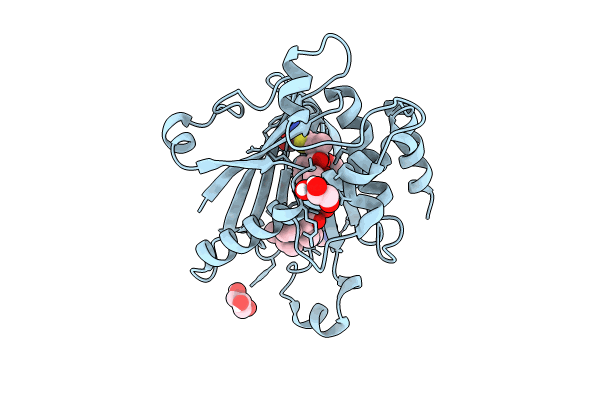
8PQO image
Deposition Date 2023-07-11
Release Date 2024-05-08
Last Version Date 2025-11-19
Entry Detail
PDB ID:
8PQO
Title:
PITP in complex with the inhibitor VT01545
Biological Source:
Source Organism:
Host Organism:
Method Details:
Experimental Method:
Resolution:
2.30 Å
R-Value Free:
0.28
R-Value Work:
0.23
R-Value Observed:
0.23
Space Group:
P 2 21 21
Macromolecular Entities
Structures with similar UniProt ID
Protein Blast
Polymer Type:polypeptide(L)
Molecule:Phosphatidylinositol transfer protein alpha isoform
Gene (Uniprot):PITPNA
Chain IDs:A
Chain Length:271
Number of Molecules:1
Biological Source:Homo sapiens
Polymer Type:polypeptide(L)
Molecule:Inhibitor VT01545
Chain IDs:B (auth: C)
Chain Length:6
Number of Molecules:1
Biological Source:synthetic construct
Primary Citation
Non-vesicular phosphatidylinositol transfer plays critical roles in defining organelle lipid composition.
Embo J. 43 2035 2061 (2024)
PMID: 38627600 DOI: 10.1038/s44318-024-00096-3

Abstact

Phosphatidylinositol (PI) is the precursor lipid for the minor phosphoinositides (PPIns), which are critical for multiple functions in all eukaryotic cells. It is poorly understood how phosphatidylinositol, which is synthesized in the ER, reaches those membranes where PPIns are formed. Here, we used VT01454, a recently identified inhibitor of class I PI transfer proteins (PITPs), to unravel their roles in lipid metabolism, and solved the structure of inhibitor-bound PITPNA to gain insight into the mode of inhibition. We found that class I PITPs not only distribute PI for PPIns production in various organelles such as the plasma membrane (PM) and late endosomes/lysosomes, but that their inhibition also significantly reduced the levels of phosphatidylserine, di- and triacylglycerols, and other lipids, and caused prominent increases in phosphatidic acid. While VT01454 did not inhibit Golgi PI4P formation nor reduce resting PM PI(4,5)P2 levels, the recovery of the PM pool of PI(4,5)P2 after receptor-mediated hydrolysis required both class I and class II PITPs. Overall, these studies show that class I PITPs differentially regulate phosphoinositide pools and affect the overall cellular lipid landscape.

Legend

Protein

Chemical

Disease

Primary Citation of related structures
Feedback Form
Name
Email
Institute
Feedback