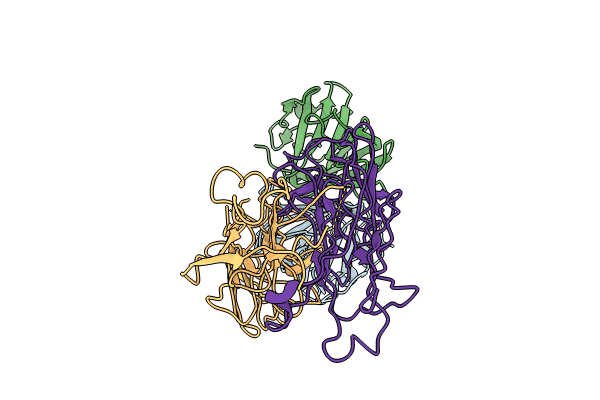
8PMX image
Deposition Date 2023-06-29
Release Date 2024-07-10
Last Version Date 2025-07-23
Entry Detail
PDB ID:
8PMX
Keywords:
Title:
rat HEV P domain in complex with glycan-sensitive nAb p60.12
Biological Source:
Source Organism:
Method Details:
Experimental Method:
Resolution:
3.92 Å
R-Value Free:
0.36
R-Value Work:
0.30
R-Value Observed:
0.30
Space Group:
P 43 21 2

Macromolecular Entities
Structures with similar UniProt ID
Protein Blast
Polymer Type:polypeptide(L)
Molecule:Pro-secreted protein ORF2
Chain IDs:A, B
Chain Length:165
Number of Molecules:2
Biological Source:Hepatitis E virus rat/R63/DEU/2009
Polymer Type:polypeptide(L)
Molecule:Fab p60.12-HC
Chain IDs:C (auth: H)
Chain Length:233
Number of Molecules:1
Biological Source:Homo sapiens
Polymer Type:polypeptide(L)
Molecule:Fab p60.12-LC
Chain IDs:D (auth: L)
Chain Length:217
Number of Molecules:1
Biological Source:Homo sapiens
Ligand Molecules
Primary Citation

Abstact

Hepatitis E virus (HEV) causes 3.3 million symptomatic cases and 44,000 deaths per year. Chronic infections can arise in immunocompromised individuals, and pregnant women may suffer from fulminant disease as a consequence of HEV infection. Despite these important implications for public health, no specific antiviral treatment has been approved to date. Here, we report combined functional, biochemical, and X-ray crystallographic studies that characterize the human antibody response in convalescent HEV patients. We identified a class of potent and broadly neutralizing human antibodies (bnAbs), targeting a quaternary epitope located at the tip of the HEV capsid protein pORF2 that contains an N-glycosylation motif and is conserved across members of the Hepeviridae. These glycan-sensitive bnAbs specifically recognize the non-glycosylated pORF2 present in infectious particles but not the secreted glycosylated form acting as antibody decoy. Our most potent bnAb protects human liver-chimeric mice from intraperitoneal HEV challenge and co-housing exposure. These results provide insights into the bnAb response to this important emerging pathogen and support the development of glycan-sensitive antibodies to combat HEV infection.

Legend

Protein

Chemical

Disease

Primary Citation of related structures
Feedback Form
Name
Email
Institute
Feedback