8PE9 image
Deposition Date 2023-06-13
Release Date 2023-06-28
Last Version Date 2024-11-20
Entry Detail
PDB ID:
8PE9
Keywords:
Title:
Complex between DDR1 DS-like domain and PRTH-101 Fab
Biological Source:
Source Organism:
Homo sapiens (Taxon ID: 9606)
Host Organism:
Method Details:
Experimental Method:
Resolution:
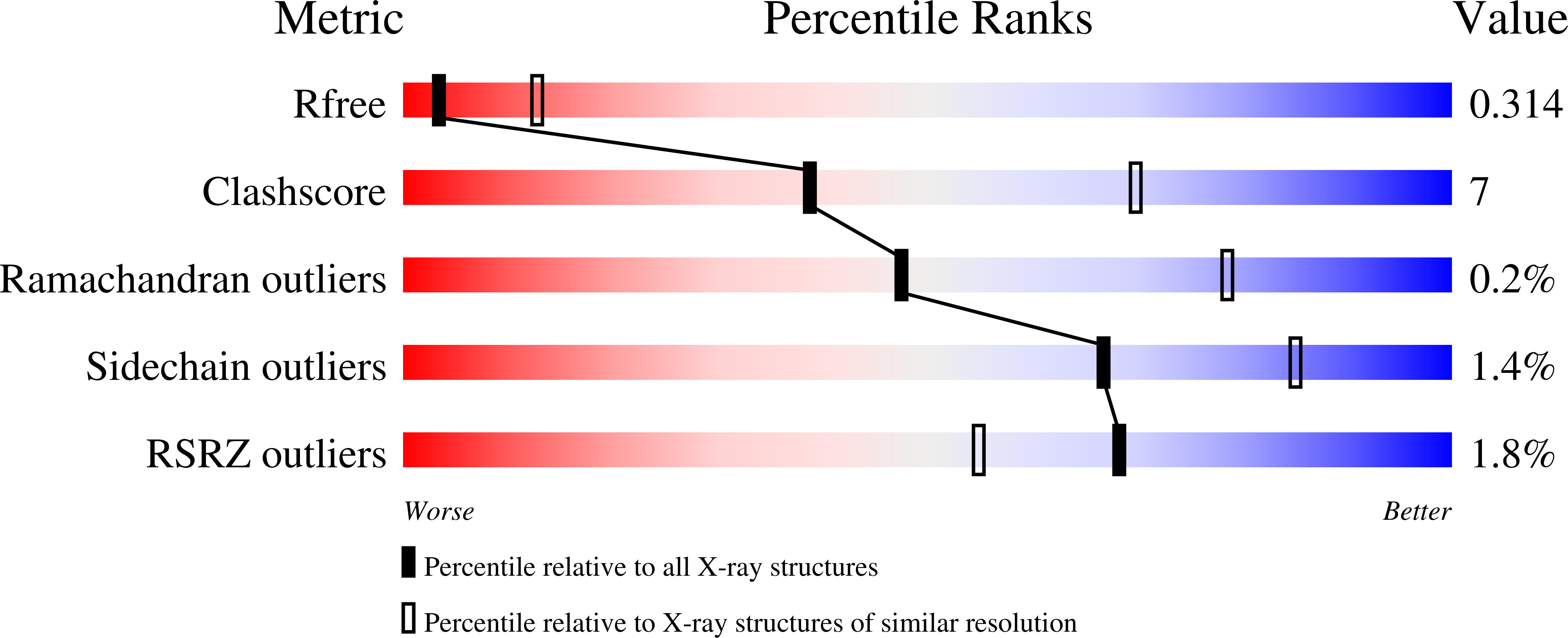
3.15 Å
R-Value Free:
0.30
R-Value Work:
0.27
R-Value Observed:
0.27
Space Group:
P 21 21 2
Macromolecular Entities
Structures with similar UniProt ID
Protein Blast
Polymer Type:polypeptide(L)
Molecule:Epithelial discoidin domain-containing receptor 1
Gene (Uniprot):DDR1
Chain IDs:A
Chain Length:183
Number of Molecules:1
Biological Source:Homo sapiens
Polymer Type:polypeptide(L)
Molecule:PRTH-101 Fab, heavy chain
Chain IDs:B (auth: H)
Chain Length:222
Number of Molecules:1
Biological Source:Homo sapiens
Polymer Type:polypeptide(L)
Molecule:PRTH-101 Fab, light chain
Chain IDs:C (auth: L)
Chain Length:212
Number of Molecules:1
Biological Source:Homo sapiens
Primary Citation
A highly selective humanized DDR1 mAb reverses immune exclusion by disrupting collagen fiber alignment in breast cancer.
J Immunother Cancer 11 ? ? (2023)
PMID: 37328286 DOI: 10.1136/jitc-2023-006720

Abstact

BACKGROUND Immune exclusion (IE) where tumors deter the infiltration of immune cells into the tumor microenvironment has emerged as a key mechanism underlying immunotherapy resistance. We recently reported a novel role of discoidin domain-containing receptor 1 (DDR1) in promoting IE in breast cancer and validated its critical role in IE using neutralizing rabbit monoclonal antibodies (mAbs) in multiple mouse tumor models. METHODS To develop a DDR1-targeting mAb as a potential cancer therapeutic, we humanized mAb9 with a complementarity-determining region grafting strategy. The humanized antibody named PRTH-101 is currently being tested in a Phase 1 clinical trial. We determined the binding epitope of PRTH-101 from the crystal structure of the complex between DDR1 extracellular domain (ECD) and the PRTH-101 Fab fragment with 3.15 Å resolution. We revealed the underlying mechanisms of action of PRTH-101 using both cell culture assays and in vivo study in a mouse tumor model. RESULTS PRTH-101 has subnanomolar affinity to DDR1 and potent antitumor efficacy similar to the parental rabbit mAb after humanization. Structural information illustrated that PRTH-101 interacts with the discoidin (DS)-like domain, but not the collagen-binding DS domain of DDR1. Mechanistically, we showed that PRTH-101 inhibited DDR1 phosphorylation, decreased collagen-mediated cell attachment, and significantly blocked DDR1 shedding from the cell surface. Treatment of tumor-bearing mice with PRTH-101 in vivo disrupted collagen fiber alignment (a physical barrier) in the tumor extracellular matrix (ECM) and enhanced CD8+ T cell infiltration in tumors. CONCLUSIONS This study not only paves a pathway for the development of PRTH-101 as a cancer therapeutic, but also sheds light on a new therapeutic strategy to modulate collagen alignment in the tumor ECM for enhancing antitumor immunity.

Legend

Protein

Chemical

Disease

Primary Citation of related structures
Feedback Form
Name
Email
Institute
Feedback