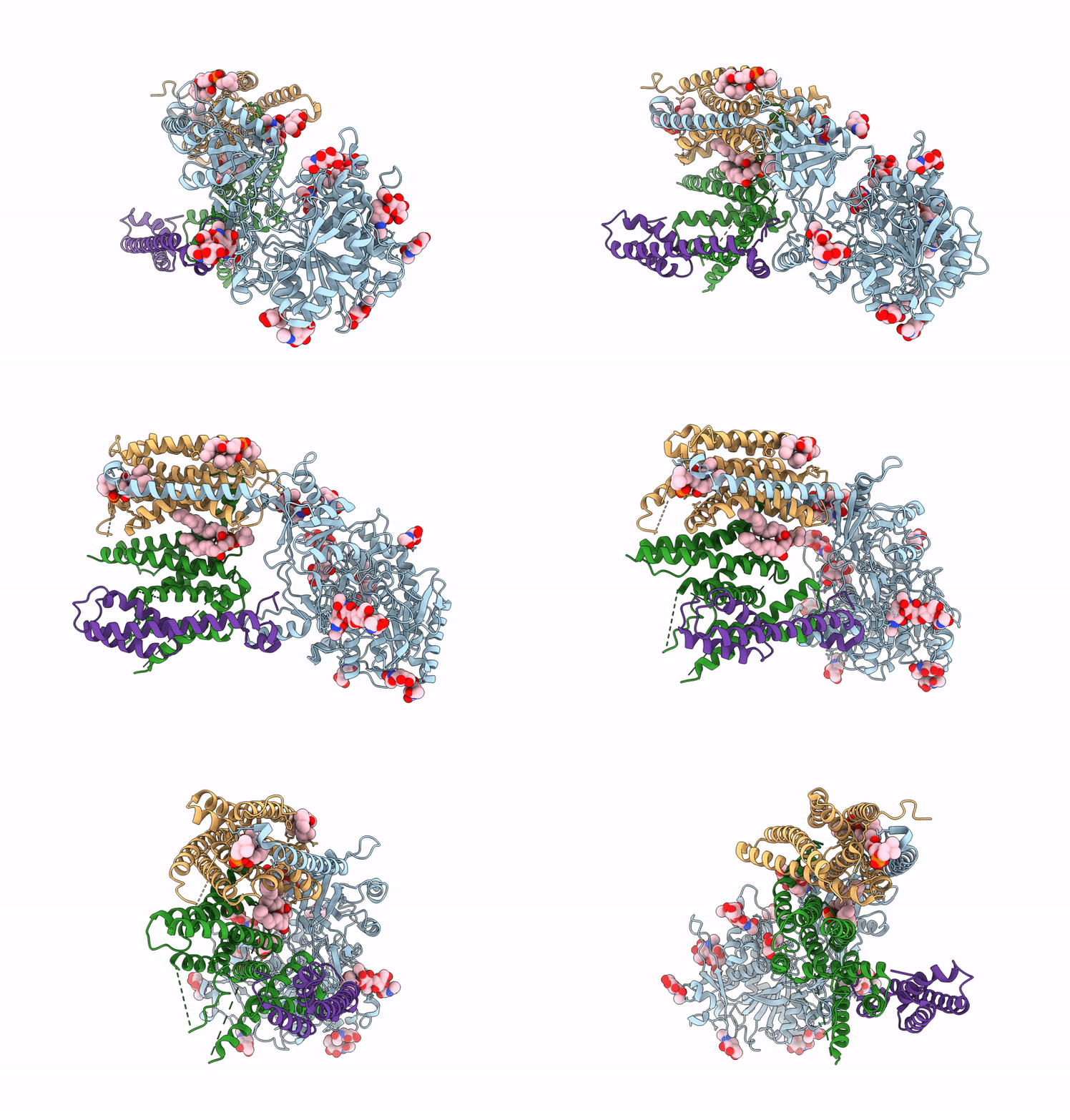
8OQY image
Deposition Date 2023-04-12
Release Date 2024-04-24
Last Version Date 2024-10-23
Entry Detail
PDB ID:
8OQY
Title:
Structure of apo form of human gamma-secretase PSEN1 APH-1B isoform reconstituted into lipid nanodisc
Biological Source:
Source Organism:
Homo sapiens (Taxon ID: 9606)
Host Organism:
Method Details:
Experimental Method:
Resolution:
3.30 Å
Aggregation State:
PARTICLE
Reconstruction Method:
SINGLE PARTICLE
Macromolecular Entities
Structures with similar UniProt ID
Protein Blast
Polymer Type:polypeptide(L)
Molecule:Nicastrin
Gene (Uniprot):NCSTN
Chain IDs:A
Chain Length:717
Number of Molecules:1
Biological Source:Homo sapiens
Structures with similar UniProt ID
Protein Blast
Polymer Type:polypeptide(L)
Molecule:Presenilin-1 CTF12
Gene (Uniprot):PSEN1
Chain IDs:B
Chain Length:467
Number of Molecules:1
Biological Source:Homo sapiens
Structures with similar UniProt ID
Protein Blast
Polymer Type:polypeptide(L)
Molecule:Gamma-secretase subunit APH-1B
Gene (Uniprot):APH1B
Chain IDs:C
Chain Length:257
Number of Molecules:1
Biological Source:Homo sapiens
Structures with similar UniProt ID
Protein Blast
Polymer Type:polypeptide(L)
Molecule:Gamma-secretase subunit PEN-2
Gene (Uniprot):PSENEN
Chain IDs:D
Chain Length:101
Number of Molecules:1
Biological Source:Homo sapiens
Primary Citation
Apo and A beta 46-bound gamma-secretase structures provide insights into amyloid-beta processing by the APH-1B isoform.
Nat Commun 15 4479 4479 (2024)
PMID: 38802343 DOI: 10.1038/s41467-024-48776-2

Abstact

Deposition of amyloid-β (Aβ) peptides in the brain is a hallmark of Alzheimer's disease. Aβs are generated through sequential proteolysis of the amyloid precursor protein by the γ-secretase complexes (GSECs). Aβ peptide length, modulated by the Presenilin (PSEN) and APH-1 subunits of GSEC, is critical for Alzheimer's pathogenesis. Despite high relevance, mechanistic understanding of the proteolysis of Aβ, and its modulation by APH-1, remain incomplete. Here, we report cryo-EM structures of human GSEC (PSEN1/APH-1B) reconstituted into lipid nanodiscs in apo form and in complex with the intermediate Aβ46 substrate without cross-linking. We find that three non-conserved and structurally divergent APH-1 regions establish contacts with PSEN1, and that substrate-binding induces concerted rearrangements in one of the identified PSEN1/APH-1 interfaces, providing structural basis for APH-1 allosteric-like effects. In addition, the GSEC-Aβ46 structure reveals an interaction between Aβ46 and loop 1PSEN1, and identifies three other H-bonding interactions that, according to functional validation, are required for substrate recognition and efficient sequential catalysis.

Legend

Protein

Chemical

Disease

Primary Citation of related structures
Feedback Form
Name
Email
Institute
Feedback