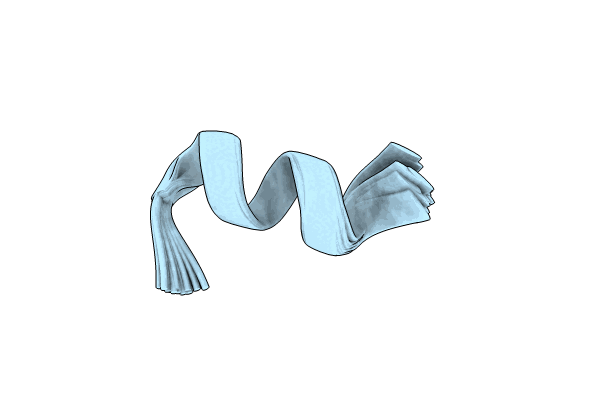
8OL8 image
Deposition Date 2023-03-30
Release Date 2024-07-10
Last Version Date 2026-01-21
Entry Detail
PDB ID:
8OL8
Title:
Solution NMR Structure of Lactamised Alpha-Synuclein 2-12 Peptide in 50% TFE.
Biological Source:
Source Organism(s):
Homo sapiens (Taxon ID: 9606)
Method Details:
Experimental Method:
Conformers Calculated:
200
Conformers Submitted:
20
Selection Criteria:
structures with the least restraint violations
Macromolecular Entities
Structures with similar UniProt ID
Protein Blast
Polymer Type:polypeptide(L)
Molecule:ACE-ASP-VAL-PHE-MET-LYS-LYS-LEU-SER-LYS-ASP-LYS-NH2
Chain IDs:A
Chain Length:13
Number of Molecules:1
Biological Source:Homo sapiens
Ligand Molecules
Primary Citation
Stabilizing a Native Fold of Alpha-Synuclein with Short Helix-Constrained Peptides.
Jacs Au 5 4321 4336 (2025)
PMID: 41001629 DOI: 10.1021/jacsau.5c00694

Abstact

Preventing the aggregation of α-synuclein (αS) into toxic oligomers and conformers is a major therapeutic goal in conditions such as Parkinson's disease and Lewy body dementia. However, the large intracellular protein-protein interfaces within such aggregates make this a challenging target for small molecule approaches or biologics, which often lack cell permeability. Peptides occupy a suitable middle ground and are increasingly being explored as preventative treatments. We previously showed that the N-terminal lipid binding region (αS1-25) inhibits αS aggregation. Building on this, we designed a series of N- and C-terminal truncations to systematically reduce the peptide length, enabling a 56% downsizing (i.e., truncating 92% of the full-length αS protein), to identify the smallest functional unit capable of binding αS and potently blocking its aggregation and toxicity. We next introduced seven systematic i → i + 4 helix constraints to assess impact on (i) α-helicity, (ii) aggregation inhibition, (iii) serum stability, (iv) neuronal uptake, and (v) phenotypic rescue. This work maps key amphipathic features and identifies residues that are critical for αS engagement and inhibitory activity. The most effective helix-constrained peptide, αS2-12(L6), showed marked improvements across all metrics and represents a strong candidate for further therapeutic development.

Legend

Protein

Chemical

Disease

Primary Citation of related structures
Feedback Form
Name
Email
Institute
Feedback