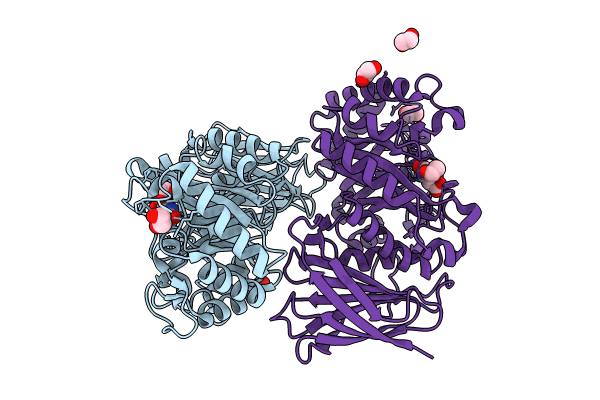
8OHW image
Deposition Date 2023-03-21
Release Date 2024-01-10
Last Version Date 2024-11-13
Entry Detail
PDB ID:
8OHW
Keywords:
Title:
Crystal structure of heparanase from Burkholderia pseudomallei in complex with siastatin B derived inhibitor
Biological Source:
Source Organism:
Host Organism:
Method Details:
Experimental Method:
Resolution:
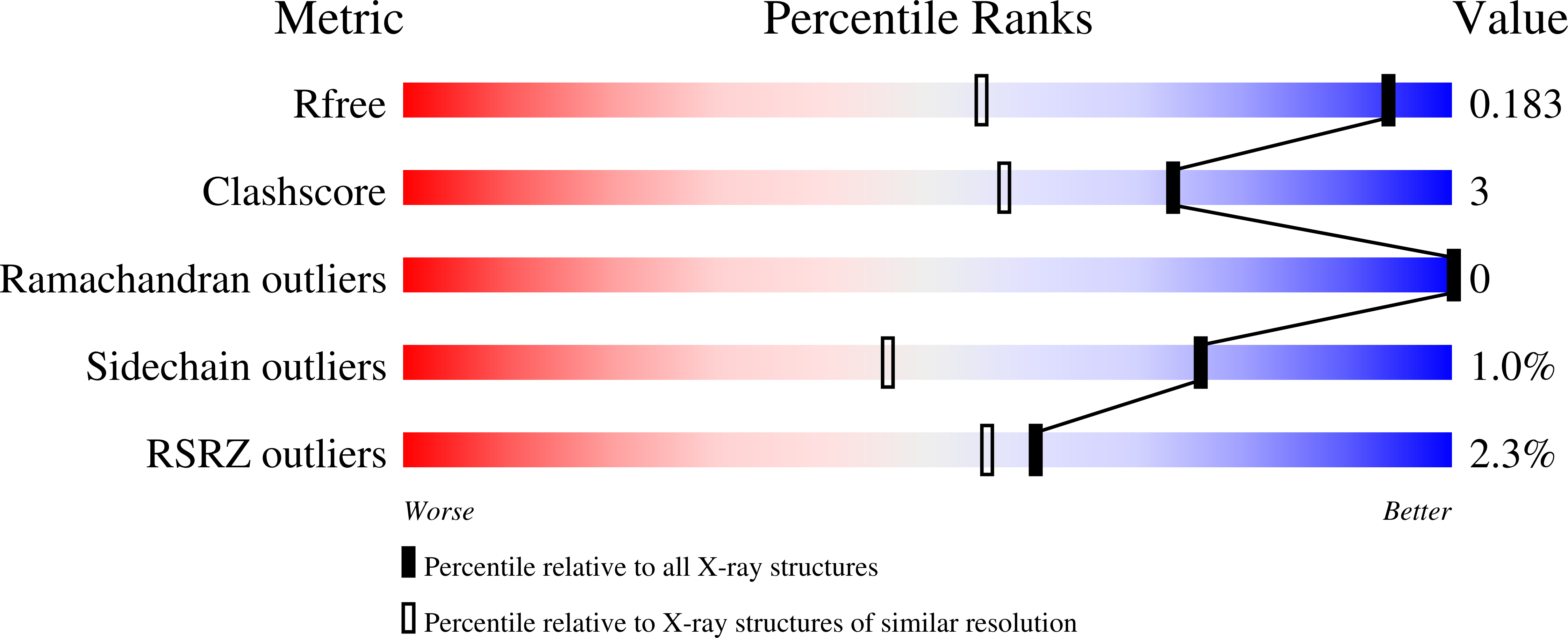
1.27 Å
R-Value Free:
0.18
R-Value Work:
0.16
Space Group:
P 21 21 21
Macromolecular Entities
Structures with similar UniProt ID
Protein Blast
Polymer Type:polypeptide(L)
Molecule:Glycoside hydrolase family 44 domain-containing protein
Gene (Uniprot):BPSL2070
Chain IDs:A (auth: AAA), B (auth: BBB)
Chain Length:438
Number of Molecules:2
Biological Source:Burkholderia pseudomallei
Primary Citation
Molecular Basis for Inhibition of Heparanases and beta-Glucuronidases by Siastatin B.
J.Am.Chem.Soc. 146 125 133 (2024)
PMID: 38118176 DOI: 10.1021/jacs.3c04162

Abstact

Siastatin B is a potent and effective iminosugar inhibitor of three diverse glycosidase classes, namely, sialidases, β-d-glucuronidases, and N-acetyl-glucosaminidases. The mode of inhibition of glucuronidases, in contrast to sialidases, has long been enigmatic as siastatin B appears too bulky and incorrectly substituted to be accommodated within a β-d-glucuronidase active site pocket. Herein, we show through crystallographic analysis of protein-inhibitor complexes that siastatin B generates both a hemiaminal and a 3-geminal diol iminosugar (3-GDI) that are, rather than the parent compound, directly responsible for enzyme inhibition. The hemiaminal product is the first observation of a natural product that belongs to the noeuromycin class of inhibitors. Additionally, the 3-GDI represents a new and potent class of the iminosugar glycosidase inhibitor. To substantiate our findings, we synthesized both the gluco- and galacto-configured 3-GDIs and characterized their binding both structurally and kinetically to exo-β-d-glucuronidases and the anticancer target human heparanase. This revealed submicromolar inhibition of exo-β-d-glucuronidases and an unprecedented binding mode by this new class of inhibitor. Our results reveal the mechanism by which siastatin B acts as a broad-spectrum glycosidase inhibitor, identify a new class of glycosidase inhibitor, and suggest new functionalities that can be incorporated into future generations of glycosidase inhibitors.

Legend

Protein

Chemical

Disease

Primary Citation of related structures
Feedback Form
Name
Email
Institute
Feedback