8K80 image
Deposition Date 2023-07-28
Release Date 2023-09-13
Last Version Date 2025-12-31
Entry Detail
PDB ID:
8K80
Keywords:
Title:
Crystal structure of Langya Virus attachment (G) glycoprotein
Biological Source:
Source Organism(s):
Langya virus (Taxon ID: 2971765)
Expression System(s):
Method Details:
Experimental Method:
Resolution:
3.37 Å
R-Value Free:
0.24
R-Value Work:
0.19
R-Value Observed:
0.20
Space Group:
P 41 21 2
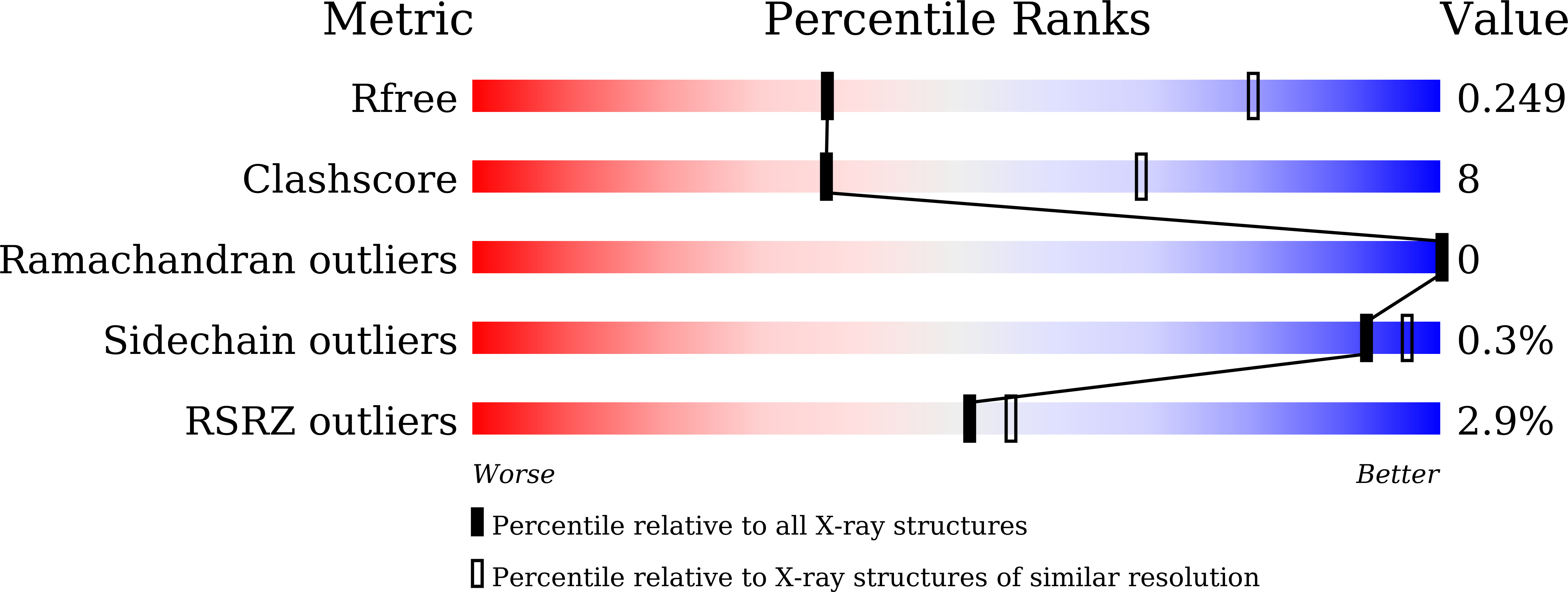
Macromolecular Entities
Polymer Type:polypeptide(L)
Molecule:Langya Virus attachment glycoprotein
Chain IDs:A, B, C
Chain Length:434
Number of Molecules:3
Biological Source:Langya virus
Ligand Molecules
Primary Citation
Antigenic and structural insights into Langya henipavirus attachment glycoprotein.
Virol Sin 40 769 777 (2025)
PMID: 40907748 DOI: 10.1016/j.virs.2025.08.005

Abstact

The invasion of host cells by the henipavirus is facilitated through the interaction between viral attachment (G) and fusion (F) glycoproteins with receptors on the cell surface. Langya henipavirus (LayV) was newly identified in China in 2022. The G proteins of LayV and Mojiang virus (MojV) exhibit high amino acid homology (86%), while they are located in a unique evolutionary clade within the Henipavirus genus. In this study, the crystal structure of the LayV G protein was resolved at a 3.37 Å resolution, revealing a head domain with six β-propeller-like domains distinct from other henipavirus G proteins, such as those of Nipah virus (NiV) and Hendra virus (HeV). Furthermore, the prominent loop in the center cavity of the LayV G protein showed unique structural features. In the ELISA and SPR assays, the LayV G protein was unable to bind to the existing henipavirus-neutralizing antibodies or the ephrin-B2 receptor. Immunogenicity studies in mice demonstrated robust antibody responses elicited by the LayV G protein. These antibodies exhibited strong reactivity against both LayV and MojV G proteins. However, only weak cross-reactivity was observed with other henipaviruses. Moreover, eight monoclonal antibodies targeting the LayV G protein were generated, two of which exhibited broad binding activity across different henipavirus G proteins. These findings underscore the need for tailored vaccines and therapeutics for LayV and related novel henipaviruses.

Legend

Protein

Chemical

Disease

Primary Citation of related structures
Feedback Form
Name
Email
Institute
Feedback