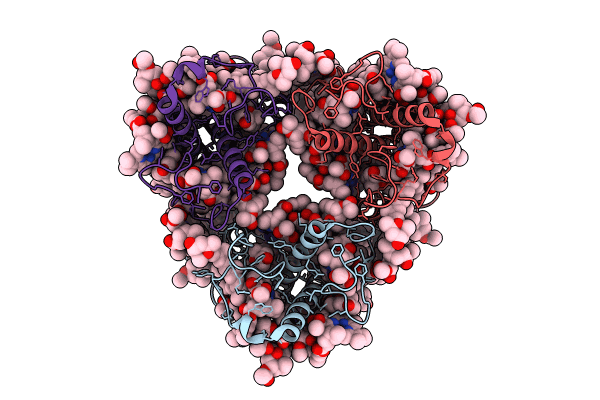
8JP3 image
Deposition Date 2023-06-10
Release Date 2024-06-12
Last Version Date 2024-11-27
Entry Detail
PDB ID:
8JP3
Keywords:
Title:
FCP trimer in diatom Thalassiosira pseudonana
Biological Source:
Source Organism:
Method Details:
Experimental Method:
Resolution:
2.73 Å
Aggregation State:
PARTICLE
Reconstruction Method:
SINGLE PARTICLE

Macromolecular Entities
Structures with similar UniProt ID
Protein Blast
Polymer Type:polypeptide(L)
Molecule:Fucoxanthin chlorophyll a/c protein 8
Gene (Uniprot):Lhcf9
Chain IDs:A, B, C
Chain Length:180
Number of Molecules:3
Biological Source:Thalassiosira pseudonana CCMP1335
Primary Citation
Structural and spectroscopic insights into fucoxanthin chlorophyll a/c-binding proteins of diatoms in diverse oligomeric states.
Plant Commun. 5 101041 101041 (2024)
PMID: 39030906 DOI: 10.1016/j.xplc.2024.101041

Abstact

Diatoms, a group of prevalent marine algae, contribute significantly to global primary productivity. Their substantial biomass is linked to enhanced absorption of blue-green light underwater, facilitated by fucoxanthin chlorophyll (Chl) a/c-binding proteins (FCPs), which exhibit oligomeric diversity across diatom species. Using mild clear native PAGE analysis of solubilized thylakoid membranes, we displayed monomeric, dimeric, trimeric, tetrameric, and pentameric FCPs in diatoms. Mass spectrometry analysis revealed that each oligomeric FCP has a specific protein composition, and together they constitute a large Lhcf family of FCP antennas. In addition, we resolved the structures of the Thalassiosira pseudonana FCP (Tp-FCP) homotrimer and the Chaetoceros gracilis FCP (Cg-FCP) pentamer by cryoelectron microscopy at 2.73-Å and 2.65-Å resolution, respectively. The distinct pigment compositions and organizations of various oligomeric FCPs affect their blue-green light-harvesting, excitation energy transfer pathways. Compared with dimeric and trimeric FCPs, the Cg-FCP tetramer and Cg-FCP pentamer exhibit stronger absorption by Chl c, redshifted and broader Chl a fluorescence emission, and more robust circular dichroism signals originating from Chl a-carotenoid dimers. These spectroscopic characteristics indicate that Chl a molecules in the Cg-FCP tetramer and Cg-FCP pentamer are more heterogeneous than in both dimers and the Tp-FCP trimer. The structural and spectroscopic insights provided by this study contribute to a better understanding of the mechanisms that empower diatoms to adapt to fluctuating light environments.

Legend

Protein

Chemical

Disease

Primary Citation of related structures
Feedback Form
Name
Email
Institute
Feedback