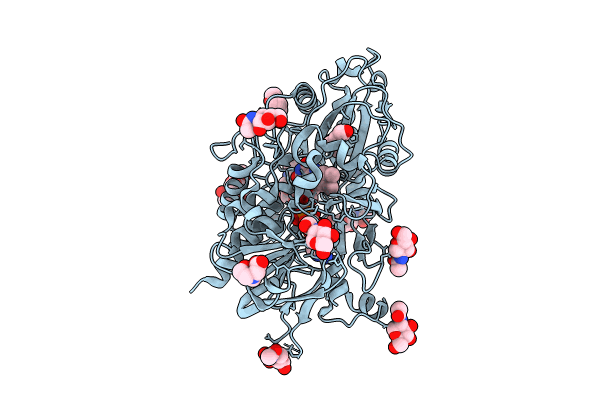
8JM0 image
Deposition Date 2023-06-04
Release Date 2024-06-12
Last Version Date 2026-01-07
Entry Detail
PDB ID:
8JM0
Keywords:
Title:
Endo-deglycosylated hydroxynitrile lyase isozyme 5 mutant L331A from Prunus communis complexed with 2,2-dimethyl-4H-benzo[d][1,3]dioxine-6-carbaldehyde from the cyanohydrin cleavage
Biological Source:
Source Organism(s):
Prunus dulcis (Taxon ID: 3755)
Expression System(s):
Method Details:
Experimental Method:
Resolution:
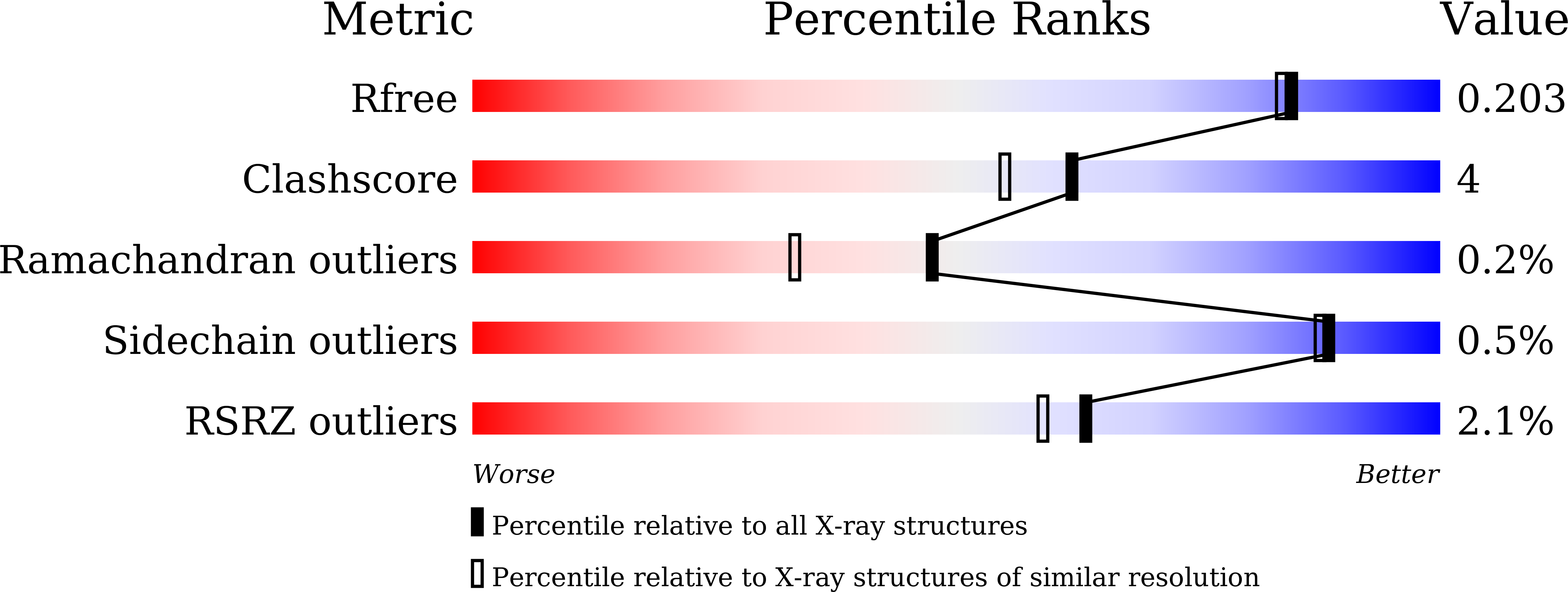
1.79 Å
R-Value Free:
0.19
R-Value Work:
0.16
R-Value Observed:
0.16
Space Group:
P 21 21 21
Macromolecular Entities
Structures with similar UniProt ID
Protein Blast
Polymer Type:polypeptide(L)
Molecule:(R)-mandelonitrile lyase
Mutagens:L331A
Chain IDs:A
Chain Length:540
Number of Molecules:1
Biological Source:Prunus dulcis
Primary Citation
Flipping of a Non-productive Substrate Binding Conformation Facilitates Hydroxynitrile Lyase Catalyzed Hydrocyanation.
Angew.Chem.Int.Ed.Engl. 64 e202515778 e202515778 (2025)
PMID: 41137404 DOI: 10.1002/anie.202515778

Abstact

Understanding enzyme-substrate conformational transformations is crucial to the design and engineering of biocatalysts. However, the mechanisms by which substrates undergo dynamic transformations that regulate the function of an enzyme remain poorly understood. Hydroxynitrile lyase from Prunus communis (PcHNL5) catalyzes the cleavage of cyanohydrins. Its reverse reaction holds significant synthetic potential for the preparation of pharmaceutical precursors. Using a combination of crystallography and computational experiments, a novel flipped substrate binding state is identified within the substrate tunnel of the PcHNL5L331A mutant. This binding state is non-productive and undergoes a conformational change before the catalytic cycle can proceed. Site-saturation mutagenesis led to the discovery of a triple mutant, PcHNL5L331A/S333V/P340L, that destabilizes the non-productive substrate binding state thereby facilitating its transition to the catalytically productive conformation and significantly enhancing catalytic efficiency. Crystallographic studies provide a structural description of the factors that stabilize versus destabilize the different binding conformers in the different enzyme variants and thus the differing catalytic efficiencies. These findings demonstrate that destabilizing unfavorable substrate binding conformations within an enzyme active site can improve functionality and provide a promising strategy for designing efficient biocatalysts.

Legend

Protein

Chemical

Disease

Primary Citation of related structures
Feedback Form
Name
Email
Institute
Feedback