8JD8 image
Deposition Date 2023-05-12
Release Date 2023-12-27
Last Version Date 2024-10-30
Entry Detail
PDB ID:
8JD8
Keywords:
Title:
Crystal structure of Citrus limon Cu-Zn superoxide dismutase
Biological Source:
Source Organism:
Citrus limon (Taxon ID: 2708)
Method Details:
Experimental Method:
Resolution:
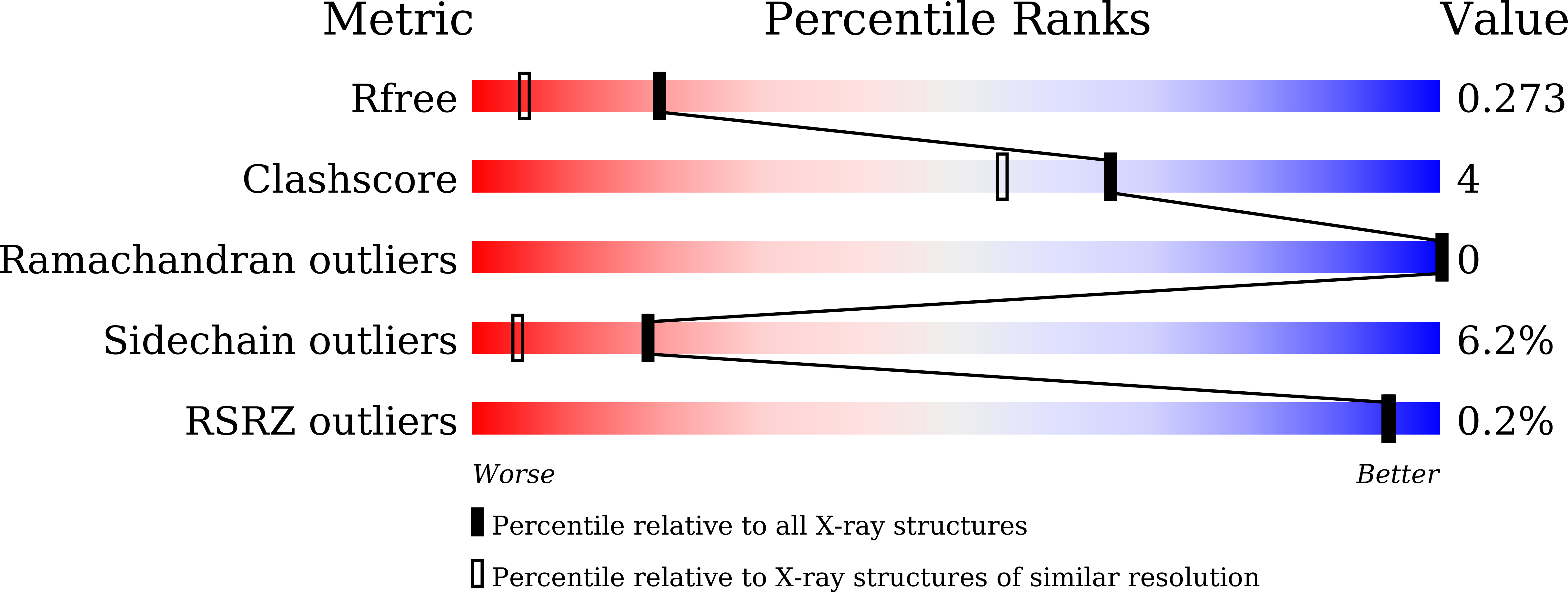
1.86 Å
R-Value Free:
0.26
R-Value Work:
0.17
R-Value Observed:
0.17
Space Group:
P 1 21 1
Macromolecular Entities
Structures with similar UniProt ID
Protein Blast
Polymer Type:polypeptide(L)
Molecule:Superoxide dismutase [Cu-Zn]
Chain IDs:A, B, C, D
Chain Length:165
Number of Molecules:4
Biological Source:Citrus limon
Primary Citation
Direct relationship between dimeric form and activity in the acidic copper-zinc superoxide dismutase from lemon.
Acta Crystallogr.,Sect.F 79 301 307 (2023)
PMID: 38108885 DOI: 10.1107/S2053230X23010646

Abstact

The copper-zinc superoxide dismutase (CuZnSOD) from lemon (SOD_CL) is active in an acidic environment and resists proteolytic degradation. The enzyme occurs as a dimer, which has an indirect effect on the enzyme activity as the monomer retains only ∼35% of the activity. Here, the crystal structure of SOD_CL at 1.86 Å resolution is reported that may explain this peculiarity. The crystal belonged to space group P21, with unit-cell parameters a = 61.11, b = 74.55, c = 61.69 Å, β = 106.86°, and contained four molecules in the asymmetric unit. The overall structure of SOD_CL resembles that of CuZnSOD from plants. The structure of SOD_CL shows a unique arrangement of surface loop IV that connects the dimer interface and the active site, which is located away from the dimer-interface region. This arrangement allows direct interaction between the residues residing in the dimer interface and those in the active site. The arrangement also includes Leu62 and Gln164, which are conserved in cytoplasmic CuZnSOD. This supports the classification of SOD_CL as a cytoplasmic CuZnSOD despite sharing the highest amino-acid sequence homology with CuZnSODs from spinach and tomato, which are chloroplastic.

Legend

Protein

Chemical

Disease

Primary Citation of related structures
Feedback Form
Name
Email
Institute
Feedback