8J8L image
Deposition Date 2023-05-02
Release Date 2024-07-17
Last Version Date 2025-11-26
Entry Detail
PDB ID:
8J8L
Title:
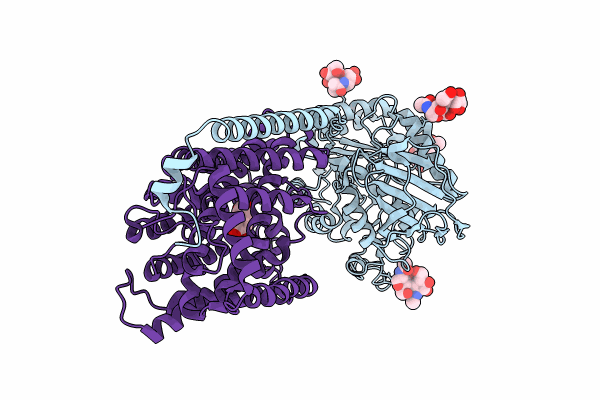
Overall structure of the LAT1-4F2hc bound with L-dopa
Biological Source:
Source Organism(s):
Homo sapiens (Taxon ID: 9606)
Expression System(s):
Method Details:
Experimental Method:
Resolution:
3.56 Å
Aggregation State:
PARTICLE
Reconstruction Method:
SINGLE PARTICLE
Macromolecular Entities
Structures with similar UniProt ID
Protein Blast
Polymer Type:polypeptide(L)
Molecule:4F2 cell-surface antigen heavy chain
Gene (Uniprot):SLC3A2
Chain IDs:A
Chain Length:647
Number of Molecules:1
Biological Source:Homo sapiens
Structures with similar UniProt ID
Protein Blast
Polymer Type:polypeptide(L)
Molecule:Large neutral amino acids transporter small subunit 1
Gene (Uniprot):SLC7A5
Chain IDs:B
Chain Length:527
Number of Molecules:1
Biological Source:Homo sapiens
Ligand Molecules
Primary Citation
Structural insights into the substrate transport mechanism of the amino acid transporter complex.
J.Biol.Chem. 301 110569 110569 (2025)
PMID: 40780412 DOI: 10.1016/j.jbc.2025.110569

Abstact

The L-type amino acid transporter 1 (LAT1), in complex with its ancillary protein 4F2hc, mediates the sodium-independent antiport of large neutral amino acids across the plasma membrane. LAT1 preferentially transports substrates, such as L-leucine, L-tyrosine, and L-tryptophan, thyroid hormones, and drugs like 3,4-dihydroxyphenylalanine. Its pivotal role in cancer development and progression has established LAT1 as a promising therapeutic target. While prior studies have resolved the LAT1-4F2hc architecture and inhibitor interactions, the molecular basis of LAT1 substrate selectivity remains elusive. Here, we present the cryo-EM structures of LAT1-4F2hc bound to L-tyrosine, L-tryptophan, L-leucine, and 3,4-dihydroxyphenylalanine, revealing distinct substrate binding modes. Comparative structural analysis highlights differences between LAT1 and LAT2 in substrate coordination, driven by key residues near the binding pocket that influence transport efficiency. These findings advance our mechanistic understanding of the LAT1-4F2hc complex and provide valuable insights for structure-based drug design targeting LAT1.

Legend

Protein

Chemical

Disease

Primary Citation of related structures
Feedback Form
Name
Email
Institute
Feedback