8J1P image
Deposition Date 2023-04-13
Release Date 2024-04-17
Last Version Date 2025-10-29
Entry Detail
PDB ID:
8J1P
Keywords:
Title:
Cryo-EM structure of Ufd4 in complex with K29/48 triUb
Biological Source:
Source Organism:
Method Details:
Experimental Method:
Resolution:
3.31 Å
Aggregation State:
PARTICLE
Reconstruction Method:
SINGLE PARTICLE
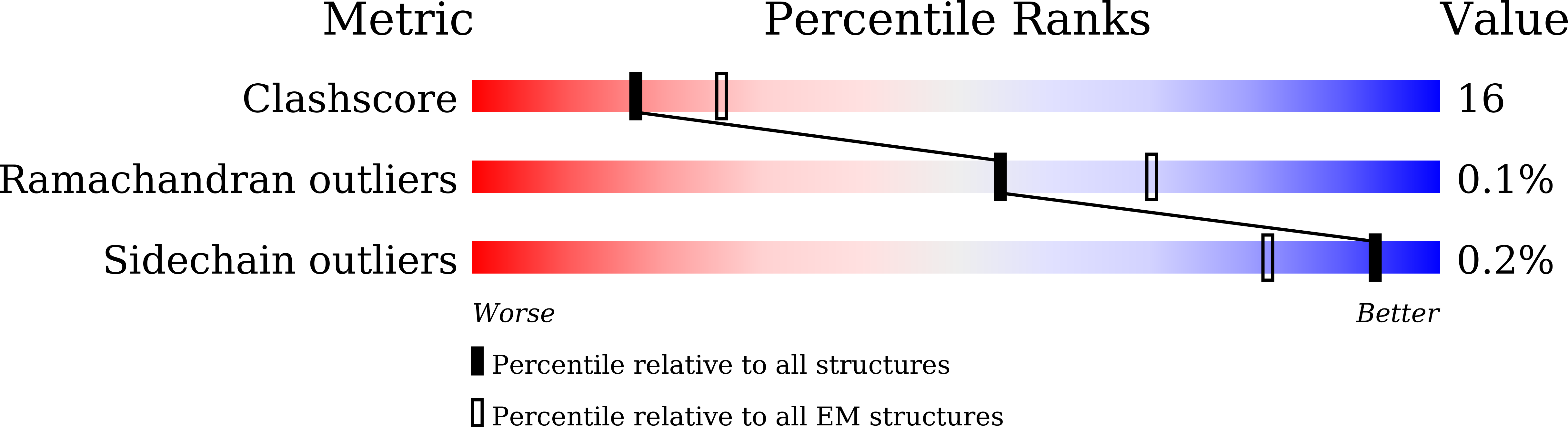
Macromolecular Entities
Structures with similar UniProt ID
Protein Blast
Polymer Type:polypeptide(L)
Molecule:Ubiquitin fusion degradation protein 4
Gene (Uniprot):UFD4
Chain IDs:A
Chain Length:1483
Number of Molecules:1
Biological Source:Saccharomyces cerevisiae
Structures with similar UniProt ID
Protein Blast
Polymer Type:polypeptide(L)
Molecule:Ubiquitin
Gene (Uniprot):UBB
Chain IDs:B (auth: C), D (auth: E)
Chain Length:76
Number of Molecules:2
Biological Source:Homo sapiens
Structures with similar UniProt ID
Protein Blast
Polymer Type:polypeptide(L)
Molecule:Ubiquitin
Gene (Uniprot):UBB
Mutagens:K29C
Chain IDs:C (auth: D)
Chain Length:76
Number of Molecules:1
Biological Source:Homo sapiens
Ligand Molecules
Primary Citation
Structural visualization of HECT-type E3 ligase Ufd4 accepting and transferring ubiquitin to form K29/K48-branched polyubiquitination.
Nat Commun 16 4313 4313 (2025)
PMID: 40341121 DOI: 10.1038/s41467-025-59569-6

Abstact

The K29/K48-linked ubiquitination generated by the cooperative catalysis of E3 ligase Ufd4 and Ubr1 is an enhanced protein degradation signal, in which Ufd4 is responsible for introducing K29-linked ubiquitination to K48-linked ubiquitin chains to augment polyubiquitination. How HECT-E3 ligase Ufd4 mediates the ubiquitination event remains unclear. Here, we biochemically determine that Ufd4 preferentially catalyses K29-linked ubiquitination on K48-linked ubiquitin chains to generate K29/K48-branched ubiquitin chains and capture structural snapshots of Ub transfer cascades for Ufd4-mediated ubiquitination. The N-terminal ARM region and HECT domain C-lobe of Ufd4 are identified and characterized as key structural elements that together recruit K48-linked diUb and orient Lys29 of its proximal Ub to the active cysteine of Ufd4 for K29-linked branched ubiquitination. These structures not only provide mechanistic insights into the architecture of the Ufd4 complex but also provide structural visualization of branched ubiquitin chain formation by a HECT-type E3 ligase.

Legend

Protein

Chemical

Disease

Primary Citation of related structures
Feedback Form
Name
Email
Institute
Feedback