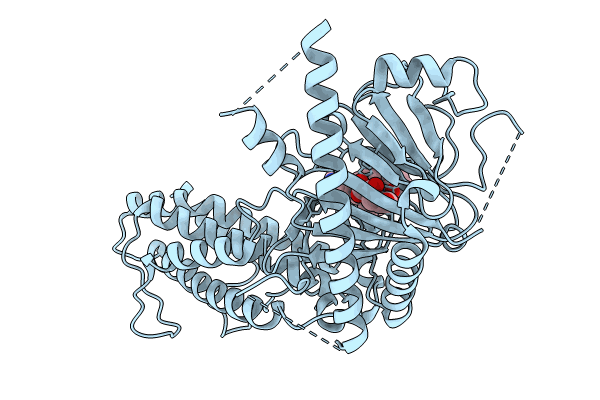
8IT9 image
Deposition Date 2023-03-22
Release Date 2024-02-14
Last Version Date 2024-02-14
Entry Detail
PDB ID:
8IT9
Keywords:
Title:
Co-crystal structure of FTO bound to 22
Biological Source:
Source Organism:
Homo sapiens (Taxon ID: 9606)
Host Organism:
Method Details:
Experimental Method:
Resolution:
2.14 Å
R-Value Free:
0.23
R-Value Work:
0.22
R-Value Observed:
0.22
Space Group:
H 3

Macromolecular Entities
Structures with similar UniProt ID
Protein Blast
Polymer Type:polypeptide(L)
Molecule:Alpha-ketoglutarate-dependent dioxygenase FTO
Gene (Uniprot):FTO
Chain IDs:A
Chain Length:491
Number of Molecules:1
Biological Source:Homo sapiens
Primary Citation
Rational Design of RNA Demethylase FTO Inhibitors with Enhanced Antileukemia Drug-Like Properties.
J.Med.Chem. 66 9731 9752 (2023)
PMID: 37418628 DOI: 10.1021/acs.jmedchem.3c00543

Abstact

The fat mass and obesity-associated protein (FTO) is an RNA N6-methyladenosine (m6A) demethylase highly expressed in diverse cancers including acute myeloid leukemia (AML). To improve antileukemia drug-like properties, we have designed 44/ZLD115, a flexible alkaline side-chain-substituted benzoic acid FTO inhibitor derived from FB23. A combination of structure-activity relationship analysis and lipophilic efficiency-guided optimization demonstrates that 44/ZLD115 exhibits better drug-likeness than the previously reported FTO inhibitors, FB23 and 13a/Dac85. Then, 44/ZLD115 shows significant antiproliferative activity in leukemic NB4 and MOLM13 cell lines. Moreover, 44/ZLD115 treatment noticeably increases m6A abundance on the AML cell RNA, upregulates RARA gene expression, and downregulates MYC gene expression in MOLM13 cells, which are consistent with FTO gene knockdown. Lastly, 44/ZLD115 exhibits antileukemic activity in xenograft mice without substantial side effects. This FTO inhibitor demonstrates promising properties that can be further developed for antileukemia applications.

Legend

Protein

Chemical

Disease

Primary Citation of related structures
Feedback Form
Name
Email
Institute
Feedback