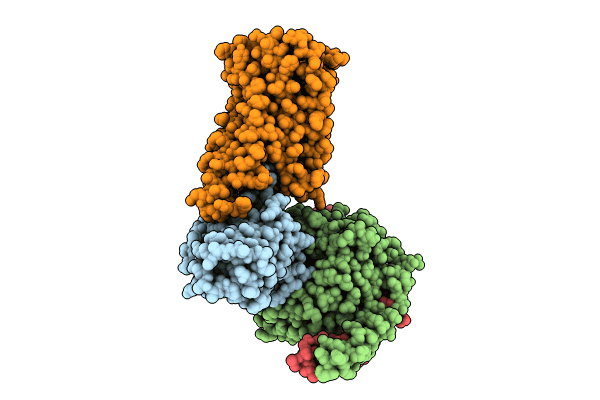
8IKG image
Deposition Date 2023-02-28
Release Date 2024-06-05
Last Version Date 2024-11-06
Entry Detail
PDB ID:
8IKG
Title:
Cryo-EM structure of human receptor with G proteins
Biological Source:
Source Organism(s):
Homo sapiens (Taxon ID: 9606)
Mus musculus (Taxon ID: 10090)
Expression System(s):
Method Details:
Experimental Method:
Resolution:
3.40 Å
Aggregation State:
PARTICLE
Reconstruction Method:
SINGLE PARTICLE
Macromolecular Entities
Structures with similar UniProt ID
Protein Blast
Polymer Type:polypeptide(L)
Molecule:Guanine nucleotide-binding protein G(i) subunit alpha-1
Gene (Uniprot):GNAI1
Chain IDs:A
Chain Length:354
Number of Molecules:1
Biological Source:Homo sapiens
Structures with similar UniProt ID
Protein Blast
Polymer Type:polypeptide(L)
Molecule:Guanine nucleotide-binding protein G(I)/G(S)/G(T) subunit beta-1
Gene (Uniprot):GNB1
Chain IDs:B
Chain Length:356
Number of Molecules:1
Biological Source:Homo sapiens
Structures with similar UniProt ID
Protein Blast
Polymer Type:polypeptide(L)
Molecule:Guanine nucleotide-binding protein G(I)/G(S)/G(O) subunit gamma-2
Gene (Uniprot):GNG2
Chain IDs:C
Chain Length:71
Number of Molecules:1
Biological Source:Homo sapiens
Structures with similar UniProt ID
Protein Blast
Polymer Type:polypeptide(L)
Molecule:Cannabinoid receptor 1
Gene (Uniprot):CNR1
Chain IDs:D (auth: R)
Chain Length:310
Number of Molecules:1
Biological Source:Homo sapiens
Polymer Type:polypeptide(L)
Molecule:scFV16
Chain IDs:E (auth: S)
Chain Length:266
Number of Molecules:1
Biological Source:Mus musculus
Ligand Molecules
Primary Citation
Structure-based identification of a G protein-biased allosteric modulator of cannabinoid receptor CB1.
Proc.Natl.Acad.Sci.USA 121 e2321532121 e2321532121 (2024)
PMID: 38830102 DOI: 10.1073/pnas.2321532121

Abstact

Cannabis sativa is known for its therapeutic benefit in various diseases including pain relief by targeting cannabinoid receptors. The primary component of cannabis, Δ9-tetrahydrocannabinol (THC), and other agonists engage the orthosteric site of CB1, activating both Gi and β-arrestin signaling pathways. The activation of diverse pathways could result in on-target side effects and cannabis addiction, which may hinder therapeutic potential. A significant challenge in pharmacology is the design of a ligand that can modulate specific signaling of CB1. By leveraging insights from the structure-function selectivity relationship (SFSR), we have identified Gi signaling-biased agonist-allosteric modulators (ago-BAMs). Further, two cryoelectron microscopy (cryo-EM) structures reveal the binding mode of ago-BAM at the extrahelical allosteric site of CB1. Combining mutagenesis and pharmacological studies, we elucidated the detailed mechanism of ago-BAM-mediated biased signaling. Notably, ago-BAM CB-05 demonstrated analgesic efficacy with fewer side effects, minimal drug toxicity and no cannabis addiction in mouse pain models. In summary, our finding not only suggests that ago-BAMs of CB1 provide a potential nonopioid strategy for pain management but also sheds light on BAM identification for GPCRs.

Legend

Protein

Chemical

Disease

Primary Citation of related structures
Feedback Form
Name
Email
Institute
Feedback