8IDF image
Deposition Date 2023-02-13
Release Date 2023-08-09
Last Version Date 2023-08-23
Entry Detail
PDB ID:
8IDF
Keywords:
Title:
Crystal structure of human TUT1 complexed with U6 snRNA
Biological Source:
Source Organism:
Homo sapiens (Taxon ID: 9606)
Host Organism:
Method Details:
Experimental Method:
Resolution:
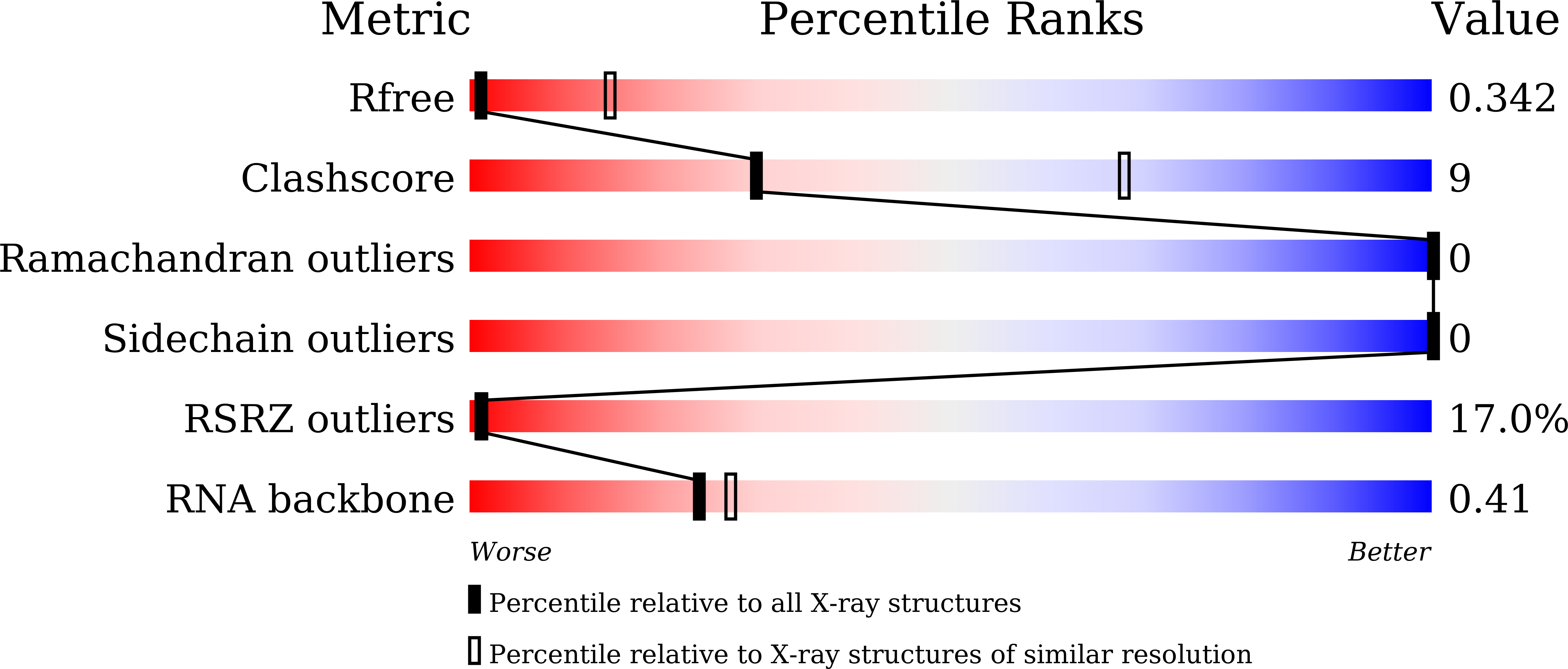
3.70 Å
R-Value Free:
0.33
R-Value Work:
0.30
R-Value Observed:
0.30
Space Group:
P 65 2 2
Macromolecular Entities
Structures with similar UniProt ID
Protein Blast
Polymer Type:polypeptide(L)
Molecule:Speckle targeted PIP5K1A-regulated poly(A) polymerase
Gene (Uniprot):TUT1
Mutagens:deletion 235-304, C19S,C372A,C415A,C501A,C504S,C399A,C574A,D218A
Chain IDs:A
Chain Length:537
Number of Molecules:1
Biological Source:Homo sapiens
Polymer Type:polyribonucleotide
Molecule:RNA (53-MER)
Chain IDs:B
Chain Length:53
Number of Molecules:1
Biological Source:Homo sapiens
Ligand Molecules
Primary Citation
Mechanism of U6 snRNA oligouridylation by human TUT1.
Nat Commun 14 4686 4686 (2023)
PMID: 37563152 DOI: 10.1038/s41467-023-40420-9

Abstact

U6 snRNA is a catalytic RNA responsible for pre-mRNA splicing reactions and undergoes various post-transcriptional modifications during its maturation process. The 3'-oligouridylation of U6 snRNA by the terminal uridylyltransferase, TUT1, provides the Lsm-binding site in U6 snRNA for U4/U6 di-snRNP formation and this ensures pre-mRNA splicing. Here, we present the crystal structure of human TUT1 (hTUT1) complexed with U6 snRNA, representing the post-uridylation of U6 snRNA by hTUT1. The N-terminal ZF-RRM and catalytic palm clamp the single-stranded AUA motif between the 5'-short stem and the 3'-telestem of U6 snRNA, and the ZF-RRM specifically recognizes the AUA motif. The ZF and the fingers hold the telestem, and the 3'-end of U6 snRNA is placed in the catalytic pocket of the palm for oligouridylation. The oligouridylation of U6 snRNA depends on the internal four-adenosine tract in the 5'-part of the telestem of U6 snRNA, and hTUT1 adds uridines until the internal adenosine tract can form base-pairs with the 3'-oligouridine tract. Together, the recognition of the specific structure and sequence of U6 snRNA by the multi-domain TUT1 protein and the intrinsic sequence and structure of U6 snRNA ensure the oligouridylation of U6 snRNA.

Legend

Protein

Chemical

Disease

Primary Citation of related structures
Feedback Form
Name
Email
Institute
Feedback