8I4I image
Deposition Date 2023-01-19
Release Date 2023-04-12
Last Version Date 2024-05-29
Entry Detail
PDB ID:
8I4I
Keywords:
Title:
The asymmetric structure of homodimeric E. coli TrpRS bound with tryptophanyl adenylate and L-tryptophan
Biological Source:
Source Organism:
Host Organism:
Method Details:
Experimental Method:
Resolution:
2.20 Å
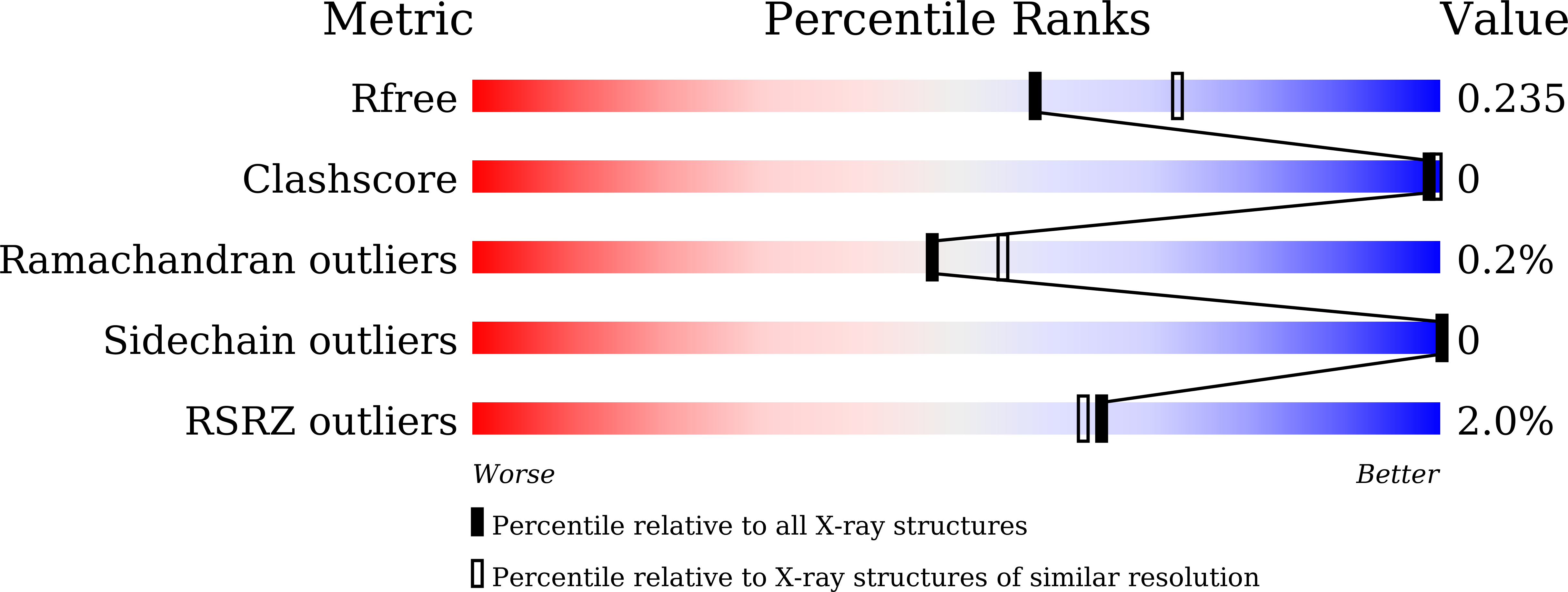
R-Value Free:
0.22
R-Value Work:
0.20
R-Value Observed:
0.20
Space Group:
P 1 21 1
Macromolecular Entities
Structures with similar UniProt ID
Protein Blast
Polymer Type:polypeptide(L)
Molecule:Tryptophan--tRNA ligase
Gene (Uniprot):trpS
Chain IDs:A, B
Chain Length:340
Number of Molecules:2
Biological Source:Escherichia coli K-12
Primary Citation
An asymmetric structure of bacterial TrpRS supports the half-of-the-sites catalytic mechanism and facilitates antimicrobial screening.
Nucleic Acids Res. 51 4637 4649 (2023)
PMID: 37070195 DOI: 10.1093/nar/gkad278

Abstact

Tryptophanyl-tRNA synthetase (TrpRS) links tryptophan to tRNATrp, thereby playing an indispensable role in protein translation. Unlike most class I aminoacyl-tRNA synthetases (AARSs), TrpRS functions as a homodimer. Herein, we captured an 'open-closed' asymmetric structure of Escherichia coli TrpRS (EcTrpRS) with one active site occupied by a copurified intermediate product and the other remaining empty, providing structural evidence for the long-discussed half-of-the-sites reactivity of bacterial TrpRS. In contrast to its human counterpart, bacterial TrpRS may rely on this asymmetric conformation to functionally bind with substrate tRNA. As this asymmetric conformation is probably a dominant form of TrpRS purified from bacterial cells, we performed fragment screening against asymmetric EcTrpRS to support antibacterial discovery. Nineteen fragment hits were identified, and 8 of them were successfully cocrystallized with EcTrpRS. While a fragment named niraparib bound to the L-Trp binding site of the 'open' subunit, the other 7 fragments all bound to an unprecedented pocket at the interface between two TrpRS subunits. Binding of these fragments relies on residues specific to bacterial TrpRS, avoiding undesired interactions with human TrpRS. These findings improve our understanding of the catalytic mechanism of this important enzyme and will also facilitate the discovery of bacterial TrpRS inhibitors with therapeutic potential.

Legend

Protein

Chemical

Disease

Primary Citation of related structures
Feedback Form
Name
Email
Institute
Feedback