8HUF image
Deposition Date 2022-12-23
Release Date 2023-12-27
Last Version Date 2024-07-10
Entry Detail
PDB ID:
8HUF
Title:
B28 in complex with CRM1-Ran-RanBP1
Biological Source:
Source Organism:
Host Organism:
Method Details:
Experimental Method:
Resolution:
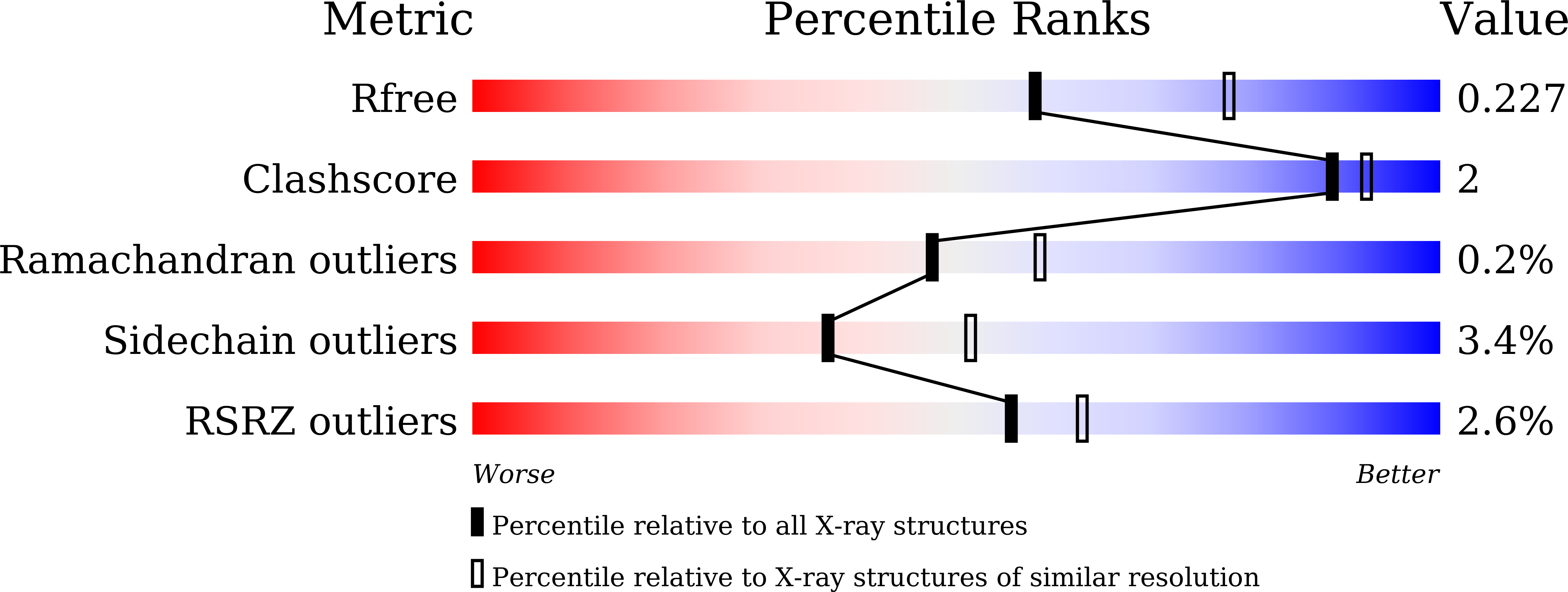
2.29 Å
R-Value Free:
0.22
R-Value Work:
0.19
R-Value Observed:
0.19
Space Group:
P 43 21 2
Macromolecular Entities
Structures with similar UniProt ID
Protein Blast
Polymer Type:polypeptide(L)
Molecule:GTP-binding nuclear protein Ran
Gene (Uniprot):RAN
Mutagens:Q69L, L182A
Chain IDs:A
Chain Length:216
Number of Molecules:1
Biological Source:Homo sapiens
Structures with similar UniProt ID
Protein Blast
Polymer Type:polypeptide(L)
Molecule:YRB1 isoform 1
Chain IDs:B
Chain Length:140
Number of Molecules:1
Biological Source:Saccharomyces cerevisiae
Structures with similar UniProt ID
Protein Blast
Polymer Type:polypeptide(L)
Molecule:CRM1 isoform 1
Mutagens:S27E , Q49E, A51V, del377-413, del441-461, D537G, T539C, V540E, K541Q, S553R, Q561E, A741T, Y1022C
Chain IDs:C
Chain Length:1003
Number of Molecules:1
Biological Source:Saccharomyces cerevisiae
Primary Citation
Discovery of a Hidden Pocket beneath the NES Groove by Novel Noncovalent CRM1 Inhibitors.
J.Med.Chem. 66 17044 17058 (2023)
PMID: 38105606 DOI: 10.1021/acs.jmedchem.3c01867

Abstact

Protein localization is frequently manipulated to favor tumor initiation and progression. In cancer cells, the nuclear export factor CRM1 is often overexpressed and aberrantly localizes many tumor suppressors via protein-protein interactions. Although targeting protein-protein interactions is usually challenging, covalent inhibitors, including the FDA-approved drug KPT-330 (selinexor), were successfully developed. The development of noncovalent CRM1 inhibitors remains scarce. Here, by shifting the side chain of two methionine residues and virtually screening against a large compound library, we successfully identified a series of noncovalent CRM1 inhibitors with a stable scaffold. Crystal structures of inhibitor-protein complexes revealed that one of the compounds, B28, utilized a deeply hidden protein interior cavity for binding. SAR analysis guided the development of several B28 derivatives with enhanced inhibition on nuclear export and growth of multiple cancer cell lines. This work may benefit the development of new CRM1-targeted therapies.

Legend

Protein

Chemical

Disease

Primary Citation of related structures
Feedback Form
Name
Email
Institute
Feedback