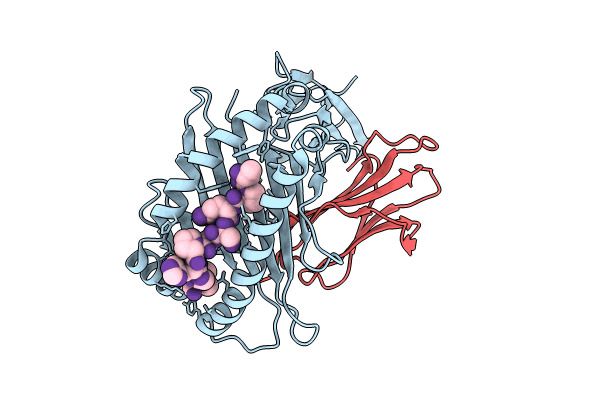
8HT1 image
Deposition Date 2022-12-20
Release Date 2023-12-20
Last Version Date 2025-01-01
Entry Detail
PDB ID:
8HT1
Keywords:
Title:
CRYSTAL STRUCTURE OF A MUTANT MYLU-B-67 FOR 2.4 ANGSTROM, 52M 53Q 54Q 55P 56W DELETED
Biological Source:
Host Organism:
Method Details:
Experimental Method:
Resolution:
2.40 Å
R-Value Free:
0.27
R-Value Work:
0.20
R-Value Observed:
0.21
Space Group:
C 2 2 21

Macromolecular Entities
Structures with similar UniProt ID
Protein Blast
Polymer Type:polypeptide(L)
Molecule:Ig-like domain-containing protein
Mutagens:52M,53Q,54Q,55P,56W DELETED
Chain IDs:A
Chain Length:275
Number of Molecules:1
Biological Source:Myotis lucifugus
Structures with similar UniProt ID
Protein Blast
Polymer Type:polypeptide(L)
Molecule:Beta-2-microglobulin
Gene (Uniprot):PAL_GLEAN10023531
Chain IDs:B
Chain Length:98
Number of Molecules:1
Biological Source:Pteropus alecto
Structures with similar UniProt ID
Protein Blast
Polymer Type:polypeptide(L)
Molecule:THR-PRO-GLN-SER-ALA-PRO-HIS-GLY-VAL
Chain IDs:C
Chain Length:9
Number of Molecules:1
Biological Source:Severe acute respiratory syndrome coronavirus 2
Primary Citation
Amino acid insertion in Bat MHC-I enhances complex stability and augments peptide presentation.
Commun Biol 7 586 586 (2024)
PMID: 38755285 DOI: 10.1038/s42003-024-06292-5

Abstact

Bats serve as reservoirs for numerous zoonotic viruses, yet they typically remain asymptomatic owing to their unique immune system. Of particular significance is the MHC-I in bats, which plays crucial role in anti-viral response and exhibits polymorphic amino acid (AA) insertions. This study demonstrated that both 5AA and 3AA insertions enhance the thermal stability of the bat MHC-I complex and enrich the diversity of bound peptides in terms of quantity and length distribution, by stabilizing the 310 helix, a region prone to conformational changes during peptide loading. However, the mismatched insertion could diminish the stability of bat pMHC-I. We proposed that a suitable insertion may help bat MHC-I adapt to high body temperatures during flight while enhancing antiviral responses. Moreover, this site-specific insertions may represent a strategy of evolutionary adaptation of MHC-I molecules to fluctuations in body temperature, as similar insertions have been found in other lower vertebrates.

Legend

Protein

Chemical

Disease

Primary Citation of related structures
Feedback Form
Name
Email
Institute
Feedback