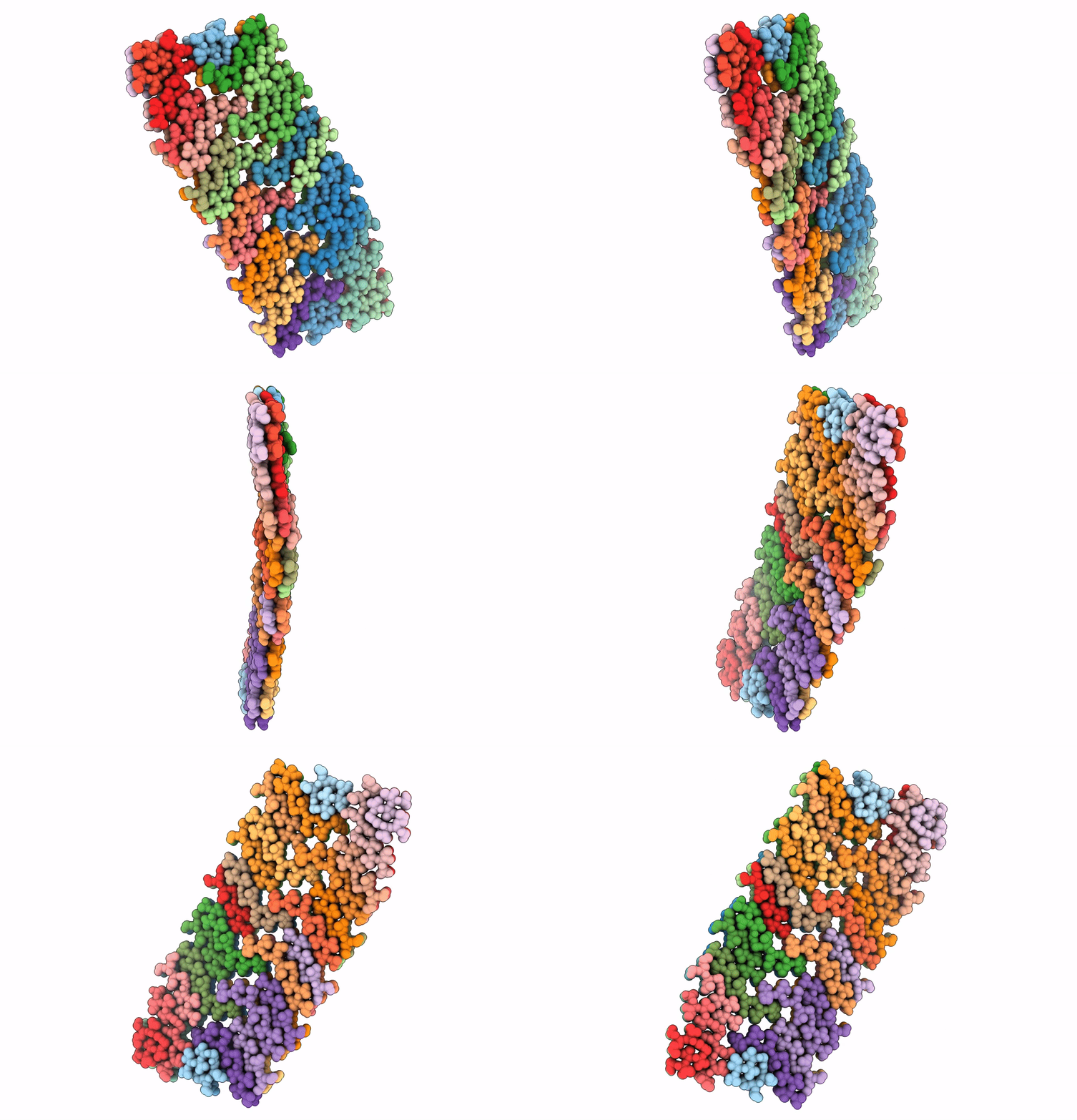
8GZ8 image
Deposition Date 2022-09-26
Release Date 2023-09-20
Last Version Date 2024-05-22
Entry Detail
PDB ID:
8GZ8
Title:
Cryo-EM structure of Abeta2 fibril polymorph1
Biological Source:
Source Organism:
Homo sapiens (Taxon ID: 9606)
Method Details:
Experimental Method:
Resolution:
2.35 Å
Aggregation State:
FILAMENT
Reconstruction Method:
HELICAL

Macromolecular Entities
Polymer Type:polypeptide(L)
Molecule:peptide self-assembled antimicrobial fibrils
Chain IDs:A (auth: e), B (auth: p), C (auth: o), D (auth: q), E (auth: s), F (auth: r), G (auth: t), H (auth: u), I (auth: w), J (auth: v), K (auth: y), L (auth: x), M (auth: O), N (auth: S), O (auth: Q), P (auth: U), Q (auth: Y), R (auth: W), S (auth: a), T (auth: c), U (auth: i), V (auth: g), W (auth: l), X (auth: k), Y (auth: 1), Z (auth: 0), AA (auth: K), BA (auth: V), CA (auth: T), DA (auth: X), EA (auth: b), FA (auth: Z), GA (auth: d), HA (auth: f), IA (auth: j), JA (auth: h), KA (auth: z), LA (auth: n), MA (auth: C), NA (auth: E), OA (auth: D), PA (auth: F), QA (auth: H), RA (auth: G), SA (auth: I), TA (auth: J), UA (auth: M), VA (auth: L), WA (auth: P), XA (auth: N), YA (auth: B), ZA (auth: A)
Chain Length:12
Number of Molecules:52
Biological Source:Homo sapiens
Primary Citation
Engineering of antimicrobial peptide fibrils with feedback degradation of bacterial-secreted enzymes.
Chem Sci 14 10914 10924 (2023)
PMID: 37829030 DOI: 10.1039/d3sc01089a

Abstact

Proteins and peptides can assemble into functional amyloid fibrils with distinct architectures. These amyloid fibrils can fulfil various biological functions in living organisms, and then be degraded. By incorporating an amyloidogenic segment and enzyme-cleavage segment together, we designed a peptide (enzyme-cleavage amyloid peptides (EAP))-based functional fibril which could be degraded specifically by gelatinase. To gain molecular insights into the assembly and degradation of EAP fibrils, we determined the atomic structure of the EAP fibril using cryo-electron microscopy. The amyloidogenic segment of EAP adopted a β-strand conformation and mediated EAP-fibril formation mainly via steric zipper-like interactions. The enzyme-cleavage segment was partially involved in self-assembly, but also exhibited high flexibility in the fibril structure, with accessibility to gelatinase binding and degradation. Moreover, we applied the EAP fibril as a tunable scaffold for developing degradable self-assembled antimicrobial fibrils (SANs) by integrating melittin and EAP together. SANs exhibited superior activity for killing bacteria, and significantly improved the stability and biocompatibility of melittin. SANs were eliminated automatically by the gelatinase secreted from targeted bacteria. Our work provides a new strategy for rational design of functional fibrils with a feedback regulatory loop for optimizing the biocompatibility and biosafety of designed fibrils. Our work may aid further developments of "smart" peptide-based biomaterials for biomedical applications.

Legend

Protein

Chemical

Disease

Primary Citation of related structures
Feedback Form
Name
Email
Institute
Feedback