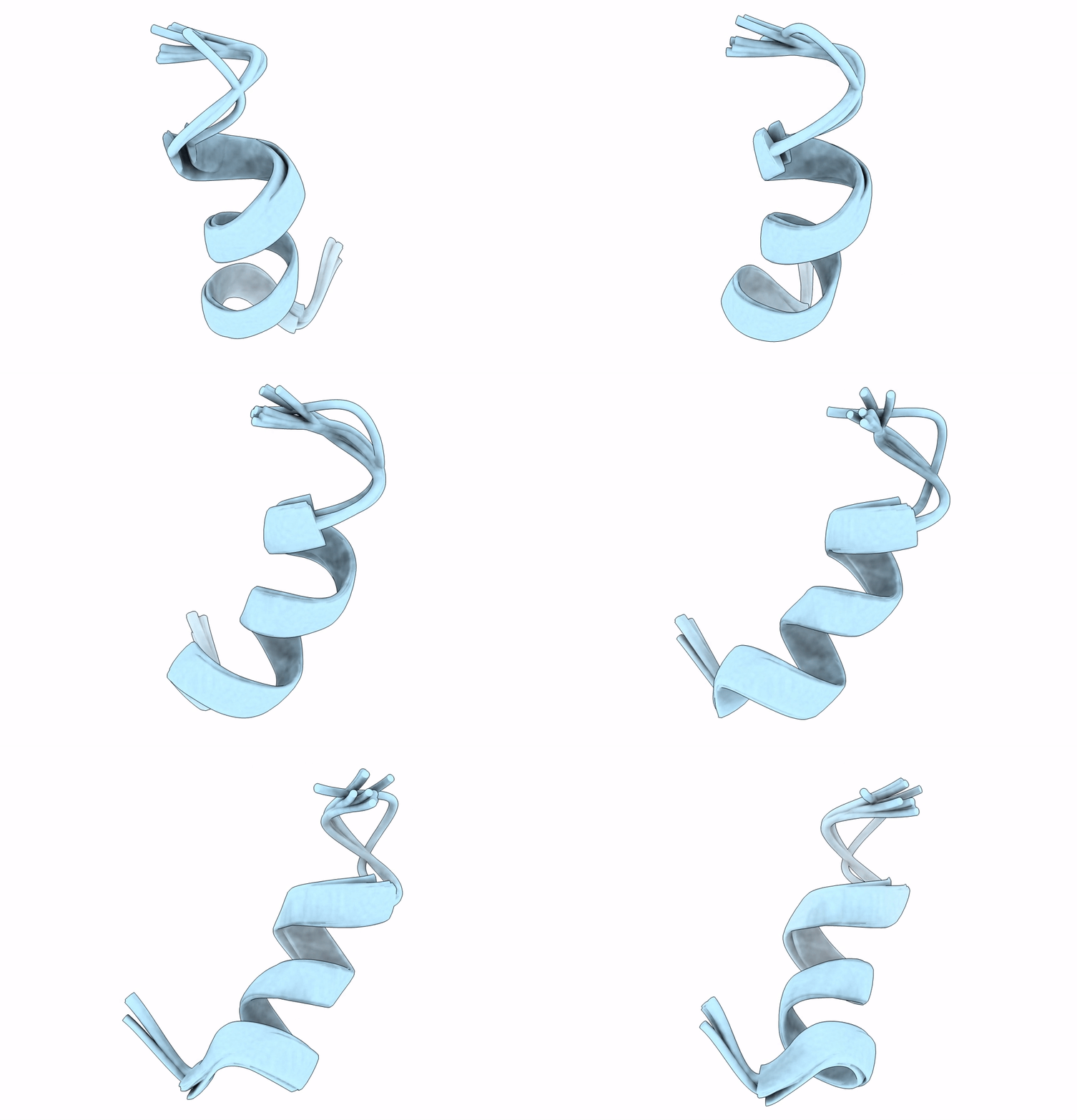
8GVN image
Deposition Date 2022-09-15
Release Date 2022-11-09
Last Version Date 2024-05-15
Entry Detail
PDB ID:
8GVN
Title:
Novel salt-resistant antimicrobial peptide, RR14
Biological Source:
Source Organism:
Method Details:
Experimental Method:
Conformers Calculated:
100
Conformers Submitted:
20
Selection Criteria:
structures with the lowest energy

Macromolecular Entities
Polymer Type:polypeptide(L)
Molecule:TRP-LEU-ARG-ARG-ILE-LYS-ALA-TRP-LEU-ARG-ARG-ILE-LYS-ALA
Chain IDs:A
Chain Length:14
Number of Molecules:1
Biological Source:Illicium anisatum
Ligand Molecules
Primary Citation
Deciphering Structure-Function Relationship Unveils Salt-Resistant Mode of Action of a Potent MRSA-Inhibiting Antimicrobial Peptide, RR14.
J.Bacteriol. 204 e0031222 e0031222 (2022)
PMID: 36377870 DOI: 10.1128/jb.00312-22

Abstact

Multidrug-resistant (MDR) bacteria lead to considerable morbidity and mortality, threatening public health worldwide. In particular, infections of methicillin-resistant Staphylococcus aureus (MRSA) in hospital and community settings are becoming a serious health problem. Antimicrobial peptides (AMPs) are considered novel therapeutic targets against MDR bacteria. However, salt sensitivity reduces the bactericidal potency of AMPs, posing a major obstacle for their development as antibiotics. Thus, the design and development of salt-insensitive peptides with potent antibacterial activity is imperative. Here, we employed biochemical and biophysical examinations coupled with molecular modeling to systematically investigate the structure-function relationship of a novel salt-insensitive AMP, RR14. The secondary structure of RR14 was characterized as an apparent α-helix, a structure that confers strong membrane-permeabilizing ability targeting bacterial-mimetic membranes. Additionally, the bioactive structure of RR14 was determined in complex with dodecylphosphocholine (DPC) micelles, where it possesses a central α-helical segment comprising residues R4 to K13 (R4-K13). RR14 was observed to orient itself into the DPC micelle with its N terminus and the α-helical segment (I5-R10) buried inside the micelles, which is essential for membrane permeabilization and bactericidal activity. Moreover, the specific and featured arrangement of positively charged residues of RR14 on its amphipathic helical conformation has great potential to render its strong salt resistance ability. Our study explored the structure-function relationship of RR14, explaining its possible mode of action against MRSA and other microbes. The insights obtained are of great applicability for the development of new antibacterial agents. IMPORTANCE Many antimicrobial peptides have been observed to become inactive in the presence of high salt concentrations. To further develop new and novel AMPs with potent bactericidal activity and salt insensitivity, understanding the structural basis for salt resistance is important. Here, we employed biochemical and biophysical examinations to systematically investigate the structure-function relationship of a novel salt-insensitive AMP, RR14. RR14 was observed to orient itself into DPC micelles with the N terminus and the α-helical segment (I5-R10) buried inside the micelles, which is essential for membrane permeabilization and bactericidal activity. Moreover, the specific and featured arrangement of cationic residues of RR14 on its amphipathic helical conformation renders its strong salt resistance ability. The insights obtained are of great applicability for developing new antibacterial agents.

Legend

Protein

Chemical

Disease

Primary Citation of related structures
Feedback Form
Name
Email
Institute
Feedback