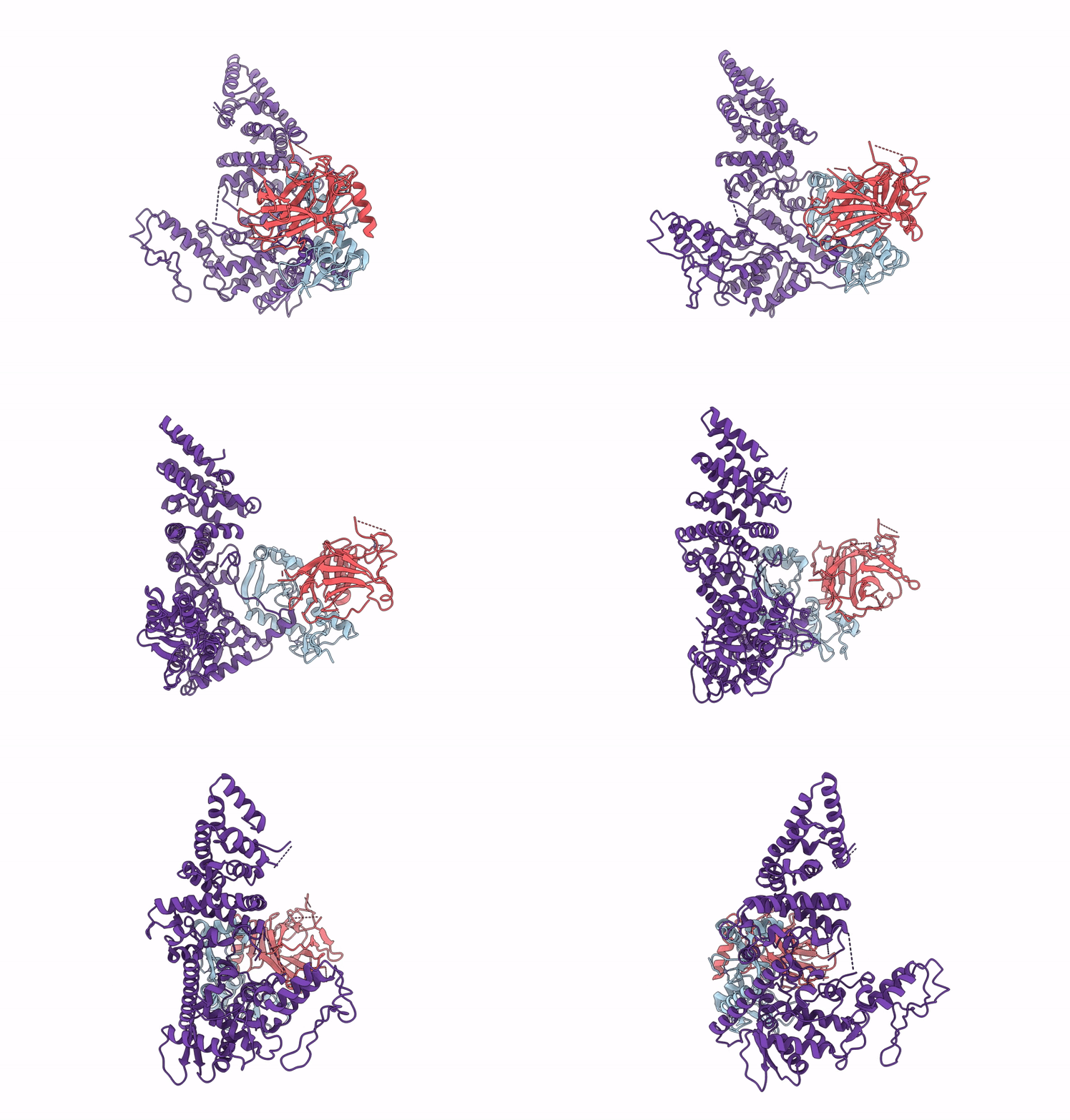
8GCR image
Deposition Date 2023-03-02
Release Date 2024-03-06
Last Version Date 2024-03-06
Entry Detail
PDB ID:
8GCR
Keywords:
Title:
HPV16 E6-E6AP-p53 complex
Biological Source:
Source Organism:
Host Organism:
Method Details:
Experimental Method:
Resolution:
3.38 Å
Aggregation State:
PARTICLE
Reconstruction Method:
SINGLE PARTICLE
Macromolecular Entities
Protein Blast
Polymer Type:polypeptide(L)
Molecule:Maltose/maltodextrin-binding periplasmic protein,Protein E6
Gene (Uniprot):E6
Mutagens:C87S,C104S,C118S,C147S
Chain IDs:A
Chain Length:541
Number of Molecules:1
Biological Source:Escherichia coli O157:H7, Human papillomavirus type 16
Structures with similar UniProt ID
Protein Blast
Polymer Type:polypeptide(L)
Molecule:Cellular tumor antigen p53
Gene (Uniprot):TP53
Chain IDs:B
Chain Length:220
Number of Molecules:1
Biological Source:Homo sapiens
Structures with similar UniProt ID
Protein Blast
Polymer Type:polypeptide(L)
Molecule:Ubiquitin-protein ligase E3A
Gene (Uniprot):UBE3A
Chain IDs:C (auth: R)
Chain Length:903
Number of Molecules:1
Biological Source:Homo sapiens
Ligand Molecules
Primary Citation
Structure of the p53 degradation complex from HPV16.
Nat Commun 15 1842 1842 (2024)
PMID: 38418456 DOI: 10.1038/s41467-024-45920-w

Abstact

Human papillomavirus (HPV) is a significant contributor to the global cancer burden, and its carcinogenic activity is facilitated in part by the HPV early protein 6 (E6), which interacts with the E3-ligase E6AP, also known as UBE3A, to promote degradation of the tumor suppressor, p53. In this study, we present a single-particle cryoEM structure of the full-length E6AP protein in complex with HPV16 E6 (16E6) and p53, determined at a resolution of ~3.3 Å. Our structure reveals extensive protein-protein interactions between 16E6 and E6AP, explaining their picomolar binding affinity. These findings shed light on the molecular basis of the ternary complex, which has been pursued as a potential therapeutic target for HPV-driven cervical, anal, and oropharyngeal cancers over the last two decades. Understanding the structural and mechanistic underpinnings of this complex is crucial for developing effective therapies to combat HPV-induced cancers. Our findings may help to explain why previous attempts to disrupt this complex have failed to generate therapeutic modalities and suggest that current strategies should be reevaluated.

Legend

Protein

Chemical

Disease

Primary Citation of related structures
Feedback Form
Name
Email
Institute
Feedback