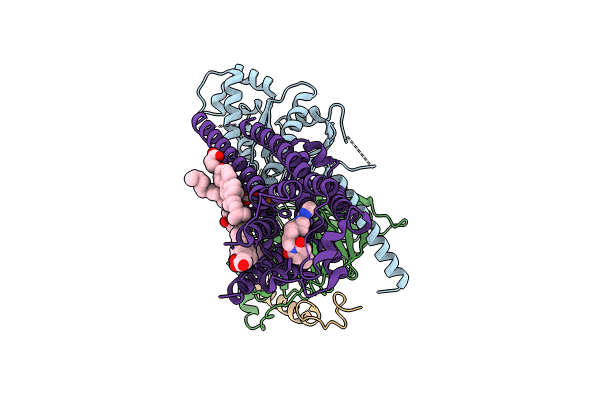
8FYX image
Deposition Date 2023-01-26
Release Date 2024-05-15
Last Version Date 2024-11-06
Entry Detail
PDB ID:
8FYX
Title:
Buspirone-bound serotonin 1A (5-HT1A) receptor-Gi1 protein complex
Biological Source:
Source Organism:
Homo sapiens (Taxon ID: 9606)
Host Organism:
Method Details:
Experimental Method:
Resolution:
2.62 Å
Aggregation State:
PARTICLE
Reconstruction Method:
SINGLE PARTICLE
Macromolecular Entities
Structures with similar UniProt ID
Protein Blast
Polymer Type:polypeptide(L)
Molecule:Guanine nucleotide-binding protein G(i) subunit alpha-1
Gene (Uniprot):GNAI1
Mutagens:4
Chain IDs:A
Chain Length:354
Number of Molecules:1
Biological Source:Homo sapiens
Structures with similar UniProt ID
Protein Blast
Polymer Type:polypeptide(L)
Molecule:Guanine nucleotide-binding protein G(I)/G(S)/G(T) subunit beta-1
Gene (Uniprot):GNB1
Chain IDs:B
Chain Length:358
Number of Molecules:1
Biological Source:Homo sapiens
Structures with similar UniProt ID
Protein Blast
Polymer Type:polypeptide(L)
Molecule:Guanine nucleotide-binding protein G(I)/G(S)/G(O) subunit gamma-2
Gene (Uniprot):GNG2
Chain IDs:C (auth: G)
Chain Length:80
Number of Molecules:1
Biological Source:Homo sapiens
Protein Blast
Polymer Type:polypeptide(L)
Molecule:Soluble cytochrome b562,5-hydroxytryptamine receptor 1A,5-hydroxytryptamine receptor 1A
Gene (Uniprot):HTR1A
Mutagens:3
Chain IDs:D (auth: R)
Chain Length:552
Number of Molecules:1
Biological Source:Homo sapiens
Primary Citation
Structural pharmacology and therapeutic potential of 5-methoxytryptamines.
Nature 630 237 246 (2024)
PMID: 38720072 DOI: 10.1038/s41586-024-07403-2

Abstact

Psychedelic substances such as lysergic acid diethylamide (LSD) and psilocybin show potential for the treatment of various neuropsychiatric disorders1-3. These compounds are thought to mediate their hallucinogenic and therapeutic effects through the serotonin (5-hydroxytryptamine (5-HT)) receptor 5-HT2A (ref. 4). However, 5-HT1A also plays a part in the behavioural effects of tryptamine hallucinogens5, particularly 5-methoxy-N,N-dimethyltryptamine (5-MeO-DMT), a psychedelic found in the toxin of Colorado River toads6. Although 5-HT1A is a validated therapeutic target7,8, little is known about how psychedelics engage 5-HT1A and which effects are mediated by this receptor. Here we map the molecular underpinnings of 5-MeO-DMT pharmacology through five cryogenic electron microscopy (cryo-EM) structures of 5-HT1A, systematic medicinal chemistry, receptor mutagenesis and mouse behaviour. Structure-activity relationship analyses of 5-methoxytryptamines at both 5-HT1A and 5-HT2A enable the characterization of molecular determinants of 5-HT1A signalling potency, efficacy and selectivity. Moreover, we contrast the structural interactions and in vitro pharmacology of 5-MeO-DMT and analogues to the pan-serotonergic agonist LSD and clinically used 5-HT1A agonists. We show that a 5-HT1A-selective 5-MeO-DMT analogue is devoid of hallucinogenic-like effects while retaining anxiolytic-like and antidepressant-like activity in socially defeated animals. Our studies uncover molecular aspects of 5-HT1A-targeted psychedelics and therapeutics, which may facilitate the future development of new medications for neuropsychiatric disorders.

Legend

Protein

Chemical

Disease

Primary Citation of related structures
Feedback Form
Name
Email
Institute
Feedback