8FML image
Deposition Date 2022-12-23
Release Date 2024-01-10
Last Version Date 2024-11-20
Entry Detail
PDB ID:
8FML
Keywords:
Title:
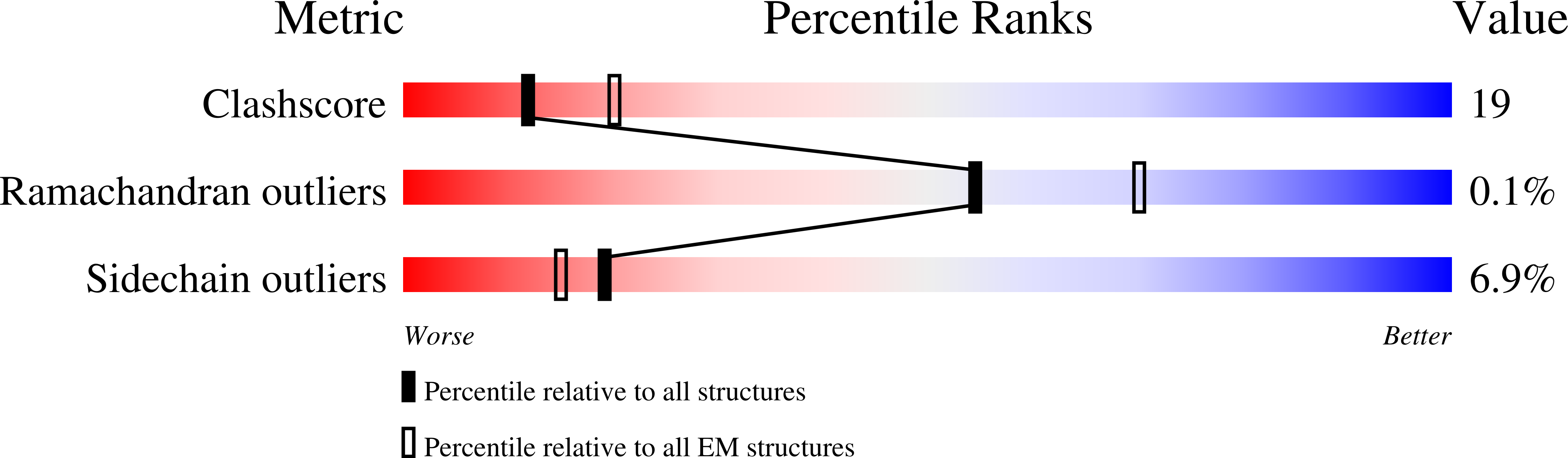
Cryo-EM structure of NLR family apoptosis inhibitory protein 5 (NAIP5) in complex with a full-length flagellin (FliC) ligand
Biological Source:
Method Details:
Experimental Method:
Resolution:
2.93 Å
Aggregation State:
CELL
Reconstruction Method:
SINGLE PARTICLE
Macromolecular Entities
Structures with similar UniProt ID
Protein Blast
Polymer Type:polypeptide(L)
Molecule:Baculoviral IAP repeat-containing protein 1e
Gene (Uniprot):Naip5
Chain IDs:A
Chain Length:1412
Number of Molecules:1
Biological Source:Mus musculus
Structures with similar UniProt ID
Protein Blast
Polymer Type:polypeptide(L)
Molecule:Flagellin
Gene (Uniprot):fliC
Chain IDs:B
Chain Length:502
Number of Molecules:1
Biological Source:Salmonella enterica subsp. enterica serovar Typhimurium str. LT2
Ligand Molecules
Primary Citation
Structural basis for flagellin-induced NAIP5 activation.
Sci Adv 9 eadi8539 eadi8539 (2023)
PMID: 38055825 DOI: 10.1126/sciadv.adi8539

Abstact

The NAIP (NLR family apoptosis inhibitory protein)/NLRC4 (NLR family CARD containing protein 4) inflammasome senses Gram-negative bacterial ligand. In the ligand-bound state, the winged helix domain of NAIP forms a steric clash with NLRC4 to open it up. However, how ligand binding activates NAIP is less clear. Here, we investigated the dynamics of the ligand-binding region of inactive NAIP5 and solved the cryo-EM structure of NAIP5 in complex with its specific ligand, FliC from flagellin, at 2.9-Å resolution. The structure revealed a "trap and lock" mechanism in FliC recognition, whereby FliC-D0C is first trapped by the hydrophobic pocket of NAIP5, then locked in the binding site by ID (insertion domain) and C-terminal tail of NAIP5. The FliC-D0N domain further inserts into ID to stabilize the complex. According to this mechanism, FliC triggers the conformational change of NAIP5 by bringing multiple flexible domains together.

Legend

Protein

Chemical

Disease

Primary Citation of related structures
Feedback Form
Name
Email
Institute
Feedback