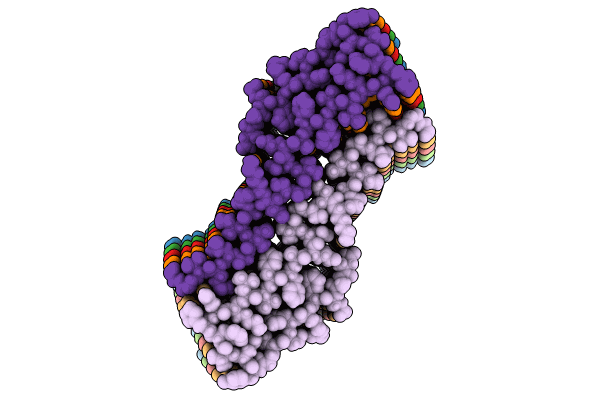
8FF2 image
Deposition Date 2022-12-07
Release Date 2023-12-06
Last Version Date 2024-05-01
Entry Detail
PDB ID:
8FF2
Keywords:
Title:
Amyloid-beta (1-40) fibrils derived from a CAA patient
Biological Source:
Source Organism:
Homo sapiens (Taxon ID: 9606)
Method Details:
Experimental Method:
Resolution:
2.87 Å
Aggregation State:
FILAMENT
Reconstruction Method:
HELICAL
Macromolecular Entities
Structures with similar UniProt ID
Protein Blast
Polymer Type:polypeptide(L)
Molecule:Amyloid-beta precursor protein
Gene (Uniprot):APP
Chain IDs:A, B, C, D, E, F, G, H (auth: I), I (auth: J), J (auth: K)
Chain Length:40
Number of Molecules:10
Biological Source:Homo sapiens
Ligand Molecules
Primary Citation
An electrostatic cluster guides A beta 40 fibril formation in sporadic and Dutch-type cerebral amyloid angiopathy.
J.Struct.Biol. 216 108092 108092 (2024)
PMID: 38615725 DOI: 10.1016/j.jsb.2024.108092

Abstact

Cerebral amyloid angiopathy (CAA) is associated with the accumulation of fibrillar Aβ peptides upon and within the cerebral vasculature, which leads to loss of vascular integrity and contributes to disease progression in Alzheimer's disease (AD). We investigate the structure of human-derived Aβ40 fibrils obtained from patients diagnosed with sporadic or familial Dutch-type (E22Q) CAA. Using cryo-EM, two primary structures are identified containing elements that have not been observed in in vitro Aβ40 fibril structures. One population has an ordered N-terminal fold comprised of two β-strands stabilized by electrostatic interactions involving D1, E22, D23 and K28. This charged cluster is disrupted in the second population, which exhibits a disordered N-terminus and is favored in fibrils derived from the familial Dutch-type CAA patient. These results illustrate differences between human-derived CAA and AD fibrils, and how familial CAA mutations can guide fibril formation.

Legend

Protein

Chemical

Disease

Primary Citation of related structures
Feedback Form
Name
Email
Institute
Feedback