8FAY image
Deposition Date 2022-11-29
Release Date 2024-05-29
Last Version Date 2025-06-11
Entry Detail
PDB ID:
8FAY
Keywords:
Title:
Human MUTYH adenine glycosylase bound to DNA containing a transition state analog (1N) paired with d(8-oxo-G)
Biological Source:
Source Organism:
Host Organism:
Method Details:
Experimental Method:
Resolution:
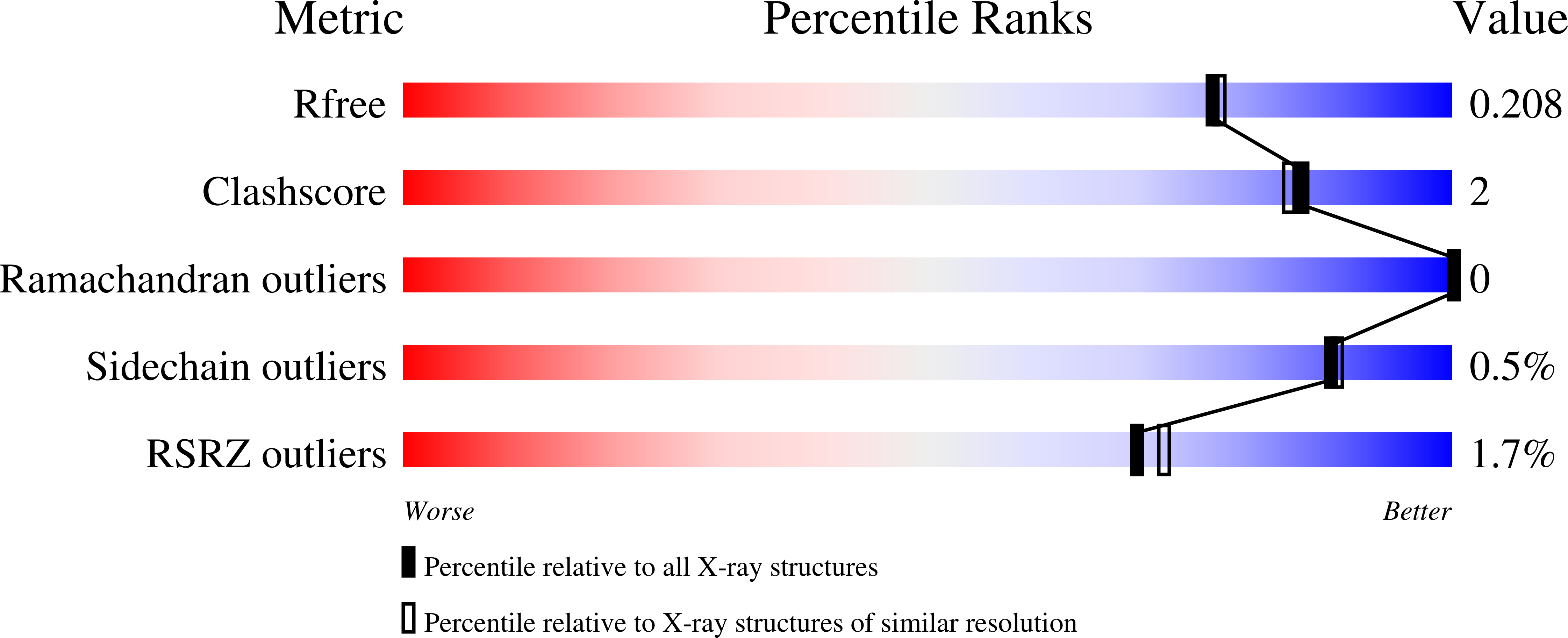
1.91 Å
R-Value Free:
0.20
R-Value Work:
0.18
R-Value Observed:
0.18
Space Group:
P 21 21 21
Macromolecular Entities
Structures with similar UniProt ID
Protein Blast
Polymer Type:polypeptide(L)
Molecule:Adenine DNA glycosylase
Gene (Uniprot):MUTYH
Chain IDs:A, D
Chain Length:459
Number of Molecules:2
Biological Source:Homo sapiens
Polymer Type:polydeoxyribonucleotide
Molecule:DNA (5'-D(*AP*AP*GP*AP*CP*(8OG)P*TP*GP*GP*AP*C)-3')
Chain IDs:B, E
Chain Length:11
Number of Molecules:2
Biological Source:synthetic construct
Polymer Type:polydeoxyribonucleotide
Molecule:DNA (5'-D(P*GP*TP*CP*CP*AP*(NR1)P*GP*TP*CP*T)-3')
Chain IDs:C, F
Chain Length:11
Number of Molecules:2
Biological Source:synthetic construct
Primary Citation
Structure of human MUTYH and functional profiling of cancer-associated variants reveal an allosteric network between its [4Fe-4S] cluster cofactor and active site required for DNA repair.
Nat Commun 16 3596 3596 (2025)
PMID: 40234396 DOI: 10.1038/s41467-025-58361-w

Abstact

MUTYH is a clinically important DNA glycosylase that thwarts mutations by initiating base-excision repair at 8-oxoguanine (OG):A lesions. The roles for its [4Fe-4S] cofactor in DNA repair remain enigmatic. Functional profiling of cancer-associated variants near the [4Fe-4S] cofactor reveals that most variations abrogate both retention of the cofactor and enzyme activity. Surprisingly, R241Q and N238S retained the metal cluster and bound substrate DNA tightly, but were completely inactive. We determine the crystal structure of human MUTYH bound to a transition state mimic and this shows that Arg241 and Asn238 build an H-bond network connecting the [4Fe-4S] cluster to the catalytic Asp236 that mediates base excision. The structure of the bacterial MutY variant R149Q, along with molecular dynamics simulations of the human enzyme, support a model in which the cofactor functions to position and activate the catalytic Asp. These results suggest that allosteric cross-talk between the DNA binding [4Fe-4S] cofactor and the base excision site of MUTYH regulate its DNA repair function.

Legend

Protein

Chemical

Disease

Primary Citation of related structures
Feedback Form
Name
Email
Institute
Feedback