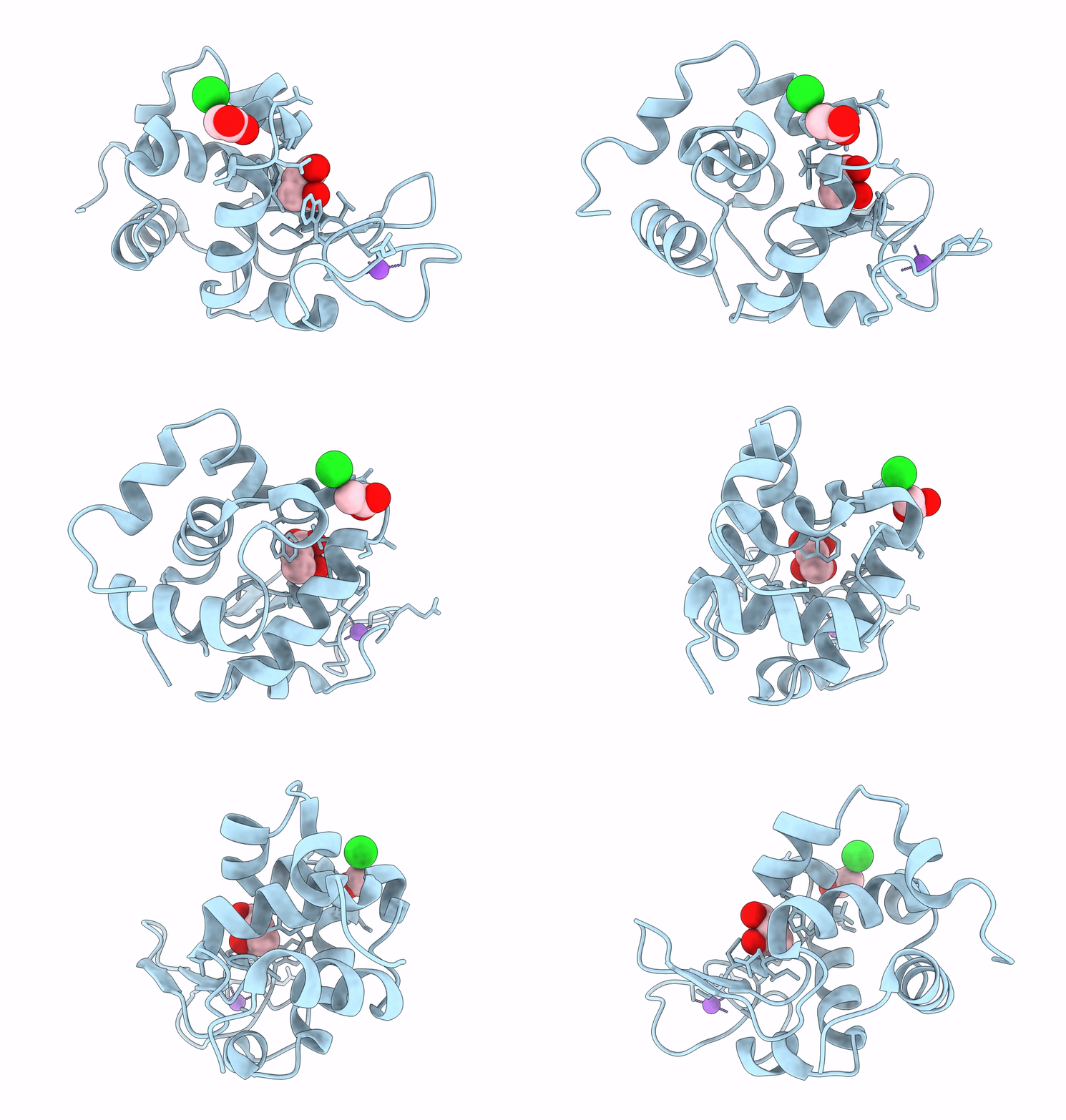
8F28 image
Deposition Date 2022-11-07
Release Date 2023-07-05
Last Version Date 2024-11-20
Entry Detail
PDB ID:
8F28
Keywords:
Title:
Lysozyme Structures from Single-Entity Crystallization Method NanoAC
Biological Source:
Source Organism:
Gallus gallus (Taxon ID: 9031)
Method Details:
Experimental Method:
Resolution:
1.20 Å
R-Value Free:
0.17
R-Value Work:
0.14
R-Value Observed:
0.14
Space Group:
P 43 21 2

Macromolecular Entities
Structures with similar UniProt ID
Protein Blast
Polymer Type:polypeptide(L)
Molecule:Lysozyme C
Gene (Uniprot):LYZ
Chain IDs:A
Chain Length:129
Number of Molecules:1
Biological Source:Gallus gallus
Primary Citation
A Single-Entity Method for Actively Controlled Nucleation and High-Quality Protein Crystal Synthesis.
Anal.Chem. 95 9462 9470 (2023)
PMID: 37243709 DOI: 10.1021/acs.analchem.3c00175

Abstact

Lack of controls and understanding in nucleation, which proceeds crystal growth and other phase transitions, has been a bottleneck challenge in chemistry, materials, biology, and other fields. The exemplary needs for better methods for biomacromolecule crystallization include (1) synthesizing crystals for high-resolution structure determinations in fundamental research and (2) tuning the crystal habit and thus the corresponding properties in materials and pharmaceutical applications. Herein, a deterministic method is established capable of sustaining the nucleation and growth of a single crystal using the protein lysozyme as a prototype. The supersaturation is localized at the interface between a sample and a precipitant solution, spatially confined by the tip of a single nanopipette. The exchange of matter between the two solutions determines the supersaturation, which is controlled by electrokinetic ion transport driven by an external potential waveform. Nucleation and subsequent crystal growth disrupt the ionic current limited by the nanotip and are detected. The nucleation and growth of individual single crystals are measured in real time. Electroanalytical and optical signatures are elucidated as feedbacks with which active controls in crystal quality and method consistency are achieved: five out of five crystals diffract at a true atomic resolution of up to 1.2 Å. As controls, those synthesized under less optimized conditions diffract poorly. The crystal habits during the growth process are tuned successfully by adjusting the flux. The universal mechanism of nano-transport kinetics, together with the correlations of the diffraction quality and crystal habit with the crystallization control parameters, lay the foundation for the generalization to other materials systems.

Legend

Protein

Chemical

Disease

Primary Citation of related structures
Feedback Form
Name
Email
Institute
Feedback