8EYJ image
Deposition Date 2022-10-27
Release Date 2022-11-16
Last Version Date 2024-10-16
Entry Detail
PDB ID:
8EYJ
Keywords:
Title:
Crystal Structure of uncleaved SARS-CoV-2 Main Protease C145S mutant in complex with Nirmatrelvir
Biological Source:
Host Organism:
Method Details:
Experimental Method:
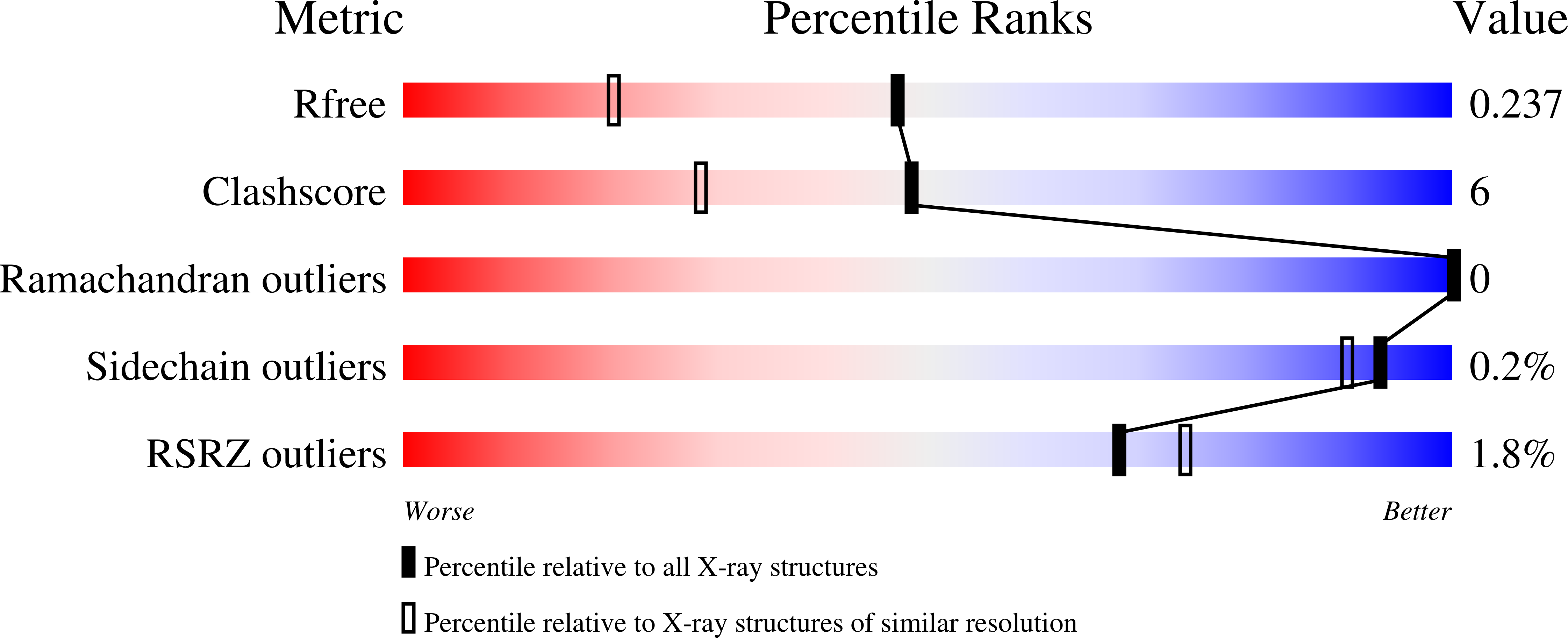
Resolution:
1.74 Å
R-Value Free:
0.23
R-Value Work:
0.19
Space Group:
P 21 21 21
Macromolecular Entities
Structures with similar UniProt ID
Protein Blast
Polymer Type:polypeptide(L)
Molecule:3C-like proteinase nsp5
Gene (Uniprot):rep
Chain IDs:A, B
Chain Length:307
Number of Molecules:2
Biological Source:Severe acute respiratory syndrome coronavirus 2
Ligand Molecules
Primary Citation
An in-solution snapshot of SARS-COV-2 main protease maturation process and inhibition.
Nat Commun 14 1545 1545 (2023)
PMID: 36941262 DOI: 10.1038/s41467-023-37035-5

Abstact

The main protease from SARS-CoV-2 (Mpro) is responsible for cleavage of the viral polyprotein. Mpro self-processing is called maturation, and it is crucial for enzyme dimerization and activity. Here we use C145S Mpro to study the structure and dynamics of N-terminal cleavage in solution. Native mass spectroscopy analysis shows that mixed oligomeric states are composed of cleaved and uncleaved particles, indicating that N-terminal processing is not critical for dimerization. A 3.5 Å cryo-EM structure provides details of Mpro N-terminal cleavage outside the constrains of crystal environment. We show that different classes of inhibitors shift the balance between oligomeric states. While non-covalent inhibitor MAT-POS-e194df51-1 prevents dimerization, the covalent inhibitor nirmatrelvir induces the conversion of monomers into dimers, even with intact N-termini. Our data indicates that the Mpro dimerization is triggered by induced fit due to covalent linkage during substrate processing rather than the N-terminal processing.

Legend

Protein

Chemical

Disease

Primary Citation of related structures
Feedback Form
Name
Email
Institute
Feedback