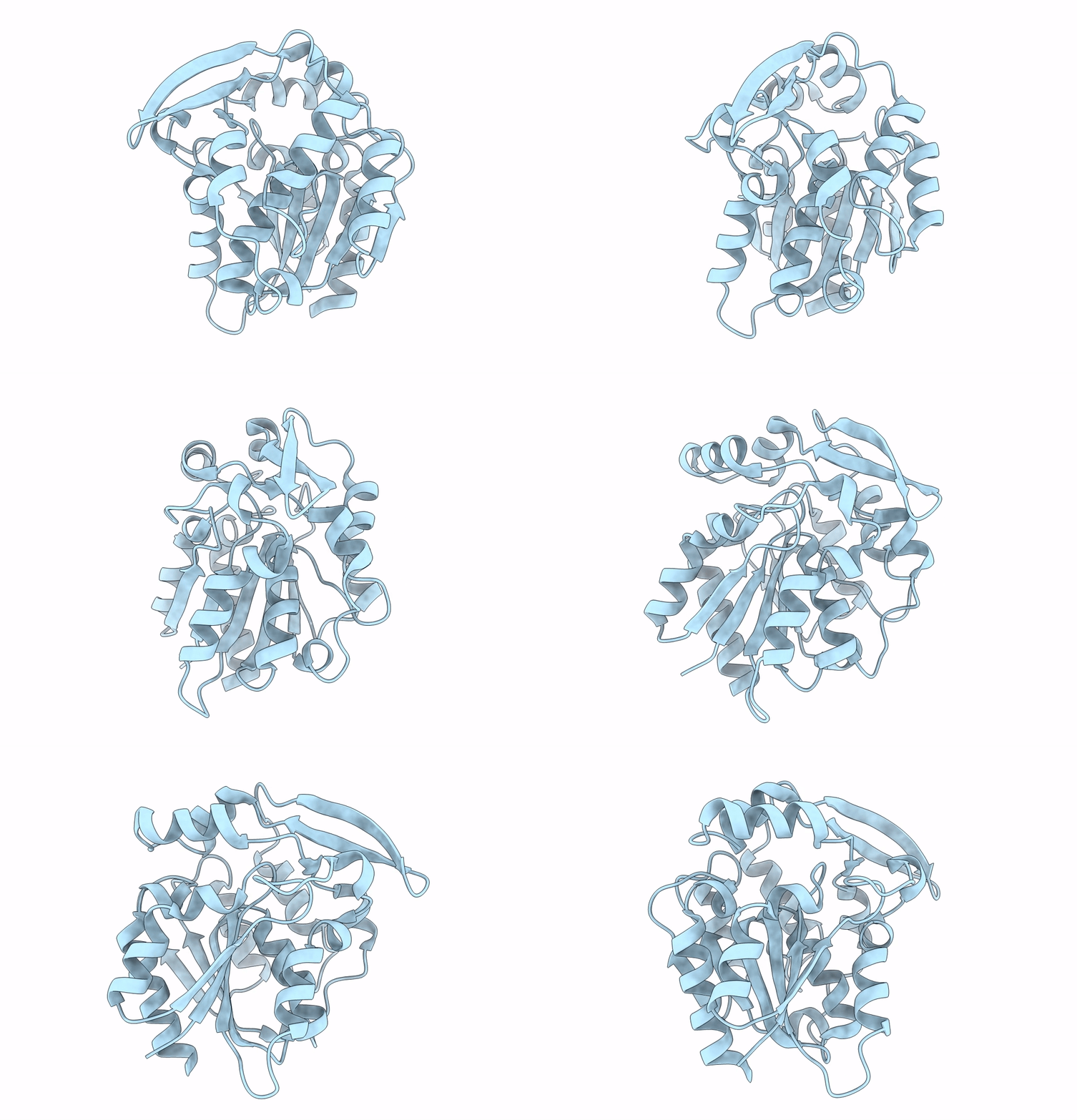
8EUO image
Deposition Date 2022-10-19
Release Date 2022-11-30
Last Version Date 2025-09-17
Entry Detail
PDB ID:
8EUO
Keywords:
Title:
Hydroxynitrile Lyase from Hevea brasiliensis with Seven Mutations
Biological Source:
Source Organism:
Host Organism:
Method Details:
Experimental Method:
Resolution:
1.99 Å
R-Value Free:
0.23
R-Value Work:
0.18
R-Value Observed:
0.18
Space Group:
C 2 2 21
Macromolecular Entities
Structures with similar UniProt ID
Protein Blast
Polymer Type:polypeptide(L)
Molecule:(S)-hydroxynitrile lyase
Gene (Uniprot):HNL
Mutagens:T11G, E79H, C81L, H103V, N104A, G176S, K236M
Chain IDs:A
Chain Length:265
Number of Molecules:1
Biological Source:Hevea brasiliensis
Primary Citation

Abstact

The α/β-hydrolase fold superfamily includes esterases and hydroxynitrile lyases which, despite catalyzing different reactions, share a Ser-His-Asp catalytic triad. We report a 1.99 Å resolution crystal structure of HNL6V, an engineered variant of hydroxynitrile lyase from Hevea brasiliensis (HbHNL) containing seven amino-acid substitutions (T11G, E79H, C81L, H103V, N104A, G176S and K236M). The structure reveals that HNL6V maintains the characteristic α/β-hydrolase fold while exhibiting systematic shifts in backbone and catalytic atom positions. Compared with wild-type HbHNL, the Cα positions in HNL6V differ by a mean of 0.2 ± 0.1 Å, representing a statistically significant displacement. Importantly, the catalytic triad and oxyanion-hole atoms have moved 0.2-0.8 Å closer to their corresponding positions in SABP2, although they remain 0.3-1.1 Å from fully achieving the configuration of SABP2. The substitutions also increase local flexibility, particularly in the lid domain covering the active site. This structural characterization demonstrates that targeted amino-acid substitutions can systematically shift catalytic geometries towards those of evolutionarily related enzymes.

Legend

Protein

Chemical

Disease

Primary Citation of related structures
Feedback Form
Name
Email
Institute
Feedback