8EFX image
Deposition Date 2022-09-09
Release Date 2023-09-20
Last Version Date 2024-05-01
Entry Detail
PDB ID:
8EFX
Title:
Structure of OtDUB DUB Domain disulfide crosslinked with Ubiquitin
Biological Source:
Source Organism(s):
Expression System(s):
Method Details:
Experimental Method:
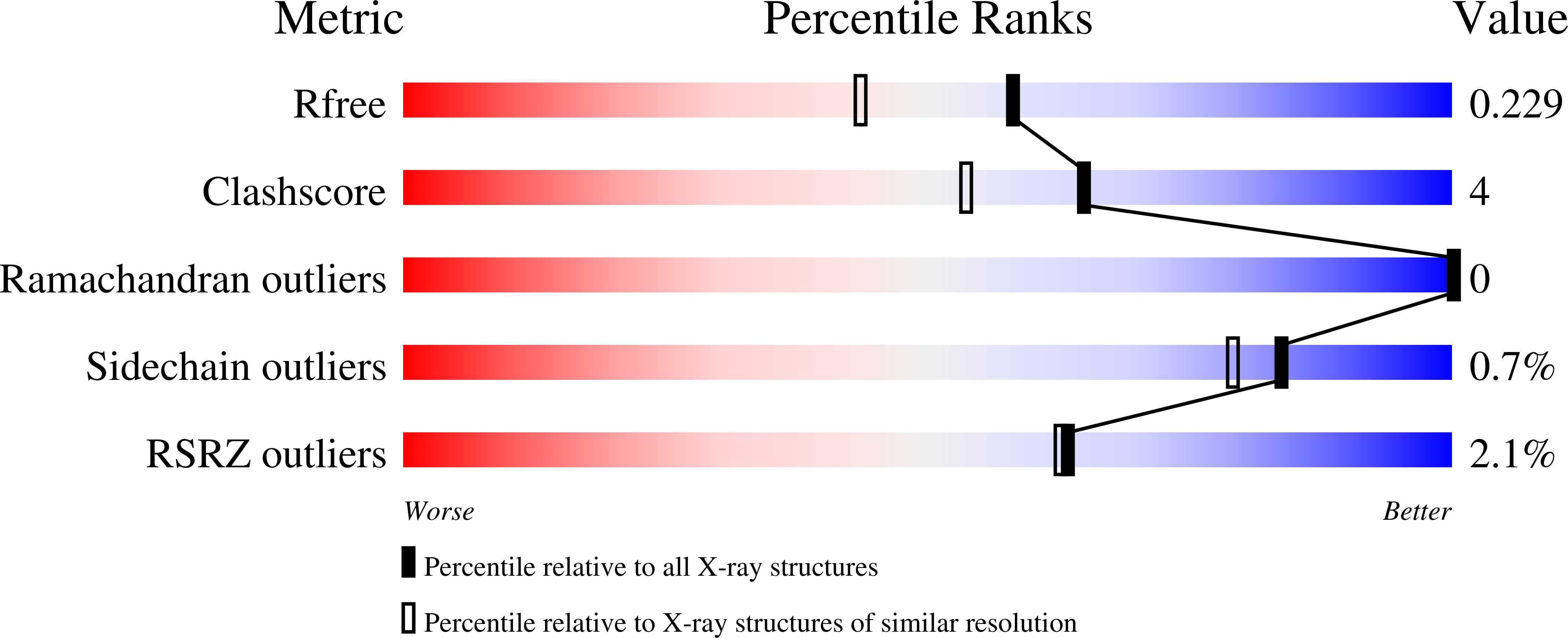
Resolution:
1.85 Å
R-Value Free:
0.22
R-Value Work:
0.19
R-Value Observed:
0.19
Space Group:
P 2 21 21
Macromolecular Entities
Structures with similar UniProt ID
Protein Blast
Polymer Type:polypeptide(L)
Molecule:OtDUB
Chain IDs:A
Chain Length:259
Number of Molecules:1
Biological Source:Orientia tsutsugamushi
Structures with similar UniProt ID
Protein Blast
Polymer Type:polypeptide(L)
Molecule:Ubiquitin
Gene (Uniprot):UBB
Mutagens:G76C
Chain IDs:B
Chain Length:76
Number of Molecules:1
Biological Source:Homo sapiens
Primary Citation
Cocrystallization of ubiquitin-deubiquitinase complexes through disulfide linkage.
Acta Crystallogr D Struct Biol 79 1044 1055 (2023)
PMID: 37877948 DOI: 10.1107/S2059798323008501

Abstact

Structural characterization of the recognition of ubiquitin (Ub) by deubiquitinases (DUBs) has largely relied on covalent complexation of the DUB through its catalytic cysteine with a Ub C-terminal electrophile. The Ub electrophiles are accessed through intein chemistry in conjunction with chemical synthesis. Here, it was asked whether DUB-Ub covalent complexes could instead be accessed by simpler disulfide chemistry using a Ub cysteine mutant in which the last glycine has been replaced with a cysteine. The Ub cysteine mutant displayed a wide variability in disulfide formation across a panel of eukaryotic and prokaryotic DUBs, with some showing no detectable reaction while others robustly produced a disulfide complex. Using this approach, two disulfide-linked ubiquitin-bound complexes were crystallized, one involving the Legionella pneumophila effector SdeA DUB and the other involving the Orientia effector OtDUB. These DUBs had previously been crystallized in Ub-bound forms using the C-terminal electrophile strategy and noncovalent complexation, respectively. While the disulfide-linked SdeA DUB-Ub complex crystallized as expected, in the OtDUB complex the disulfide bond to the Ub mutant involved a cysteine that differed from the catalytic cysteine. Disulfide formation with the SdeA DUB catalytic cysteine was accompanied by local distortion of the helix carrying the active-site cysteine, whereas OtDUB reacted with the Ub mutant using a surface-exposed cysteine.

Legend

Protein

Chemical

Disease

Primary Citation of related structures
Feedback Form
Name
Email
Institute
Feedback