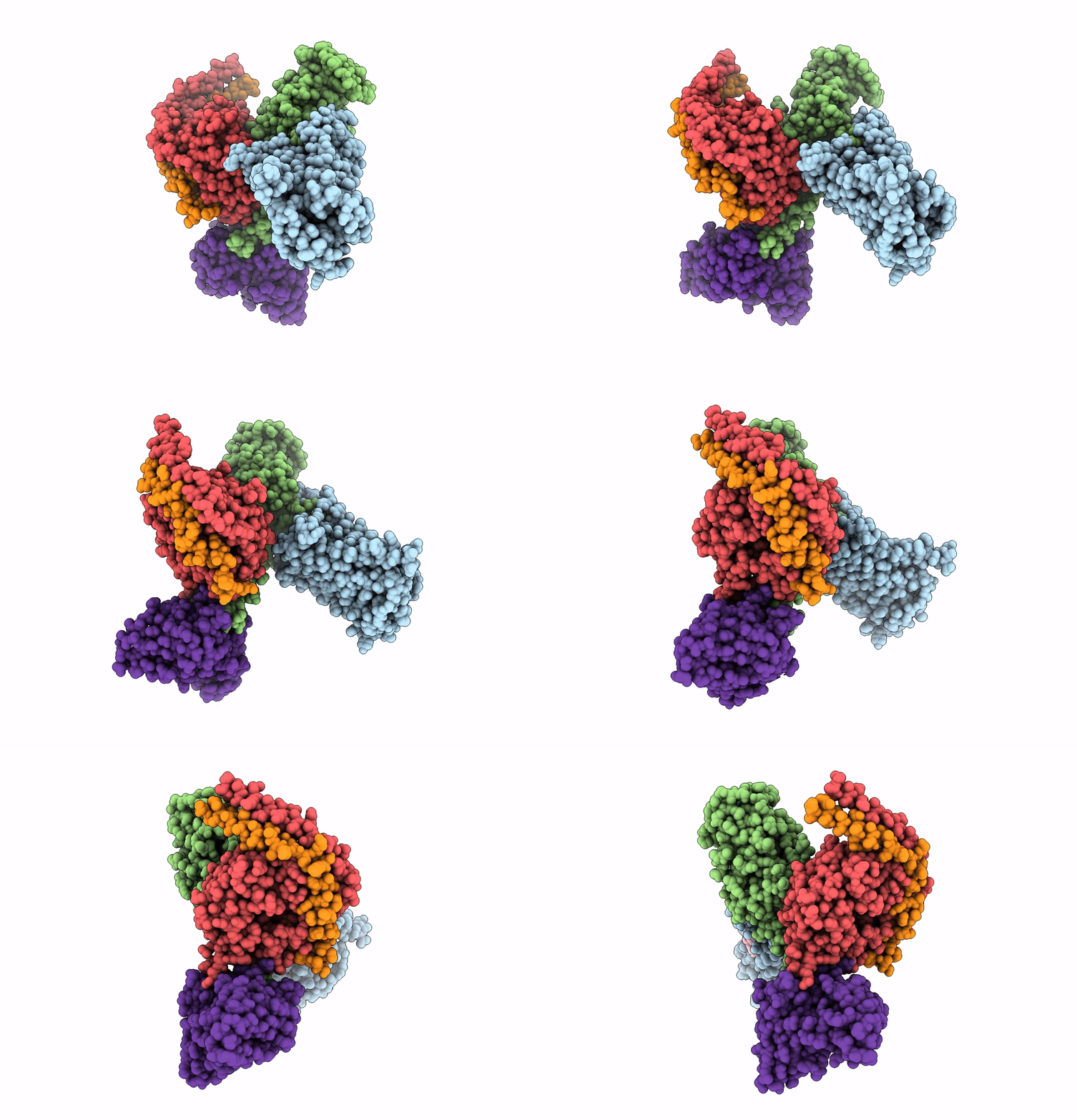
8E9Z image
Deposition Date 2022-08-27
Release Date 2022-11-30
Last Version Date 2025-05-28
Entry Detail
PDB ID:
8E9Z
Title:
CryoEM structure of miniGq-coupled hM3R in complex with Iperoxo
Biological Source:
Source Organism:
Homo sapiens (Taxon ID: 9606)
Mus musculus (Taxon ID: 10090)
Host Organism:
Method Details:
Experimental Method:
Resolution:
2.69 Å
Aggregation State:
PARTICLE
Reconstruction Method:
SINGLE PARTICLE

Macromolecular Entities
Structures with similar UniProt ID
Protein Blast
Polymer Type:polypeptide(L)
Molecule:Muscarinic acetylcholine receptor M3
Gene (Uniprot):CHRM3
Chain IDs:A
Chain Length:568
Number of Molecules:1
Biological Source:Homo sapiens
Polymer Type:polypeptide(L)
Molecule:miniGq
Chain IDs:B
Chain Length:246
Number of Molecules:1
Biological Source:Homo sapiens
Structures with similar UniProt ID
Protein Blast
Polymer Type:polypeptide(L)
Molecule:Guanine nucleotide-binding protein G(I)/G(S)/G(T) subunit beta-1
Gene (Uniprot):GNB1
Chain IDs:C
Chain Length:368
Number of Molecules:1
Biological Source:Homo sapiens
Structures with similar UniProt ID
Protein Blast
Polymer Type:polypeptide(L)
Molecule:Guanine nucleotide-binding protein G(I)/G(S)/G(O) subunit gamma-2
Gene (Uniprot):GNG2
Chain IDs:D
Chain Length:71
Number of Molecules:1
Biological Source:Homo sapiens
Polymer Type:polypeptide(L)
Molecule:scFv16
Chain IDs:E
Chain Length:251
Number of Molecules:1
Biological Source:Mus musculus
Primary Citation
Molecular basis for selective activation of DREADD-based chemogenetics.
Nature 612 354 362 (2022)
PMID: 36450989 DOI: 10.1038/s41586-022-05489-0

Abstact

Designer receptors exclusively activated by designer drugs (DREADDs) represent a powerful chemogenetic technology for the remote control of neuronal activity and cellular signalling1-4. The muscarinic receptor-based DREADDs are the most widely used chemogenetic tools in neuroscience research. The Gq-coupled DREADD (hM3Dq) is used to enhance neuronal activity, whereas the Gi/o-coupled DREADD (hM4Di) is utilized to inhibit neuronal activity5. Here we report four DREADD-related cryogenic electron microscopy high-resolution structures: a hM3Dq-miniGq complex and a hM4Di-miniGo complex bound to deschloroclozapine; a hM3Dq-miniGq complex bound to clozapine-N-oxide; and a hM3R-miniGq complex bound to iperoxo. Complemented with mutagenesis, functional and computational simulation data, our structures reveal key details of the recognition of DREADD chemogenetic actuators and the molecular basis for activation. These findings should accelerate the structure-guided discovery of next-generation chemogenetic tools.

Legend

Protein

Chemical

Disease

Primary Citation of related structures
Feedback Form
Name
Email
Institute
Feedback