8E0G image
Deposition Date 2022-08-09
Release Date 2023-10-18
Last Version Date 2024-10-30
Entry Detail
PDB ID:
8E0G
Title:
Re-refined model of active mu-opioid receptor (PDB 5c1m) as an adduct with BU72
Biological Source:
Source Organism:
Mus musculus (Taxon ID: 10090)
Lama glama (Taxon ID: 9844)
Host Organism:
Method Details:
Experimental Method:
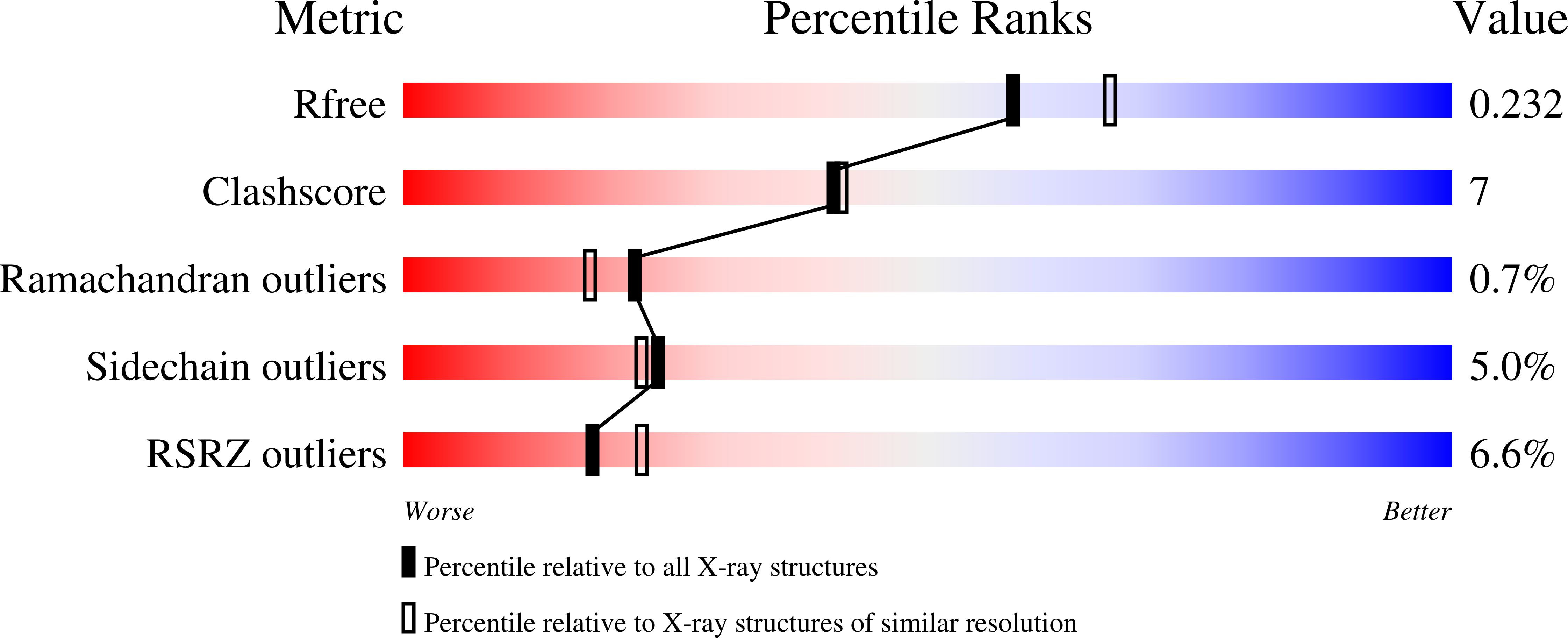
Resolution:
2.10 Å
R-Value Free:
0.22
R-Value Work:
0.19
R-Value Observed:
0.19
Space Group:
I 21 21 21
Macromolecular Entities
Structures with similar UniProt ID
Protein Blast
Polymer Type:polypeptide(L)
Molecule:Mu-type opioid receptor
Gene (Uniprot):Oprm1
Chain IDs:A
Chain Length:296
Number of Molecules:1
Biological Source:Mus musculus
Polymer Type:polypeptide(L)
Molecule:Nanobody 39
Chain IDs:B
Chain Length:125
Number of Molecules:1
Biological Source:Lama glama
Modified Residue
Compound ID Chain ID Parent Comp ID Details 2D Image
YCM A CYS modified residue
Primary Citation
Reanalysis of a mu opioid receptor crystal structure reveals a covalent adduct with BU72.
Bmc Biol. 21 213 213 (2023)
PMID: 37817141 DOI: 10.1186/s12915-023-01689-w

Abstact

BACKGROUND The first crystal structure of the active μ opioid receptor (μOR) exhibited several unexplained features. The ligand BU72 exhibited many extreme deviations from ideal geometry, along with unexplained electron density. I previously showed that inverting the benzylic configuration resolved these problems, establishing revised stereochemistry of BU72 and its analog BU74. However, another problem remains unresolved: additional unexplained electron density contacts both BU72 and a histidine residue in the N-terminus, revealing the presence of an as-yet unidentified atom. RESULTS These short contacts and uninterrupted density are inconsistent with non-covalent interactions. Therefore, BU72 and μOR form a covalent adduct, rather than representing two separate entities as in the original model. A subsequently proposed magnesium complex is inconsistent with multiple lines of evidence. However, oxygen fits the unexplained density well. While the structure I propose is tentative, similar adducts have been reported previously in the presence of reactive oxygen species. Moreover, known sources of reactive oxygen species were present: HEPES buffer, nickel ions, and a sequence motif that forms redox-active nickel complexes. This motif contacts the unexplained density. The adduct exhibits severe strain, and the tethered N-terminus forms contacts with adjacent residues. These forces, along with the nanobody used as a G protein substitute, would be expected to influence the receptor conformation. Consistent with this, the intracellular end of the structure differs markedly from subsequent structures of active μOR bound to Gi protein. CONCLUSIONS Later Gi-bound structures are likely to be more accurate templates for ligand docking and modelling of active G protein-bound μOR. The possibility of reactions like this should be considered in the choice of protein truncation sites and purification conditions, and in the interpretation of excess or unexplained density.

Legend

Protein

Chemical

Disease

Primary Citation of related structures
Feedback Form
Name
Email
Institute
Feedback