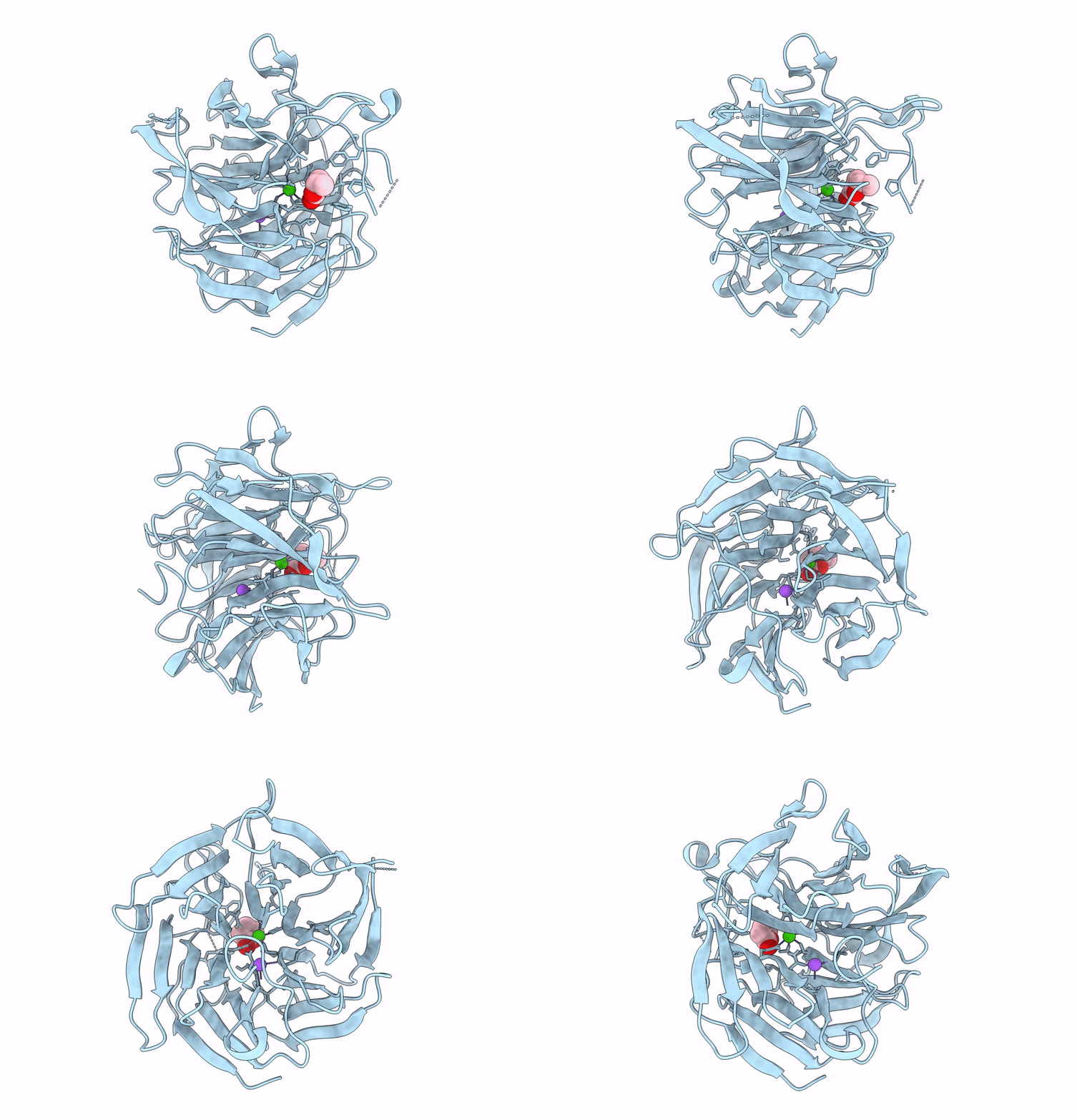
8DK0 image
Deposition Date 2022-07-01
Release Date 2023-01-11
Last Version Date 2023-10-25
Entry Detail
PDB ID:
8DK0
Keywords:
Title:
Crystal structure of RPA3624, a beta-propeller lactonase from Rhodopseudomonas palustris, with active-site bound (S)gamma-valerolactone
Biological Source:
Source Organism:
Host Organism:
Method Details:
Experimental Method:
Resolution:
1.55 Å
R-Value Free:
0.21
R-Value Work:
0.17
R-Value Observed:
0.17
Space Group:
P 32 2 1
Macromolecular Entities
Structures with similar UniProt ID
Protein Blast
Polymer Type:polypeptide(L)
Molecule:Gluconolactonase
Gene (Uniprot):TX73_018780
Chain IDs:A
Chain Length:312
Number of Molecules:1
Biological Source:Rhodopseudomonas palustris CGA009
Primary Citation
A broad specificity beta-propeller enzyme from Rhodopseudomonas palustris that hydrolyzes many lactones including gamma-valerolactone.
J.Biol.Chem. 299 102782 102782 (2022)
PMID: 36502920 DOI: 10.1016/j.jbc.2022.102782

Abstact

Lactones are prevalent in biological and industrial settings, yet there is a lack of information regarding enzymes used to metabolize these compounds. One compound, γ-valerolactone (GVL), is used as a solvent to dissolve plant cell walls into sugars and aromatic molecules for subsequent microbial conversion to fuels and chemicals. Despite the promise of GVL as a renewable solvent for biomass deconstruction, residual GVL can be toxic to microbial fermentation. Here, we identified a Ca2+-dependent enzyme from Rhodopseudomonas palustris (Rpa3624) and showed that it can hydrolyze aliphatic and aromatic lactones and esters, including GVL. Maximum-likelihood phylogenetic analysis of other related lactonases with experimentally determined substrate preferences shows that Rpa3624 separates by sequence motifs into a subclade with preference for hydrophobic substrates. Additionally, we solved crystal structures of this β-propeller enzyme separately with either phosphate, an inhibitor, or a mixture of GVL and products to define an active site where calcium-bound water and calcium-bound aspartic and glutamic acid residues make close contact with substrate and product. Our kinetic characterization of WT and mutant enzymes combined with structural insights inform a reaction mechanism that centers around activation of a calcium-bound water molecule promoted by general base catalysis and close contacts with substrate and a potential intermediate. Similarity of Rpa3624 with other β-propeller lactonases suggests this mechanism may be relevant for other members of this emerging class of versatile catalysts.

Legend

Protein

Chemical

Disease

Primary Citation of related structures
Feedback Form
Name
Email
Institute
Feedback