8DH5 image
Deposition Date 2022-06-24
Release Date 2023-02-01
Last Version Date 2023-10-25
Entry Detail
PDB ID:
8DH5
Title:
T7 RNA polymerase elongation complex with unnatural base dPa-ATP mismatch
Biological Source:
Source Organism:
Method Details:
Experimental Method:
Resolution:
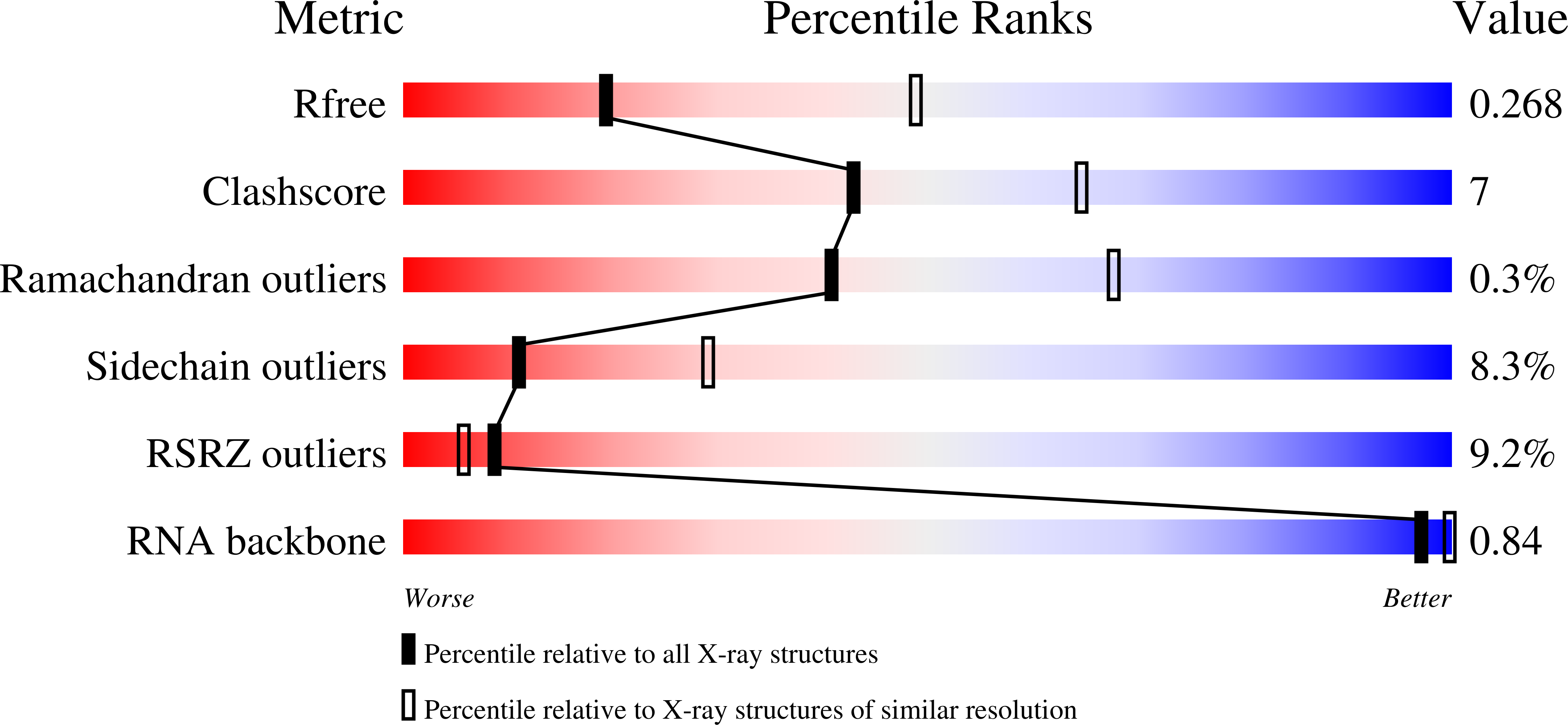
2.85 Å
R-Value Free:
0.26
R-Value Work:
0.23
R-Value Observed:
0.23
Space Group:
P 1
Macromolecular Entities
Polymer Type:polydeoxyribonucleotide
Molecule:Template strand DNA
Chain IDs:B (auth: A), F, J, N
Chain Length:18
Number of Molecules:4
Biological Source:synthetic construct
Structures with similar UniProt ID
Protein Blast
Polymer Type:polypeptide(L)
Molecule:T7 RNA polymerase
Gene (Uniprot):1
Chain IDs:A (auth: B), E, I, M
Chain Length:883
Number of Molecules:4
Biological Source:Escherichia phage T7
Polymer Type:polyribonucleotide
Molecule:RNA
Chain IDs:C, G, K, O
Chain Length:12
Number of Molecules:4
Biological Source:synthetic construct
Polymer Type:polydeoxyribonucleotide
Molecule:Non-template strand DNA
Chain IDs:D, H, L, P
Chain Length:9
Number of Molecules:4
Biological Source:synthetic construct
Primary Citation
Structural basis of transcription recognition of a hydrophobic unnatural base pair by T7 RNA polymerase.
Nat Commun 14 195 195 (2023)
PMID: 36635281 DOI: 10.1038/s41467-022-35755-8

Abstact

Bacteriophage T7 RNA polymerase (T7 RNAP) is widely used for synthesizing RNA molecules with synthetic modifications and unnatural base pairs (UBPs) for a variety of biotechnical and therapeutic applications. However, the molecular basis of transcription recognition of UBPs by T7 RNAP remains poorly understood. Here we focused on a representative UBP, 7-(2-thienyl)-imidazo[4,5-b]pyridine (Ds) and pyrrole 2-carbaldehyde (Pa), and investigated how the hydrophobic Ds-Pa pair is recognized by T7 RNAP. Our kinetic assays revealed that T7 RNAP selectively recognizes the Ds or Pa base in the templates and preferentially incorporates their cognate unnatural base nucleotide substrate (PaTP or DsTP) over natural NTPs. Our structural studies reveal that T7 RNAP recognizes the unnatural substrates at the pre-insertion state in a distinct manner compared to natural substrates. These results provide mechanistic insights into transcription recognition of UBP by T7 RNAP and provide valuable information for designing the next generation of UBPs.

Legend

Protein

Chemical

Disease

Primary Citation of related structures
Feedback Form
Name
Email
Institute
Feedback