8D88 image
Deposition Date 2022-06-08
Release Date 2022-11-16
Last Version Date 2024-10-09
Entry Detail
PDB ID:
8D88
Keywords:
Title:
Structure of Y430F D-ornithine/D-lysine decarboxylase complex with D-lysine
Biological Source:
Expression System(s):
Method Details:
Experimental Method:
Resolution:
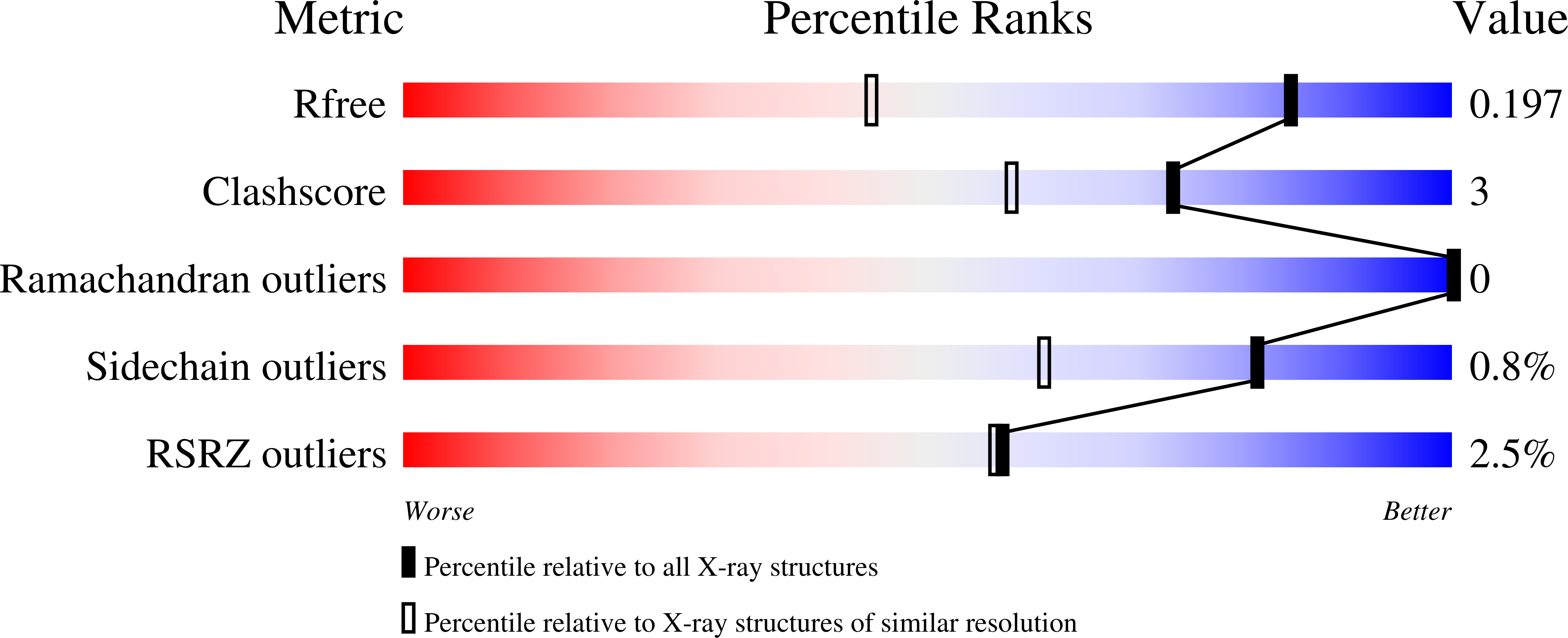
1.41 Å
R-Value Free:
0.19
R-Value Work:
0.17
R-Value Observed:
0.17
Space Group:
C 1 2 1
Macromolecular Entities
Structures with similar UniProt ID
Protein Blast
Polymer Type:polypeptide(L)
Molecule:D-ornithine/D-lysine decarboxylase
Gene (Uniprot):dokD
Mutagens:Y430F
Chain IDs:A, B
Chain Length:478
Number of Molecules:2
Biological Source:Salmonella enterica subsp. enterica serovar Typhimurium
Primary Citation
The Y430F mutant of Salmonella d-ornithine/d-lysine decarboxylase has altered stereospecificity and a putrescine allosteric activation site.
Arch.Biochem.Biophys. 731 109429 109429 (2022)
PMID: 36265649 DOI: 10.1016/j.abb.2022.109429

Abstact

Tyrosine-430 of d-ornithine/d-lysine decarboxylase (DOKDC) is located in the active site, and was suggested to be responsible for the D-stereospecificity of the enzyme. We have prepared the Y430F mutant form of Salmonella enterica serovar typhimurium DOKDC and evaluated its catalytic activity with D- and l-lysine and ornithine. The kinetic results show that the Y430F mutant has measurable decarboxylase activity with both D- and l-lysine and ornithine, which wild type DOKDC does not. Spectroscopic experiments show that these amino acids bind to form external aldimine complexes with the pyridoxal-5'-phosphate with λmax = 425 nm. In addition, we have obtained crystal structures of Y430F DOKDC bound to HEPES, putrescine, d-ornithine, d-lysine, and d-arginine. The d-amino acids bind in the crystals to form equilibrium mixtures of gem-diamine and external aldimine complexes. Furthermore, the crystal structures reveal an unexpected allosteric product activator site for putrescine located on the 2-fold axis between the two active sites. Putrescine binds by donating hydrogen bonds from the ammonium groups to Asp-361 and Gln-358 in the specificity helix of both chains. Addition of 0.1-1 mM putrescine eliminates the lag in steady state kinetics and abolishes the sigmoid kinetics. The catalytic loop was modeled with AlphaFold2, and the model shows that Glu-181 can form additional hydrogen bonds with the bound putrescine, likely stabilizing the catalytic closed conformation.

Legend

Protein

Chemical

Disease

Primary Citation of related structures
Feedback Form
Name
Email
Institute
Feedback