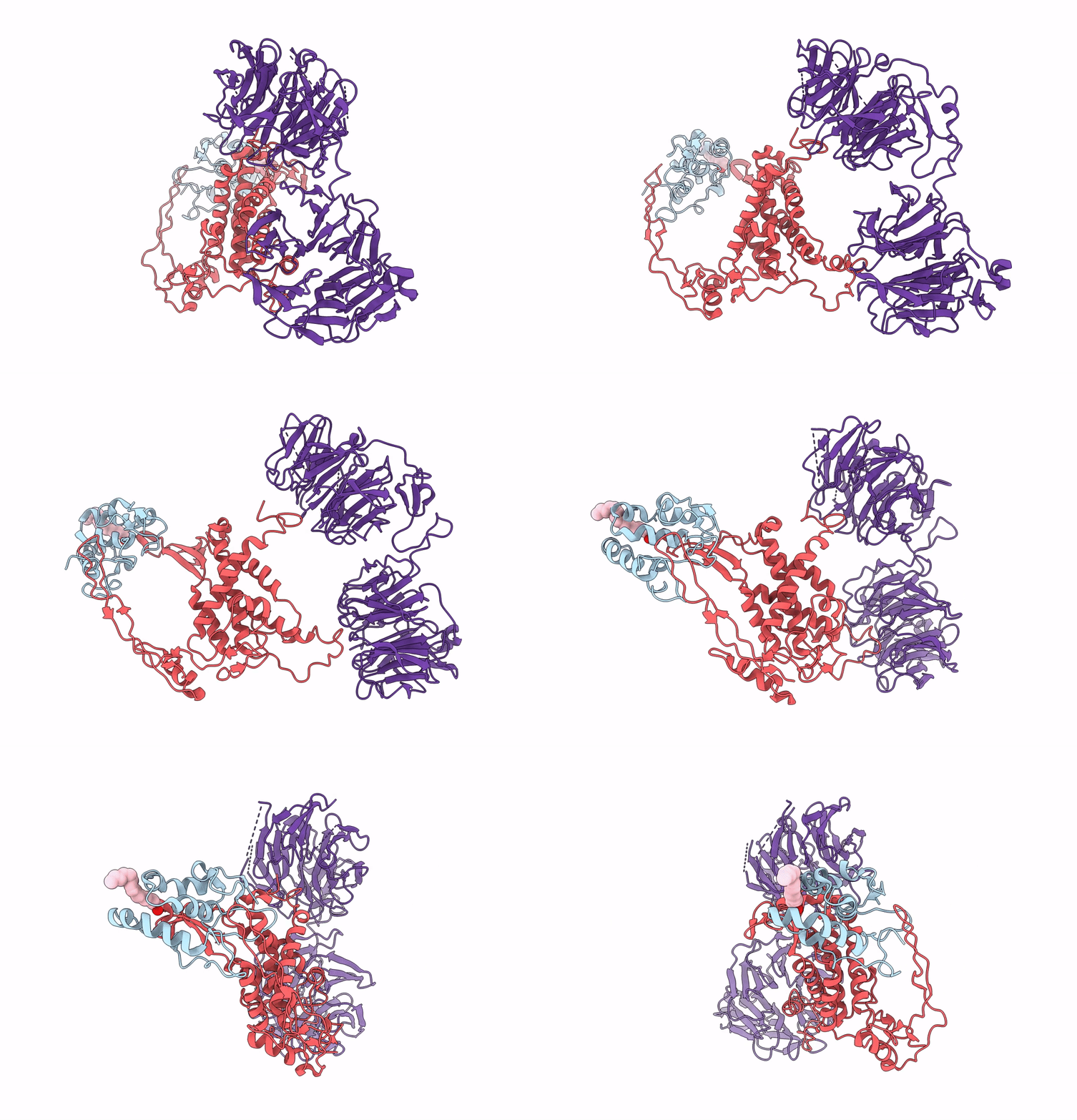
8CTG image
Deposition Date 2022-05-14
Release Date 2023-03-15
Last Version Date 2024-11-13
Entry Detail
PDB ID:
8CTG
Title:
Extracellular architecture of an engineered canonical Wnt signaling ternary complex
Biological Source:
Source Organism:
Mus musculus (Taxon ID: 10090)
Xenopus laevis (Taxon ID: 8355)
Homo sapiens (Taxon ID: 9606)
Method Details:
Experimental Method:
Resolution:
3.80 Å
Aggregation State:
PARTICLE
Reconstruction Method:
SINGLE PARTICLE
Macromolecular Entities
Structures with similar UniProt ID
Protein Blast
Polymer Type:polypeptide(L)
Molecule:Frizzled-8
Gene (Uniprot):Fzd8
Chain IDs:A
Chain Length:132
Number of Molecules:1
Biological Source:Mus musculus
Structures with similar UniProt ID
Protein Blast
Polymer Type:polypeptide(L)
Molecule:Protein Wnt-8
Gene (Uniprot):wnt8
Chain IDs:B
Chain Length:327
Number of Molecules:1
Biological Source:Xenopus laevis
Structures with similar UniProt ID
Protein Blast
Polymer Type:polypeptide(L)
Molecule:Low-density lipoprotein receptor-related protein 6
Gene (Uniprot):LRP6
Chain IDs:C
Chain Length:649
Number of Molecules:1
Biological Source:Homo sapiens
Ligand Molecules
Primary Citation
Structure of the Wnt-Frizzled-LRP6 initiation complex reveals the basis for coreceptor discrimination.
Proc.Natl.Acad.Sci.USA 120 e2218238120 e2218238120 (2023)
PMID: 36893265 DOI: 10.1073/pnas.2218238120

Abstact

Wnt morphogens are critical for embryonic development and tissue regeneration. Canonical Wnts form ternary receptor complexes composed of tissue-specific Frizzled (Fzd) receptors together with the shared LRP5/6 coreceptors to initiate β-catenin signaling. The cryo-EM structure of a ternary initiation complex of an affinity-matured XWnt8-Frizzled8-LRP6 complex elucidates the basis of coreceptor discrimination by canonical Wnts by means of their N termini and linker domains that engage the LRP6 E1E2 domain funnels. Chimeric Wnts bearing modular linker "grafts" were able to transfer LRP6 domain specificity between different Wnts and enable non-canonical Wnt5a to signal through the canonical pathway. Synthetic peptides comprising the linker domain serve as Wnt-specific antagonists. The structure of the ternary complex provides a topological blueprint for the orientation and proximity of Frizzled and LRP6 within the Wnt cell surface signalosome.

Legend

Protein

Chemical

Disease

Primary Citation of related structures
Feedback Form
Name
Email
Institute
Feedback