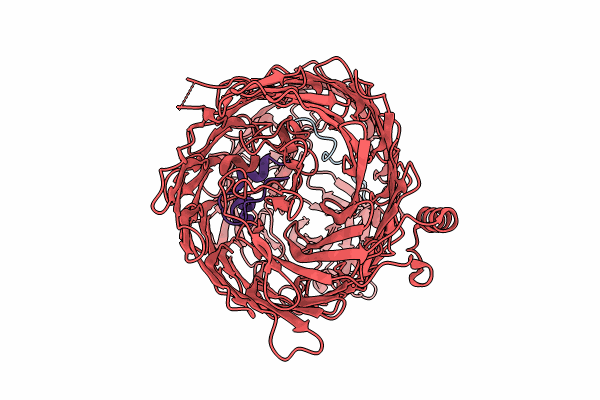
8CP6 image
Deposition Date 2023-03-01
Release Date 2023-12-06
Last Version Date 2023-12-06
Entry Detail
PDB ID:
8CP6
Keywords:
Title:
Type six secretion system exported effector 5 (Tse5)
Biological Source:
Source Organism:
Host Organism:
Method Details:
Experimental Method:
Resolution:
2.45 Å
Aggregation State:
PARTICLE
Reconstruction Method:
SINGLE PARTICLE
Macromolecular Entities
Structures with similar UniProt ID
Protein Blast
Polymer Type:polypeptide(L)
Molecule:Toxin protein Tse5
Gene (Uniprot):tse5
Chain IDs:A
Chain Length:73
Number of Molecules:1
Biological Source:Pseudomonas aeruginosa
Structures with similar UniProt ID
Protein Blast
Polymer Type:polypeptide(L)
Molecule:Toxin protein Tse5
Gene (Uniprot):tse5
Chain IDs:B
Chain Length:1121
Number of Molecules:1
Biological Source:Pseudomonas aeruginosa
Structures with similar UniProt ID
Protein Blast
Polymer Type:polypeptide(L)
Molecule:Toxin protein Tse5
Gene (Uniprot):tse5
Chain IDs:C
Chain Length:149
Number of Molecules:1
Biological Source:Pseudomonas aeruginosa
Ligand Molecules
Primary Citation
Structural and functional insights into the delivery of a bacterial Rhs pore-forming toxin to the membrane.
Nat Commun 14 7808 7808 (2023)
PMID: 38016939 DOI: 10.1038/s41467-023-43585-5

Abstact

Bacterial competition is a significant driver of toxin polymorphism, which allows continual compensatory evolution between toxins and the resistance developed to overcome their activity. Bacterial Rearrangement hot spot (Rhs) proteins represent a widespread example of toxin polymorphism. Here, we present the 2.45 Å cryo-electron microscopy structure of Tse5, an Rhs protein central to Pseudomonas aeruginosa type VI secretion system-mediated bacterial competition. This structural insight, coupled with an extensive array of biophysical and genetic investigations, unravels the multifaceted functional mechanisms of Tse5. The data suggest that interfacial Tse5-membrane binding delivers its encapsulated pore-forming toxin fragment to the target bacterial membrane, where it assembles pores that cause cell depolarisation and, ultimately, bacterial death.

Legend

Protein

Chemical

Disease

Primary Citation of related structures
Feedback Form
Name
Email
Institute
Feedback