8C5L image
Deposition Date 2023-01-09
Release Date 2024-01-10
Last Version Date 2025-10-22
Entry Detail
PDB ID:
8C5L
Keywords:
Title:
NR2F6 ligand binding domain in complex with NSD1 peptide
Biological Source:
Source Organism(s):
Expression System(s):
Method Details:
Experimental Method:
Resolution:
2.60 Å
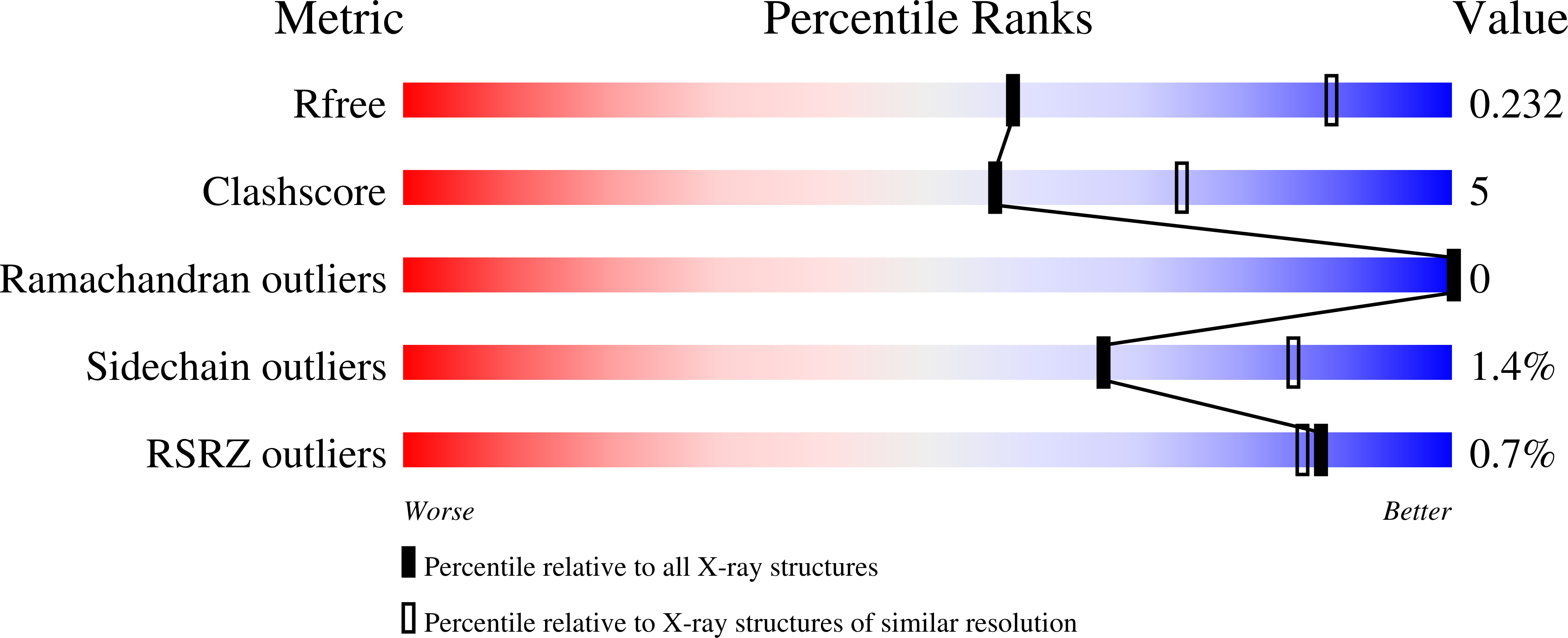
R-Value Free:
0.23
R-Value Work:
0.20
R-Value Observed:
0.20
Space Group:
P 61
Macromolecular Entities
Protein Blast
Polymer Type:polypeptide(L)
Molecule:Maltose/maltodextrin-binding periplasmic protein,Nuclear receptor subfamily 2 group F member 6
Gene (Uniprot):malE, NR2F6
Mutagens:D108A,K109A,E198A,N199A,K265A,E385A,K388A,D389A in Maltose/maltodextrin-binding periplasmic protein (Uniprot ID P0AEX9)
Chain IDs:A, B
Chain Length:568
Number of Molecules:2
Biological Source:Escherichia coli K-12, Homo sapiens
Structures with similar UniProt ID
Protein Blast
Polymer Type:polypeptide(L)
Molecule:Histone-lysine N-methyltransferase, H3 lysine-36 specific
Gene (Uniprot):NSD1
Chain IDs:C, D
Chain Length:19
Number of Molecules:2
Biological Source:Homo sapiens
Peptide-like Molecules
PRD_900001
Primary Citation
Structural Elucidation and Covalent Modulation of the Autorepressed Orphan Nuclear Receptor NR2F6.
Acs Chem.Biol. 20 2308 2317 (2025)
PMID: 40931005 DOI: 10.1021/acschembio.5c00475

Abstact

The orphan nuclear receptor NR2F6 (Nuclear Receptor subfamily 2 group F member 6) is an emerging therapeutic target for cancer immunotherapy. Upregulation of NR2F6 expression in tumor cells has been linked to proliferation and metastasis, while in immune cells NR2F6 inhibits antitumor T-cell responses. Small molecule modulation of NR2F6 activity might therefore be a novel strategy in cancer treatment, benefiting from this dual role of NR2F6. However, there are no molecular strategies available for targeting NR2F6, hampered among others by lack of structural insights and appropriate biochemical assays. To overcome these challenges, several noncanonical nuclear receptor coregulator peptide motifs were identified to be constitutively recruited to the NR2F6 ligand binding domain (LBD). Co-crystallization of the NR2F6 LBD with a peptide from the coregulator Nuclear Receptor Binding SET Domain Protein 1 (NSD1) enabled, for the first time, the structural elucidation of the unliganded (apo) form of NR2F6. This revealed an autorepressed, homodimeric LBD conformation in which helix 12 folds over the canonical coregulator binding site, generating an alternative contact surface for NSD1 binding. Screening of a focused library of covalent NR probes identified compounds that preferentially target a cysteine residue near the NSD1 binding site, inhibiting NR2F6 coregulator recruitment. Combined, these results provide structural insights into the ligand-independent transcriptional activity of NR2F6 and may serve as a starting point for the development of novel NR2F6 modulators.

Legend

Protein

Chemical

Disease

Primary Citation of related structures
Feedback Form
Name
Email
Institute
Feedback