8C4I image
Deposition Date 2023-01-04
Release Date 2023-02-22
Last Version Date 2023-11-15
Entry Detail
PDB ID:
8C4I
Keywords:
Title:
Ligand-free Crystal Structure of the decameric Sulfofructose Transaldolase BmSF-TAL
Biological Source:
Source Organism:
Method Details:
Experimental Method:
Resolution:
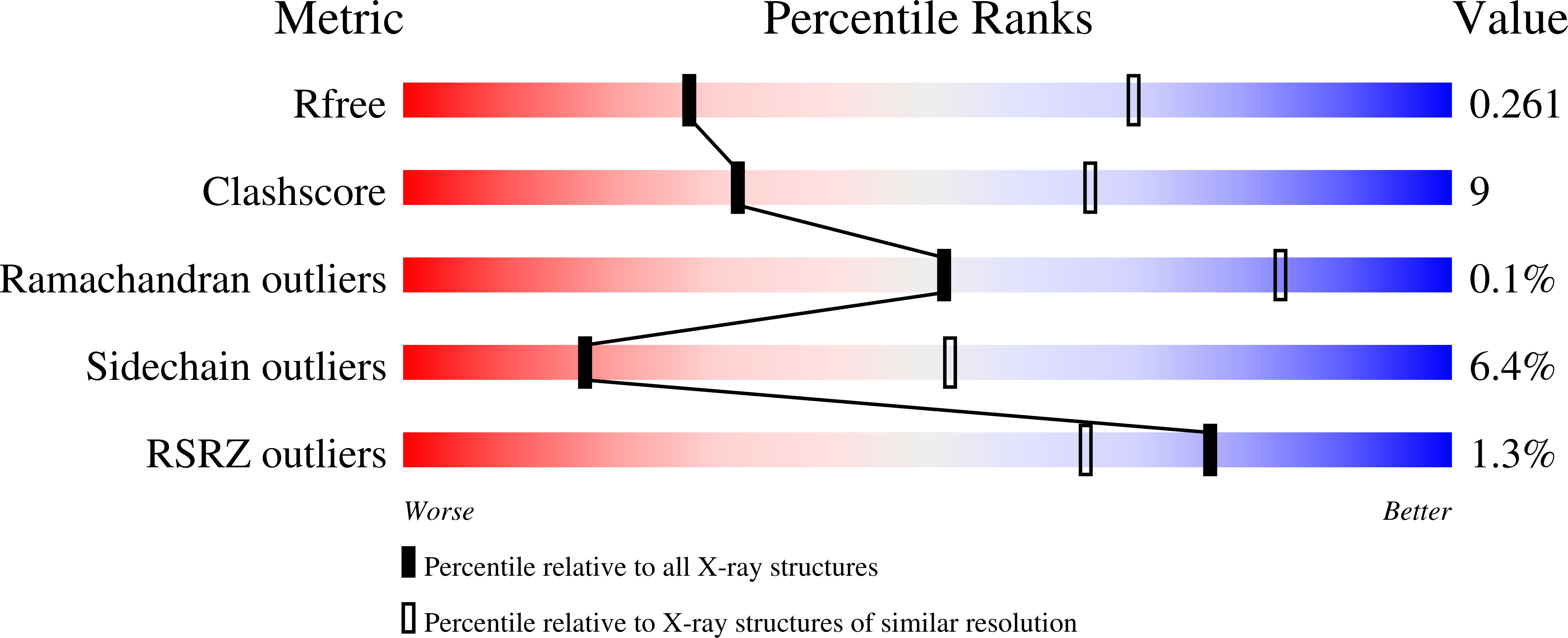
3.20 Å
R-Value Free:
0.26
R-Value Work:
0.23
Space Group:
P 1 21 1
Macromolecular Entities
Structures with similar UniProt ID
Protein Blast
Polymer Type:polypeptide(L)
Molecule:BmSF-TAL
Gene (Uniprot):sftT
Chain IDs:A, B, C, D, E, F, G, H, I (auth: J), J (auth: K)
Chain Length:226
Number of Molecules:10
Biological Source:Bacillus aryabhattai
Primary Citation
Structure and mechanism of sulfofructose transaldolase, a key enzyme in sulfoquinovose metabolism.
Structure 31 244 ? (2023)
PMID: 36805128 DOI: 10.1016/j.str.2023.01.010

Abstact

Sulfoquinovose (SQ) is a key component of plant sulfolipids (sulfoquinovosyl diacylglycerols) and a major environmental reservoir of biological sulfur. Breakdown of SQ is achieved by bacteria through the pathways of sulfoglycolysis. The sulfoglycolytic sulfofructose transaldolase (sulfo-SFT) pathway is used by gut-resident firmicutes and soil saprophytes. After isomerization of SQ to sulfofructose (SF), the namesake enzyme catalyzes the transaldol reaction of SF transferring dihydroxyacetone to 3C/4C acceptors to give sulfolactaldehyde and fructose-6-phosphate or sedoheptulose-7-phosphate. We report the 3D cryo-EM structure of SF transaldolase from Bacillus megaterium in apo and ligand bound forms, revealing a decameric structure formed from two pentameric rings of the protomer. We demonstrate a covalent "Schiff base" intermediate formed by reaction of SF with Lys89 within a conserved Asp-Lys-Glu catalytic triad and defined by an Arg-Trp-Arg sulfonate recognition triad. The structural characterization of the signature enzyme of the sulfo-SFT pathway provides key insights into molecular recognition of the sulfonate group of sulfosugars.

Legend

Protein

Chemical

Disease

Primary Citation of related structures
Feedback Form
Name
Email
Institute
Feedback