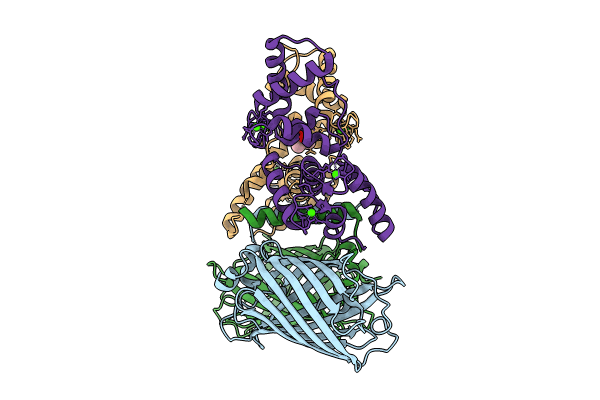
8BBJ image
Deposition Date 2022-10-13
Release Date 2024-04-03
Last Version Date 2024-11-13
Entry Detail
PDB ID:
8BBJ
Title:
Secretagogin (mouse) in complex with its target peptide from Syntaxin-4
Biological Source:
Source Organism:
Aequorea victoria (Taxon ID: 6100)
Mus musculus (Taxon ID: 10090)
Method Details:
Experimental Method:
Resolution:
2.65 Å
R-Value Free:
0.26
R-Value Work:
0.21
R-Value Observed:
0.21
Space Group:
P 21 21 21
Macromolecular Entities
Protein Blast
Polymer Type:polypeptide(L)
Molecule:Green fluorescent protein,Syntaxin-4
Gene (Uniprot):GFP, Stx4
Mutagens:F64L,Q80R,I167T
Chain IDs:A, B
Chain Length:261
Number of Molecules:2
Biological Source:Aequorea victoria, Mus musculus
Structures with similar UniProt ID
Protein Blast
Polymer Type:polypeptide(L)
Molecule:Secretagogin
Gene (Uniprot):Scgn
Chain IDs:C, D
Chain Length:190
Number of Molecules:2
Biological Source:Mus musculus
Modified Residue
Compound ID Chain ID Parent Comp ID Details 2D Image
CRO A GLY chromophore
Primary Citation
A hydrophobic groove in secretagogin allows for alternate interactions with SNAP-25 and syntaxin-4 in endocrine tissues.
Proc.Natl.Acad.Sci.USA 121 e2309211121 e2309211121 (2024)
PMID: 38593081 DOI: 10.1073/pnas.2309211121

Abstact

Vesicular release of neurotransmitters and hormones relies on the dynamic assembly of the exocytosis/trans-SNARE complex through sequential interactions of synaptobrevins, syntaxins, and SNAP-25. Despite SNARE-mediated release being fundamental for intercellular communication in all excitable tissues, the role of auxiliary proteins modulating the import of reserve vesicles to the active zone, and thus, scaling repetitive exocytosis remains less explored. Secretagogin is a Ca2+-sensor protein with SNAP-25 being its only known interacting partner. SNAP-25 anchors readily releasable vesicles within the active zone, thus being instrumental for 1st phase release. However, genetic deletion of secretagogin impedes 2nd phase release instead, calling for the existence of alternative protein-protein interactions. Here, we screened the secretagogin interactome in the brain and pancreas, and found syntaxin-4 grossly overrepresented. Ca2+-loaded secretagogin interacted with syntaxin-4 at nanomolar affinity and 1:1 stoichiometry. Crystal structures of the protein complexes revealed a hydrophobic groove in secretagogin for the binding of syntaxin-4. This groove was also used to bind SNAP-25. In mixtures of equimolar recombinant proteins, SNAP-25 was sequestered by secretagogin in competition with syntaxin-4. Kd differences suggested that secretagogin could shape unidirectional vesicle movement by sequential interactions, a hypothesis supported by in vitro biological data. This mechanism could facilitate the movement of transport vesicles toward release sites, particularly in the endocrine pancreas where secretagogin, SNAP-25, and syntaxin-4 coexist in both α- and β-cells. Thus, secretagogin could modulate the pace and fidelity of vesicular hormone release by differential protein interactions.

Legend

Protein

Chemical

Disease

Primary Citation of related structures
Feedback Form
Name
Email
Institute
Feedback