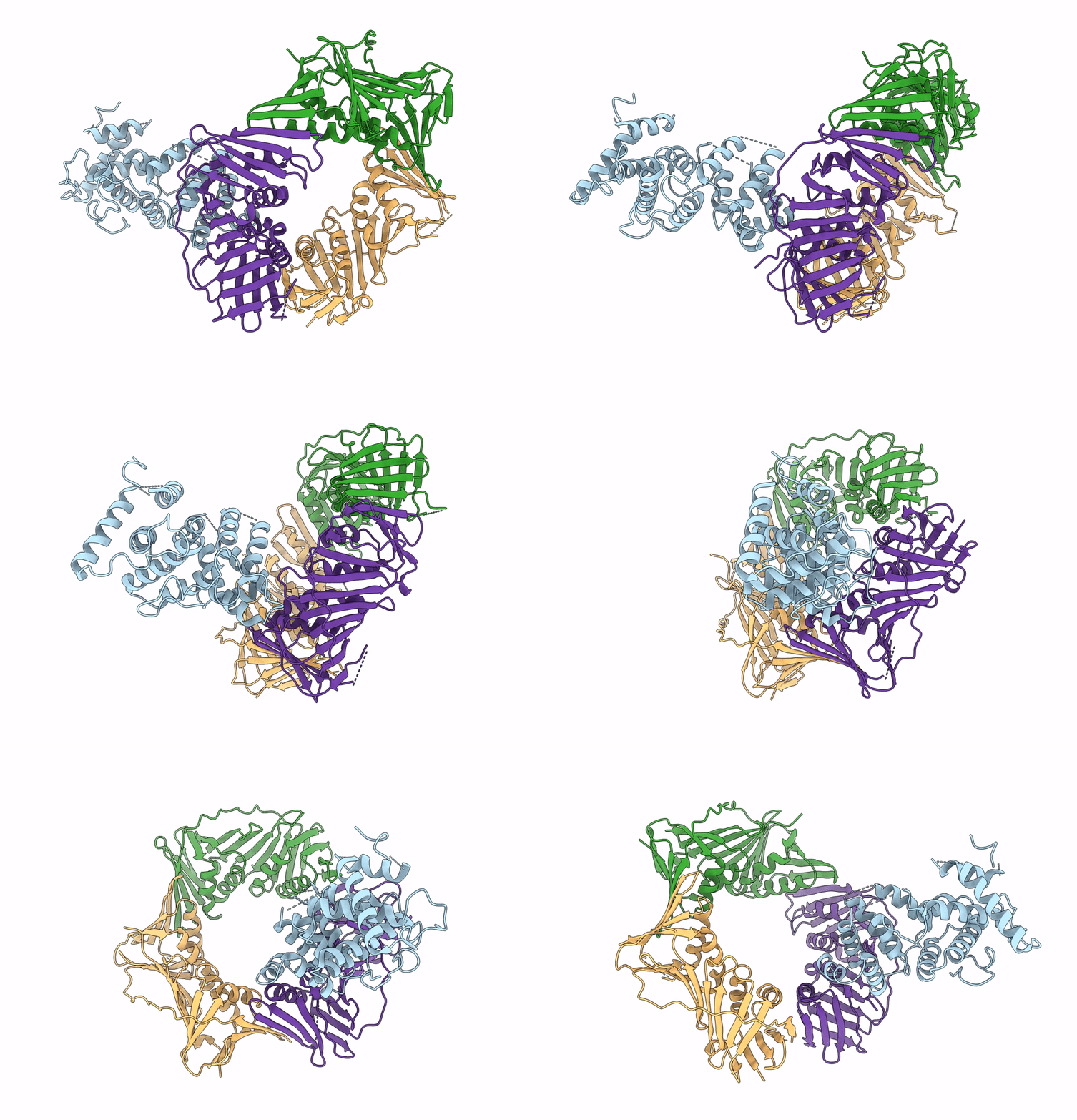
8B8T image
Deposition Date 2022-10-05
Release Date 2023-01-11
Last Version Date 2025-07-09
Entry Detail
PDB ID:
8B8T
Keywords:
Title:
Open conformation of the complex of DNA ligase I on PCNA and DNA in the presence of ATP
Biological Source:
Source Organism:
Homo sapiens (Taxon ID: 9606)
Method Details:
Experimental Method:
Resolution:
4.20 Å
Aggregation State:
PARTICLE
Reconstruction Method:
SINGLE PARTICLE
Macromolecular Entities
Structures with similar UniProt ID
Protein Blast
Polymer Type:polypeptide(L)
Molecule:DNA ligase 1
Gene (Uniprot):LIG1
Chain IDs:A
Chain Length:274
Number of Molecules:1
Biological Source:Homo sapiens
Structures with similar UniProt ID
Protein Blast
Polymer Type:polypeptide(L)
Molecule:Proliferating cell nuclear antigen
Gene (Uniprot):PCNA
Chain IDs:B (auth: E), C (auth: F), D (auth: G)
Chain Length:258
Number of Molecules:3
Biological Source:Homo sapiens
Ligand Molecules
Primary Citation
Mechanism of human Lig1 regulation by PCNA in Okazaki fragment sealing.
Nat Commun 13 7833 7833 (2022)
PMID: 36539424 DOI: 10.1038/s41467-022-35475-z

Abstact

During lagging strand synthesis, DNA Ligase 1 (Lig1) cooperates with the sliding clamp PCNA to seal the nicks between Okazaki fragments generated by Pol δ and Flap endonuclease 1 (FEN1). We present several cryo-EM structures combined with functional assays, showing that human Lig1 recruits PCNA to nicked DNA using two PCNA-interacting motifs (PIPs) located at its disordered N-terminus (PIPN-term) and DNA binding domain (PIPDBD). Once Lig1 and PCNA assemble as two-stack rings encircling DNA, PIPN-term is released from PCNA and only PIPDBD is required for ligation to facilitate the substrate handoff from FEN1. Consistently, we observed that PCNA forms a defined complex with FEN1 and nicked DNA, and it recruits Lig1 to an unoccupied monomer creating a toolbelt that drives the transfer of DNA to Lig1. Collectively, our results provide a structural model on how PCNA regulates FEN1 and Lig1 during Okazaki fragments maturation.

Legend

Protein

Chemical

Disease

Primary Citation of related structures
Feedback Form
Name
Email
Institute
Feedback