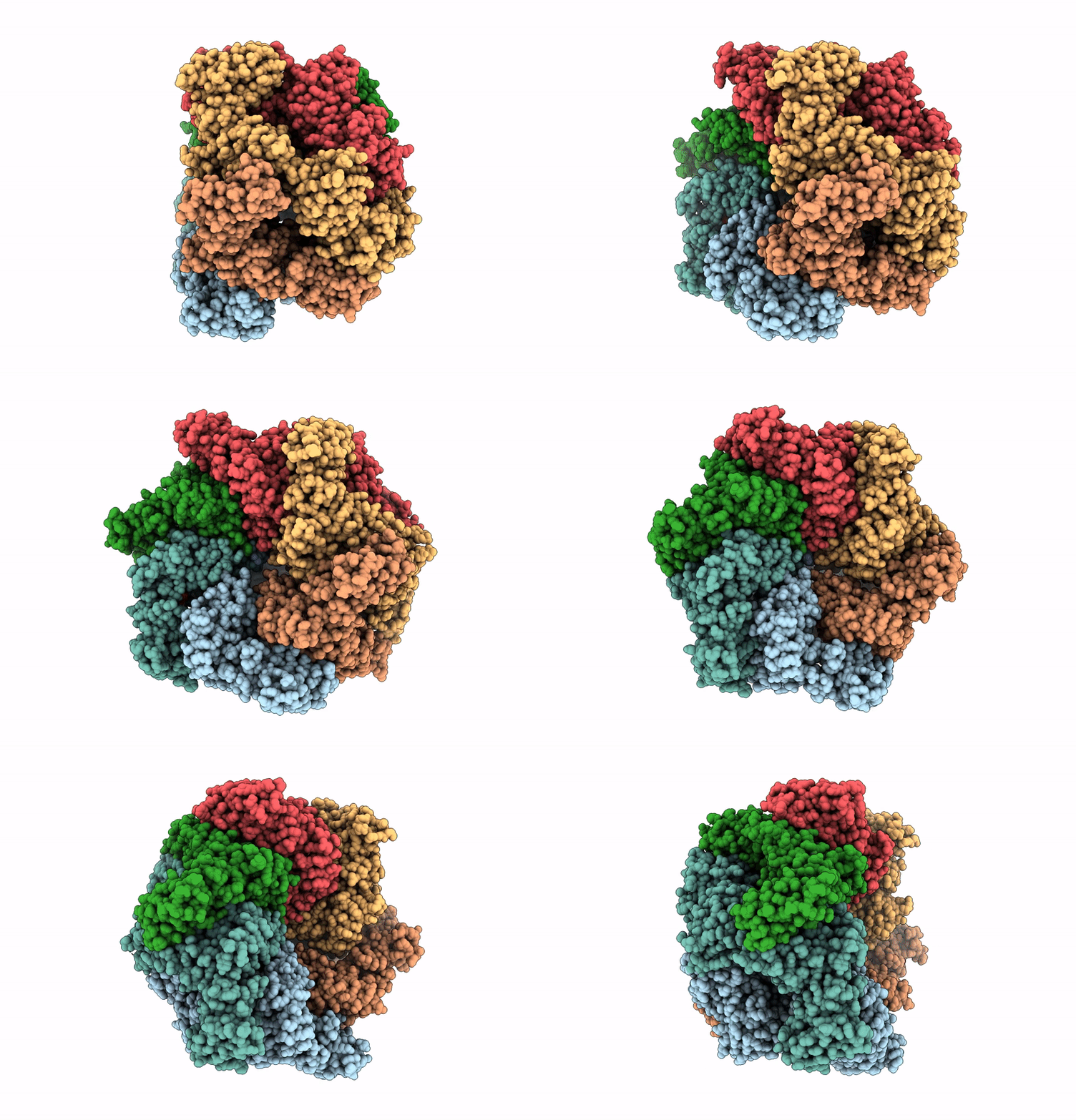
8A8U image
Deposition Date 2022-06-24
Release Date 2022-10-26
Last Version Date 2024-07-24
Entry Detail
PDB ID:
8A8U
Keywords:
Title:
Mycobacterium tuberculosis ClpC1 hexamer structure
Biological Source:
Source Organism:
Host Organism:
Method Details:
Experimental Method:
Resolution:
3.62 Å
Aggregation State:
PARTICLE
Reconstruction Method:
SINGLE PARTICLE
Macromolecular Entities
Structures with similar UniProt ID
Protein Blast
Polymer Type:polypeptide(L)
Molecule:ATP-dependent Clp protease ATP-binding subunit ClpC1
Gene (Uniprot):clpC1
Chain IDs:A, B, C, D, E, F
Chain Length:856
Number of Molecules:6
Biological Source:Mycobacterium tuberculosis
Polymer Type:polypeptide(L)
Molecule:Bound polypeptide
Chain IDs:G
Chain Length:23
Number of Molecules:1
Biological Source:Mycobacterium tuberculosis
Ligand Molecules
Primary Citation
Structure of the drug target ClpC1 unfoldase in action provides insights on antibiotic mechanism of action.
J.Biol.Chem. 298 102553 102553 (2022)
PMID: 36208775 DOI: 10.1016/j.jbc.2022.102553

Abstact

The unfoldase ClpC1 is one of the most exciting drug targets against tuberculosis. This AAA+ unfoldase works in cooperation with the ClpP1P2 protease and is the target of at least four natural product antibiotics: cyclomarin, ecumicin, lassomycin, and rufomycin. Although these molecules are promising starting points for drug development, their mechanisms of action remain largely unknown. Taking advantage of a middle domain mutant, we determined the first structure of Mycobacterium tuberculosis ClpC1 in its apo, cyclomarin-, and ecumicin-bound states via cryo-EM. The obtained structure displays features observed in other members of the AAA+ family and provides a map for further drug development. While the apo and cyclomarin-bound structures are indistinguishable and have N-terminal domains that are invisible in their respective EM maps, around half of the ecumicin-bound ClpC1 particles display three of their six N-terminal domains in an extended conformation. Our structural observations suggest a mechanism where ecumicin functions by mimicking substrate binding, leading to ATPase activation and changes in protein degradation profile.

Legend

Protein

Chemical

Disease

Primary Citation of related structures
Feedback Form
Name
Email
Institute
Feedback