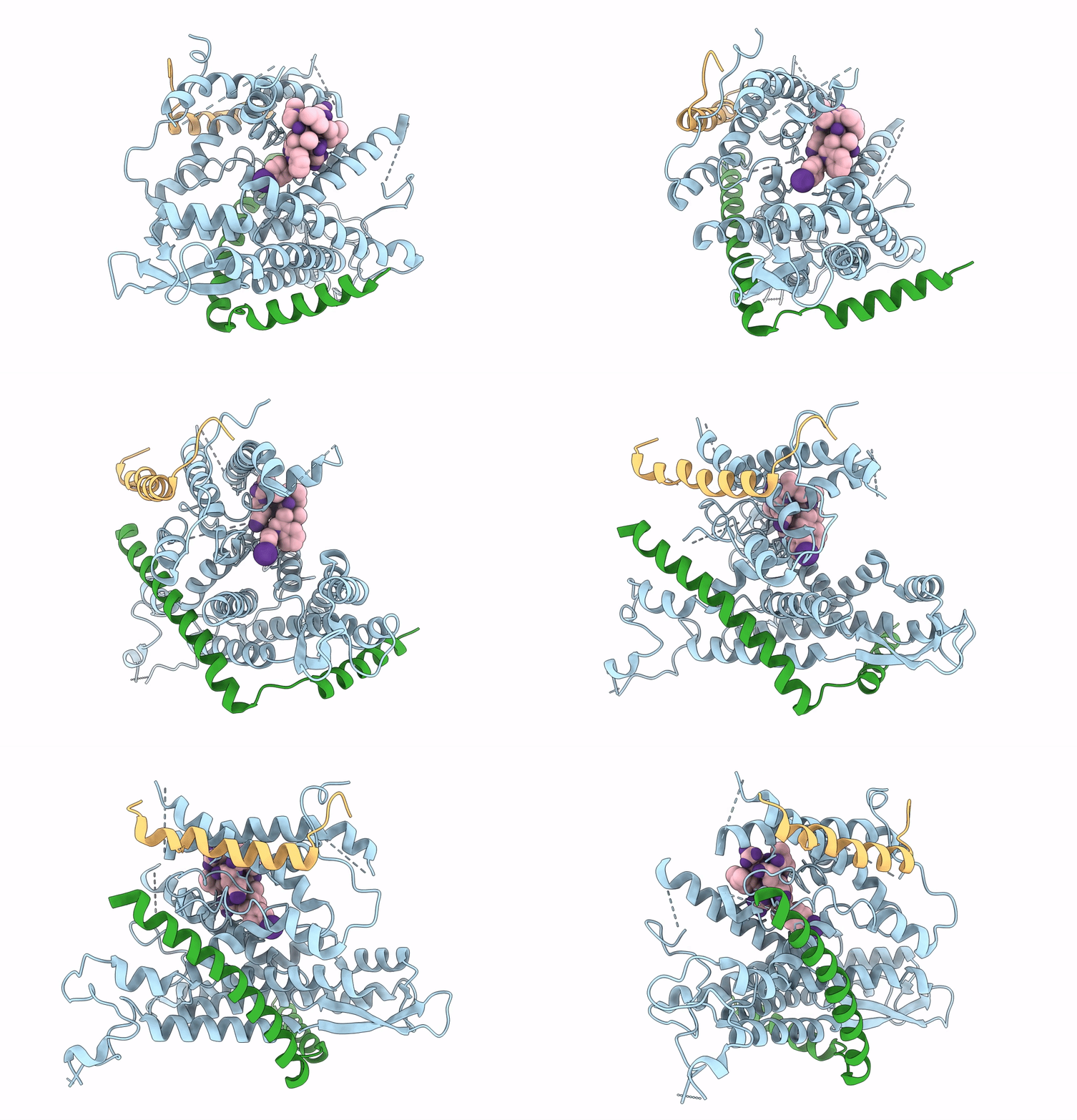
7ZL3 image
Deposition Date 2022-04-13
Release Date 2023-03-22
Last Version Date 2023-11-15
Entry Detail
PDB ID:
7ZL3
Title:
Signal peptide mimicry primes Sec61 for client-selective inhibition
Biological Source:
Source Organism:
synthetic construct (Taxon ID: 32630)
Ovis aries (Taxon ID: 9940)
Method Details:
Experimental Method:
Resolution:
3.20 Å
Aggregation State:
PARTICLE
Reconstruction Method:
SINGLE PARTICLE

Macromolecular Entities
Structures with similar UniProt ID
Protein Blast
Polymer Type:polypeptide(L)
Molecule:Protein transport protein Sec61 subunit alpha
Gene (Uniprot):JEQ12_008626
Chain IDs:A
Chain Length:475
Number of Molecules:1
Biological Source:Ovis aries
Structures with similar UniProt ID
Protein Blast
Polymer Type:polypeptide(L)
Molecule:Protein transport protein Sec61 subunit gamma
Gene (Uniprot):LOC114117822
Chain IDs:B
Chain Length:68
Number of Molecules:1
Biological Source:Ovis aries
Polymer Type:polypeptide(L)
Molecule:Protein transport protein Sec61 subunit beta
Chain IDs:C
Chain Length:29
Number of Molecules:1
Biological Source:Ovis aries
Polymer Type:polypeptide(L)
Molecule:Cyclic depsipeptide signal peptide mimic
Chain IDs:D (auth: E)
Chain Length:6
Number of Molecules:1
Biological Source:synthetic construct
Ligand Molecules
Primary Citation

Abstact

Preventing the biogenesis of disease-relevant proteins is an attractive therapeutic strategy, but attempts to target essential protein biogenesis factors have been hampered by excessive toxicity. Here we describe KZR-8445, a cyclic depsipeptide that targets the Sec61 translocon and selectively disrupts secretory and membrane protein biogenesis in a signal peptide-dependent manner. KZR-8445 potently inhibits the secretion of pro-inflammatory cytokines in primary immune cells and is highly efficacious in a mouse model of rheumatoid arthritis. A cryogenic electron microscopy structure reveals that KZR-8445 occupies the fully opened Se61 lateral gate and blocks access to the lumenal plug domain. KZR-8445 binding stabilizes the lateral gate helices in a manner that traps select signal peptides in the Sec61 channel and prevents their movement into the lipid bilayer. Our results establish a framework for the structure-guided discovery of novel therapeutics that selectively modulate Sec61-mediated protein biogenesis.

Legend

Protein

Chemical

Disease

Primary Citation of related structures
Feedback Form
Name
Email
Institute
Feedback